1. Programmes
  2. Autism Spectrum Disorder
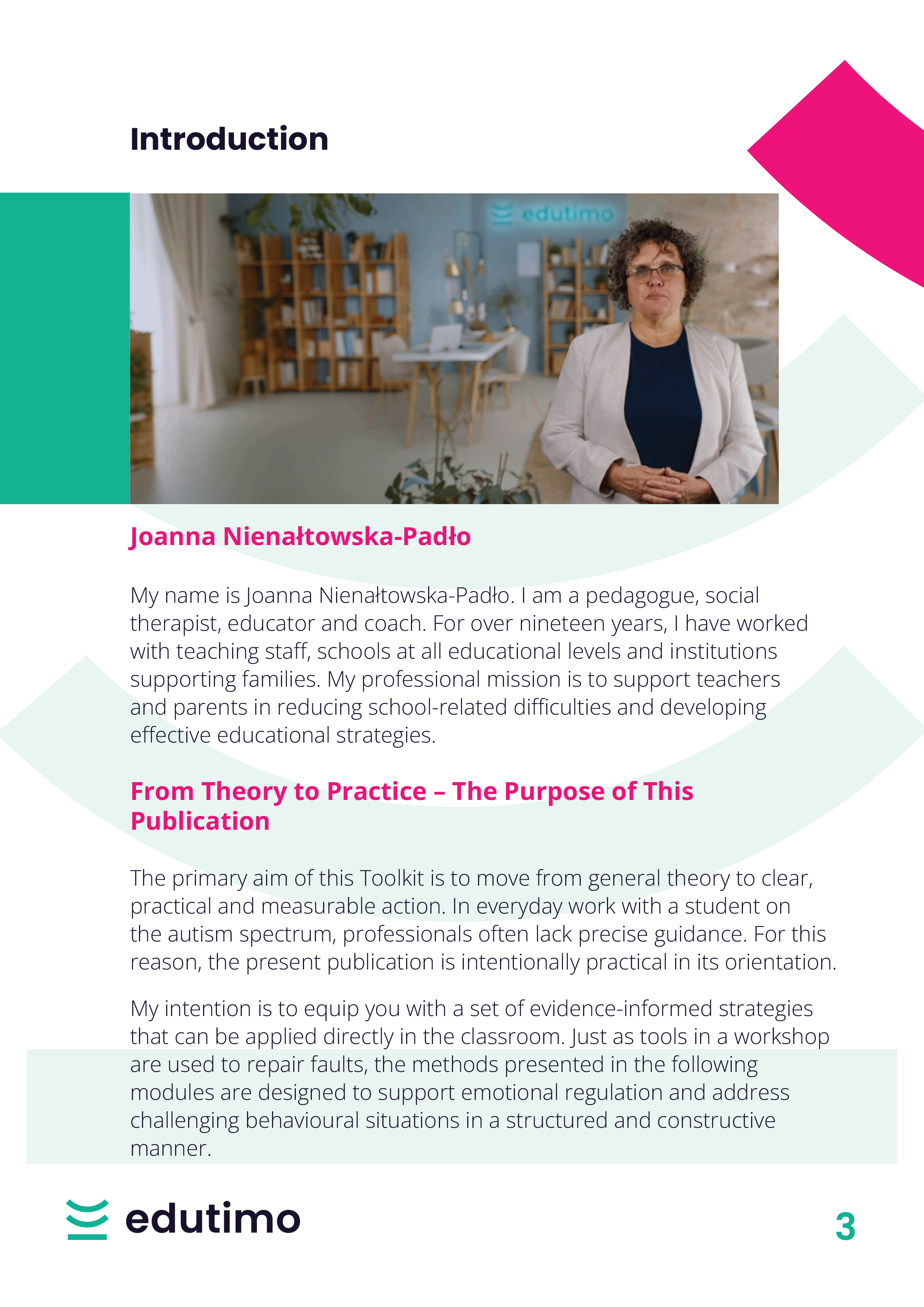
Joanna Nienałtowska-Padło
Specialist in autism spectrum support

Autism Spectrum Disorder

An autistic student may know the answer, use advanced vocabulary and excel in a favourite subject, yet struggle with an unexpected change, a vague instruction or the social rules everyone else seems to understand automatically. This programme helps you recognise the mechanisms behind those everyday difficulties and respond with greater confidence. Learn how to support communication, emotional regulation, anxiety, rigidity, sensory overload and executive functioning with practical strategies you can use in school.

Essential

£49.00

£89.00
One-time · 12 months access
  • 6 video modules
  • Teacher's Toolkit
  • Certificate
  • Teacher's Toolkit
  • Classroom materials
  • Case studies
Professional Recommended

£69.00

£129.00
One-time · 12 months access
  • 6 video modules
  • Teacher's Toolkit (66 pages)
  • Certificate
  • 47 classroom materials
  • 5 case studies
  • Knowledge Booster (30 days)
Until 25 October 2026, this and every other programme is 45% off.
Standard price from 26 October: Essential £89, Professional £129.

Is this for you?

We use AI as a tool to support production, but we do not hand over responsibility for the content. Our materials are based on real webinars by our trainers and are reviewed and approved by a person before publication. The videos feature an AI-generated avatar and voice of the trainer, used with her consent.

What you'll implement?

What's inside this programme?

Video modules

6 modules · approx. 81 min total · one film per module
  1. 1
    Programme introduction
    2 min
    Free preview
    Why this training is built as a practical Teacher’s Toolkit, how autistic students may experience school as “Linux in a Windows world”, and why the goal is to stop seeing bad intentions and start recognising specific mechanisms.
  2. 2
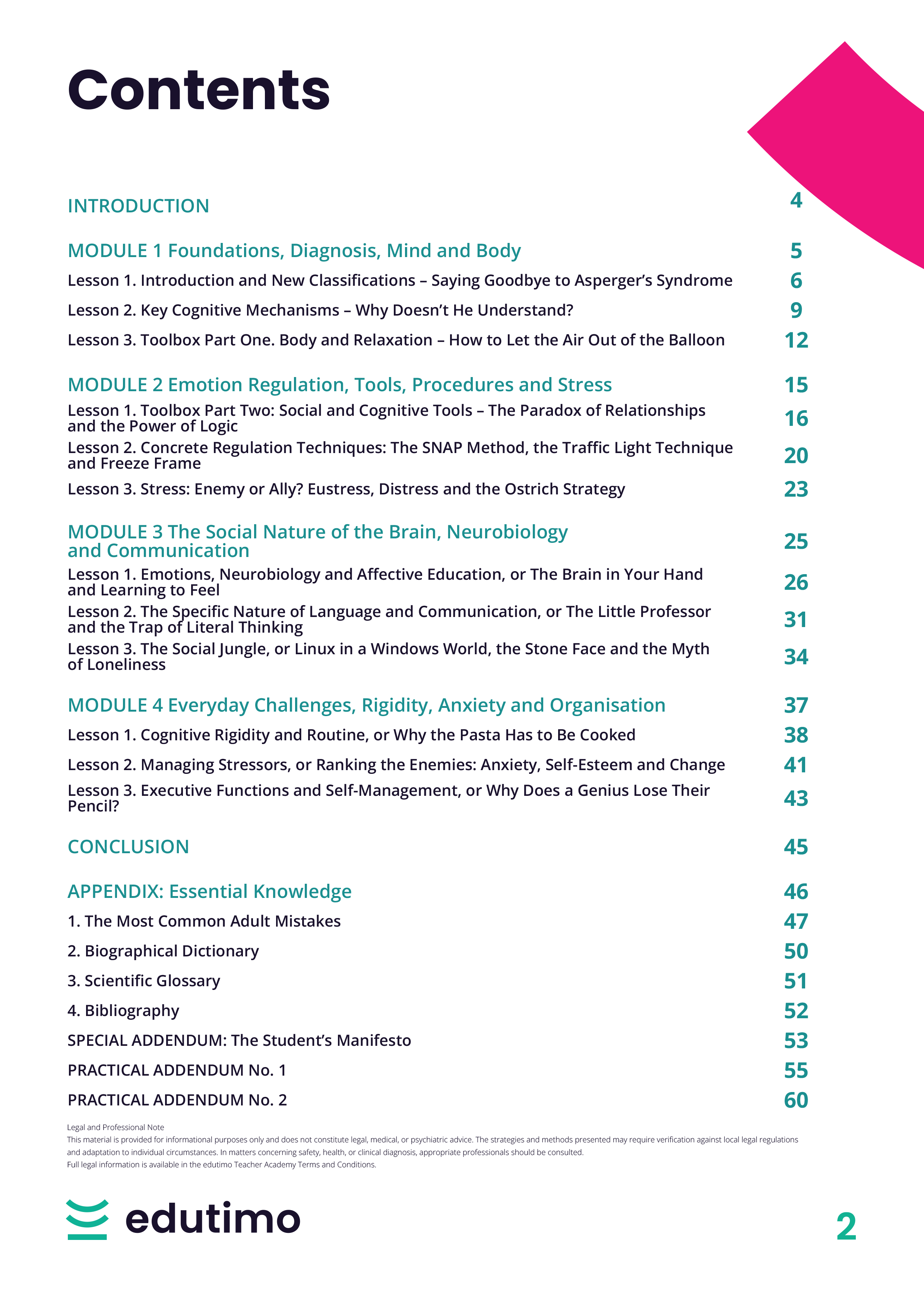
    Foundations, Diagnosis, Mind and Body
    16 min
    Available after purchase
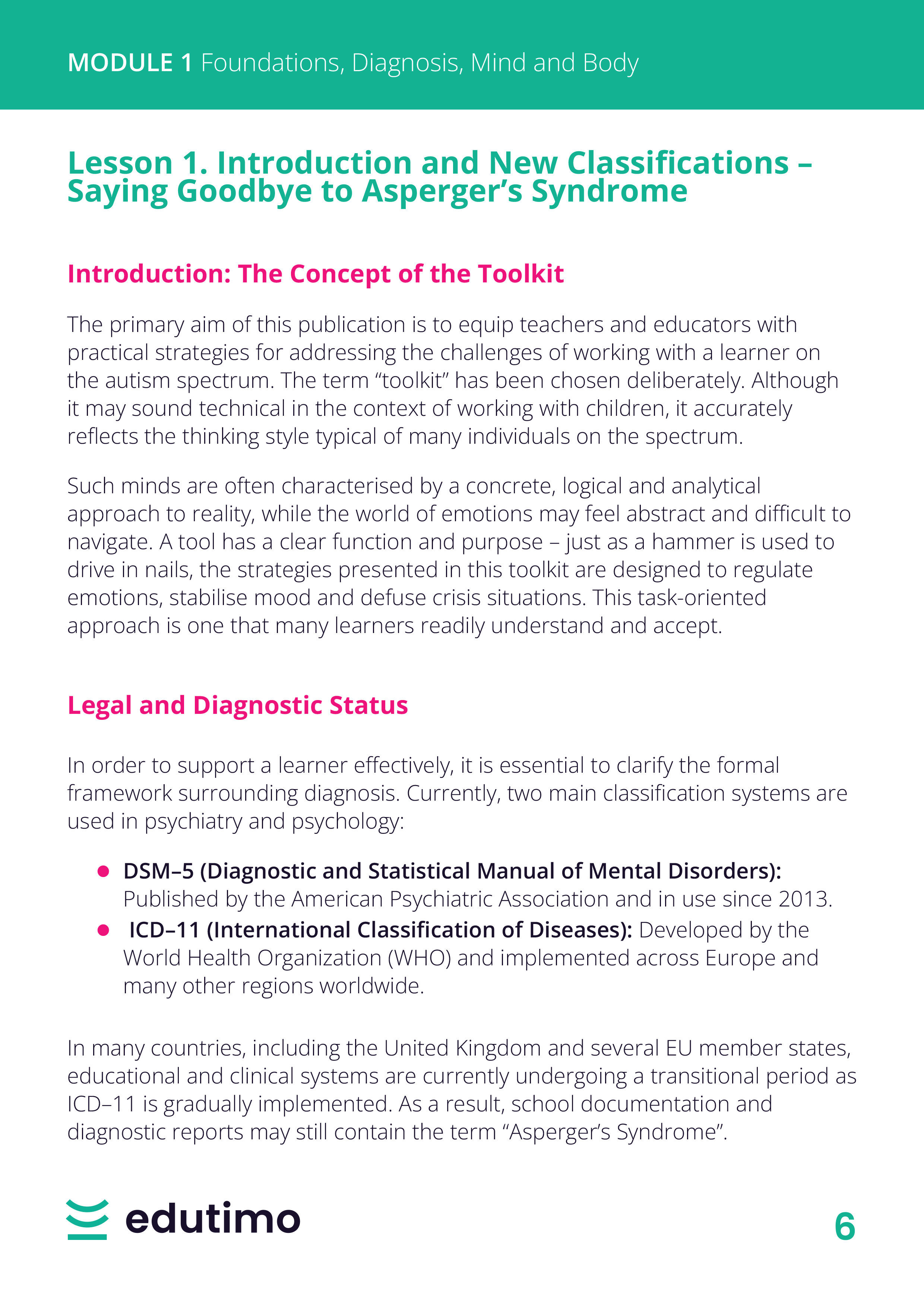
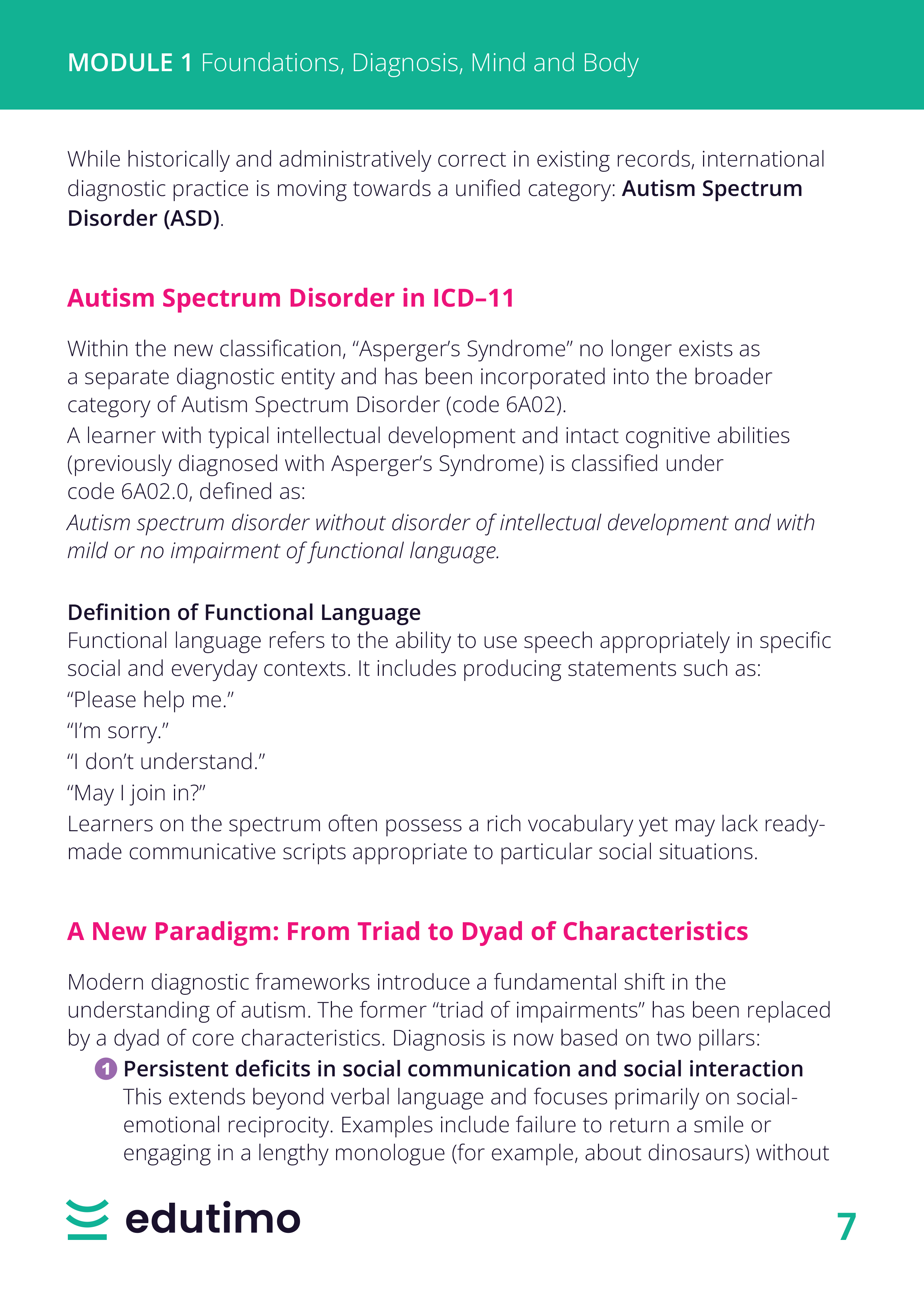
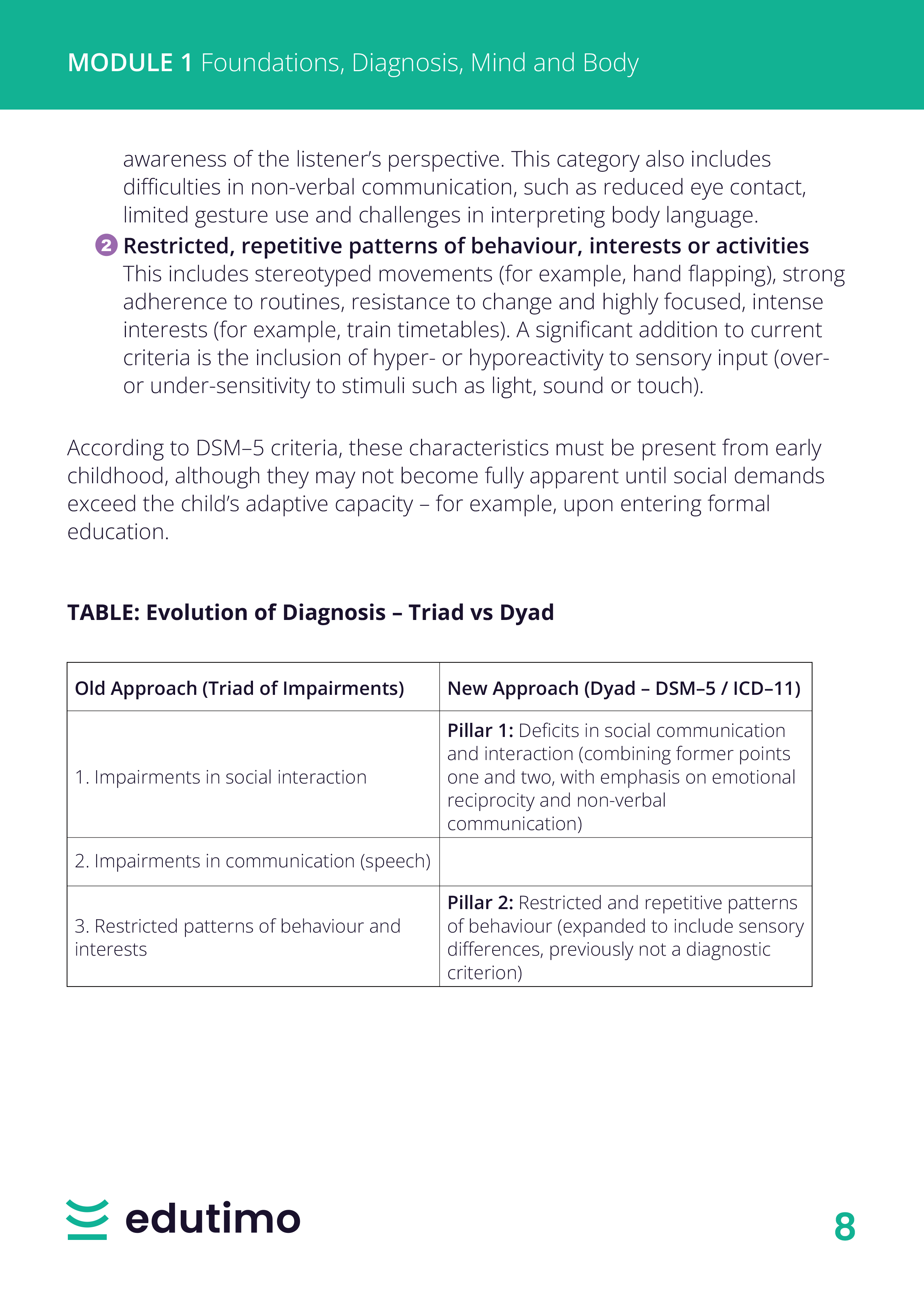
    Why the language of diagnosis is changing, what the Asperger profile means within Autism Spectrum Disorder, and how autistic students experience communication, emotions, body signals and sensory overload.
    Lessons in this module
    1. Introduction and New Classifications – Saying Goodbye to Asperger’s Syndrome
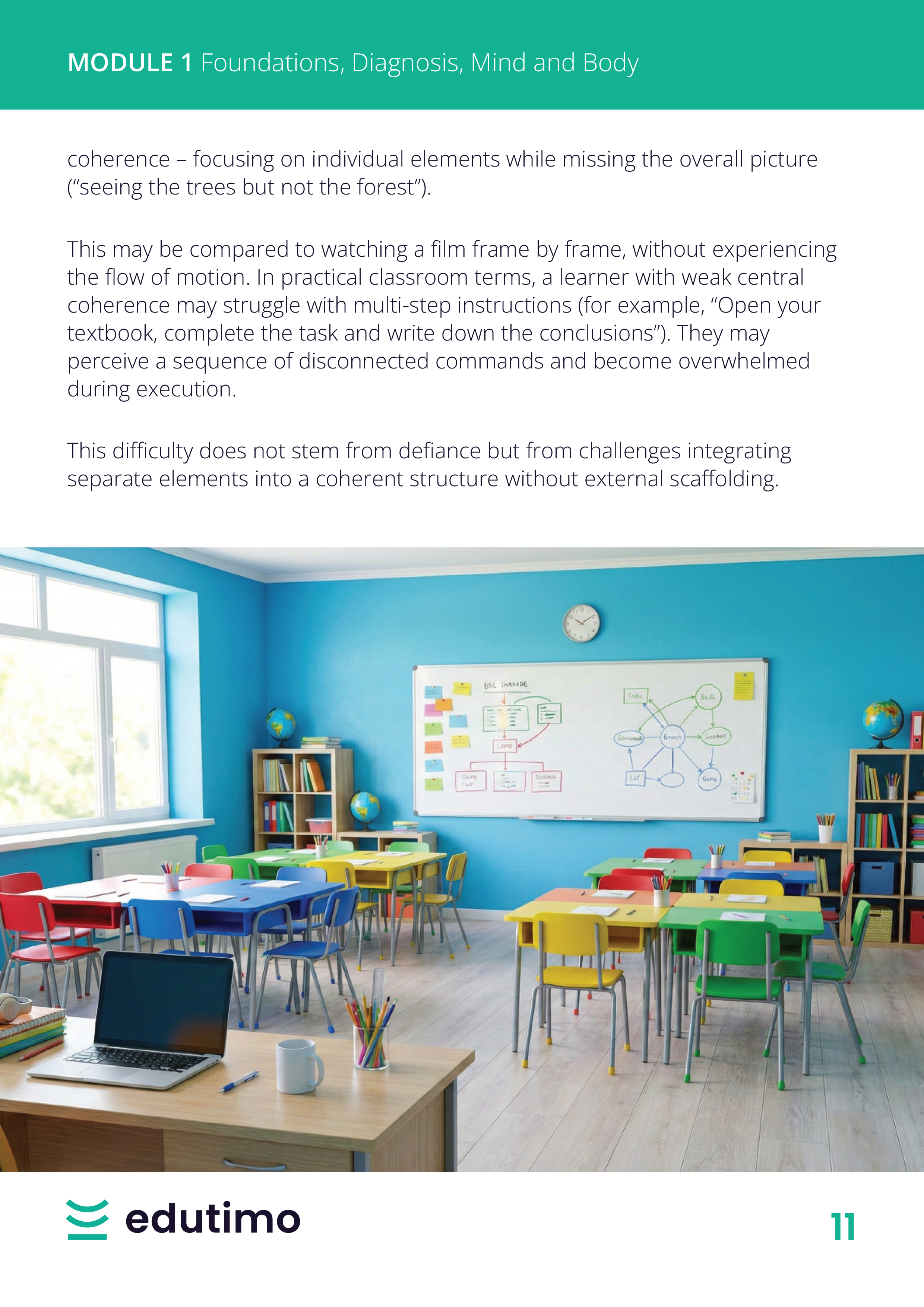
    2. Key Cognitive Mechanisms – Why Doesn’t He Understand?
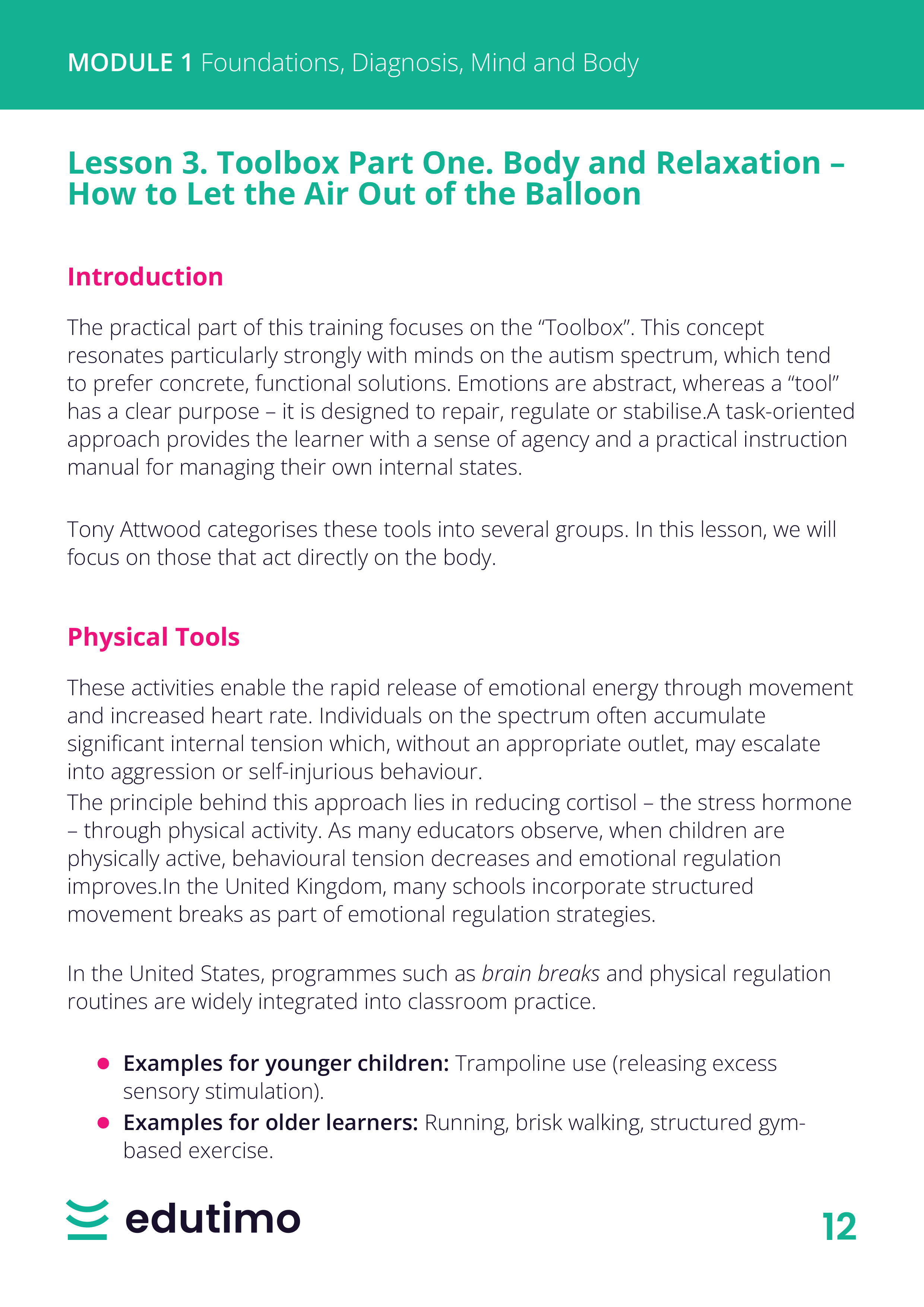
    3. Toolbox Part One. Body and Relaxation – How to Let the Air Out of the Balloon
  3. 3
    Emotion Regulation, Tools, Procedures and Stress
    22 min
    Available after purchase
    Practical strategies for emotional regulation, including social tools, cognitive tools and emergency procedures for difficult moments in school.
    Lessons in this module
    1. Toolbox Part Two: Social and Cognitive Tools – The Paradox of Relationships and the Power of Logic
    2. Concrete Regulation Techniques: The SNAP Method, the Traffic Light Technique and Freeze Frame
    3. Stress: Enemy or Ally? Eustress, Distress and the Ostrich Strategy
  4. 4
    The Social Nature of the Brain, Neurobiology and Communication
    20 min
    Available after purchase
    What happens in the brain during emotional overload, how autistic students process emotions and why communication can be advanced in vocabulary but difficult in real social situations.
    Lessons in this module
    1. Emotions, Neurobiology and Affective Education, or The Brain in Your Hand and Learning to Feel
    2. The Specific Nature of Language and Communication, or The Little Professor and the Trap of Literal Thinking
    3. The Social Jungle, or Linux in a Windows World, the Stone Face and the Myth of Loneliness
  5. 5
    Everyday Challenges, Rigidity, Anxiety and Organisation
    20 min
    Available after purchase
    How routine, anxiety, change and executive functions affect school life — from coping with a supply teacher to packing a bag, starting work and managing daily tasks.
    Lessons in this module
    1. Cognitive Rigidity and Routine, or Why the Pasta Has to Be Cooked
    2. Managing Stressors, or Ranking the Enemies: Anxiety, Self-Esteem and Change
    3. Executive Functions and Self-Management, or Why Does a Genius Lose Their Pencil?
  6. 6
    Course conclusion
    1 min
    Available after purchase
    A final summary of the Toolkit approach: how to use patience, structure and practical tools to support a student who struggles with anxiety, social overload, rigidity and emotional regulation — while also recognising their strengths.

Teacher's Toolkit

66-page implementation guide · PDF
The written companion to the video training. It helps you return to the key concepts, procedures and strategies whenever you need them.
  • Module summaries and key takeaways
  • Clear explanations of diagnostic changes and the Asperger profile
  • Practical frameworks for understanding behaviour
  • Emergency procedures such as SNAP, Traffic Lights and Freeze Frame
  • Communication examples and classroom strategies
  • Tools for anxiety, rigidity, stress and executive functions
See sample pages

Classroom Resource Library

Practical resources for real classroom situations

The Professional version gives you access to the complete library of practical resources created specifically for this programme. Inside, you’ll find ready-to-use materials that support classroom practice, behaviour analysis, communication, planning and implementation. Selected resources are available to preview for free, so you can see the format and approach before accessing the full library.

  • 52
    materials total
  • 3
    free for everyone
  • 52
    in Professional
  • Case studies
    5 materials
    • Case Study Cards
      Four typical classroom situations analysed through what the teacher sees, what happens in the pupil’s mind and what tools to use.
      Coming soon
    • The Boy Who Called It As He Saw It
      Bblunt factual feedback, Theory of Mind, literalism and the correct response
      Open
    • The Timetable That Broke
      Meltdown after an unannounced lesson change
      Read
    • The Genius Who Couldn’t Start
      High ability, executive function difficulty and the missing “CEO”
      Read
    • The Girl Who Smiled Through Everything
      Masking, social batteries and the hidden cost of appearing fine
      Read
  • Classroom posters
    5 materials
    • The Pupil’s Manifesto
      Eight first-person requests from a pupil on the spectrum to their teacher.
    • 7 Common Adult Mistakes
      Staffroom poster showing well-intentioned adult responses that can escalate distress, with better alternatives
    • Plutchik’s Wheel of Emotions
      Colour map of core emotions, opposites and emotional blends, with a classroom instruction card.
      Open
    • Social Batteries: The 1:2 Rule
      Staffroom poster explaining why one hour of social interaction may require two hours of quiet recovery
      Open
    • The Enemy Ranking
      Poster ranking the main stressors: anxiety, low self-esteem, change and meltdown, with matching tools
      Open
  • Quick reference cards
    5 materials
    • Quick Reference Card
      Ten golden rules for working with a pupil on the spectrum
      Open
    • SNAP Procedure Card
      Pocket card for the Stop / Now And / Plan emotion-regulation procedure
      Open
    • Teacher’s Dictionary
      Two-column guide: what to avoid and what to say instead
      Open
    • Micro-Strategy Card
      Eight immediate strategies including the Third-Eye Trick, 1:2 Rule, writing instead of speaking and Safe Haven.
      Open
    • Glossary Card
      Fourteen key terms explained in plain English, including ASD, dyad, Theory of Mind, masking and meltdown
      Open
  • Checklists and audits
    4 materials
    • Checklist: What Can I Change Tomorrow?
      Six-area daily practice checklist for language, response time, written communication, interpretation, organisation and adult regulation
      Open
    • Checklist: Staff Meeting
      Team checklist for agreeing shared standards across staff
      Open
    • Self-Audit: Does My Practice Support My ASD Pupil?
      Nine-area reflective audit linked to programme lessons
      Open
    • Checklist: Preparing for a Parent Conversation
      Five-point preparation tool for difficult parent meetings
      Open
  • Emergency procedures
    2 materials
    • Meltdown & Shutdown Protocol
      Pocket guide distinguishing meltdown from shutdown, with a three-phase response.
      Open
    • IF–THEN Mini-Procedures
      Rapid-response scripts for common difficult situations such as refusing work, shutdown, outburst or rigid rule-following
      Open
  • Pupil and 1:1 tools
    8 materials
    • The Competing Thought Worksheet
      Worksheet for working with rumination through “poison and antidote” thinking
      Open
    • Conversation Script: MEBO Model
      1:1 conversation guide using Thought, Emotion, Behaviour and Outcome
      Open
    • The Assumption Box
      Tool for separating facts from catastrophic assumptions.
      Open
    • Social Stories
      Five ready-made stories for common school situations, plus a blank template
      Open
    • My User Manual
      Pupil self-assessment form covering superpowers, kryptonite, warning signals and lifelines.
      Open
    • Contingency Plan
      Five-step form for managing change and restoring predictability.
      Open
    • Roman Room Memory Technique
      Guide to the Method of Loci for pupils with weak working memory.
      Open
    • Visual Timetable
      Fill-in lesson and day plan templates for reducing uncertainty.
      Open
  • Staff and parent tools
    6 materials
    • Diagnostic Profile Card
      Structured pupil profile covering strengths, challenges and preferred strategies
      Open
    • Sensory Toolkit
      Classroom inventory of discreet regulation tools and the sensory needs they address
      Open
    • Teacher–Parent Conversation Scripts
      Scripted responses for denying, resigned or angry parents
      Open
    • Staff Meeting INSET Presentation
      Ready-to-run 45-minute staff training session
      Open
    • Bibliotherapy Card
      Curated reading list for teachers, parents, pupils and young adults
      Open
    • EHCP/IEP Quick Guide
      Mapping table linking Toolkit materials to formal support plan areas and measurable outcomes
      Open
  • Classroom activities: Early Years / KS1
    3 materials
    • Emotion Monsters
      Card game for teaching emotion recognition through pointing, mirroring and sentence completion.
      Open
    • Traffic Lights in Your Body
      Movement activity for practising RED / YELLOW / GREEN responses before crisis occurs
      Open
    • Body Detective
      Activity helping children notice where emotions appear in the body and recognise escalation levels
      Open
  • Classroom activities: games
    3 materials
    • What’s Going On Inside?
      Team game for recognising internal states behind behaviour
      Open
    • Emotion Detective
      Activity for identifying emotional clues and possible meanings
      Open
    • The Translator’s Dictionary
      Word game for changing unclear phrases into clearer language
      Open
  • Classroom activities: role-play
    3 materials
    • A Day in the Spectrum
      Simulation helping students and staff understand sensory and social load
      Open
    • The Two-Person Saw
      Role-play showing how relationships require timing and mutual adjustment
      Coming soon
    • The Neurotypical Translator
      Role-play for naming a pupil’s internal state and offering a concrete solution
      Open
  • Classroom activities: debates
    2 materials
    • Tom’s Trial
      Mock trial activity for analysing facts, assumptions and interpretations
      Open
    • Linux Has a Voice
      Debate activity exploring the “different operating system” metaphor
      Open
  • Classroom activities: reflection and ritual
    2 materials
    • My User Manual
      Whole-class activity helping pupils describe their strengths, triggers and support needs
      Open
    • Class Thermometer
      30-second daily ritual for checking the emotional state of the class
      Open
  • Classroom activities: new additions
    2 materials
    • Spot the Masking
      Discussion activity for recognising hidden distress behind apparent compliance
      Open
    • Stims Are Tools
      Card-sorting activity reframing stimming as a regulation strategy
      Open
  • Classroom activities: teacher self-assessment
    2 materials
    • My Mistakes Ranking
      CPD activity for identifying which adult responses may escalate distress.
      Open
    • My Toolkit - What Do I Already Have?
      Teacher reflection activity for mapping current strategies and next steps
      Open

Knowledge Booster

The Professional version includes the Knowledge Booster, which helps you return to the programme after completing the video course - step by step, without trying to implement everything at once. Inspired by Ebbinghaus’s forgetting curve, it uses short emails sent at the right intervals to help you remember and apply what you learn.

Professional: 10 emails over 28 days
  1. 1
    Day 1
    Why your student isn’t being difficult
  2. 2
    Day 4
    "Why doesn't he understand?"
  3. 3
    Day 7
    The Brain in the Palm of Your Hand
  4. 4
    Day 10
    Physical and relaxation tools
  5. 5
    Day 13
    Traffic Lights and SNAP
  6. 6
    Day 16
    Freeze-Frame
  7. 7
    Day 19
    The Little Professor
  8. 8
    Day 22
    Cooked spaghetti
  9. 9
    Day 25
    Anxiety and the Assumption Box
  10. 10
    Day 28
    Captain of their own ship
You control when it starts. Activate from your account whenever you're ready - it won't start automatically.

Certificate of completion

Each Edutimo programme includes a short end-of-programme test. After completing the modules, take the test to confirm what you have learned and download your certificate of completion. The test is included in the programme and can be retaken if needed.

Ready? Take the test and get your certificate.

9 questions · approx. 10 min · available after completing all modules

Your trainer

Joanna Nienałtowska-Padło

Educator, psychoprevention specialist, sociotherapist and trainer, valued for warmth, authenticity and practical tools for teachers and parents.

  • autism spectrum support
  • challenging behaviours
  • students with SEN
  • parent-teacher collaboration
  • motivation
  • teaching methodology
What teachers say?

Trusted by teachers across Europe

Noelia Carnero
SEN teacher
"Edutimo has been a great discovery. I find it particularly useful because it provides a wide range of practical ideas and resources that could easily be adapted to my classroom and the individual needs of my learners. I especially appreciated that the activities were not just theoretical, but focused on things that could realistically be implemented in a classroom setting. One of the most useful aspects was having ready-made ideas that helped me think about how to make learning more engaging, interactive and accessible for pupils with different levels of ability. I could take several of the suggested activities and use them straight away, particularly when planning sensory, creative and practical activities. This was especially helpful for my SEN/pre-formal learners, where activities often need to be simple, hands-on and adaptable. Edutimo also gave me ideas that I could incorporate into continuous provision and different classroom stations, helping me to provide meaningful learning opportunities while still allowing pupils to explore independently. I found it useful for saving planning time and, at the same time, giving me inspiration when I was looking for new ways to approach a topic. Overall, I found Edutimo to be a practical and inspiring resource that I could apply directly to my everyday teaching."
Hedwig S.
Teacher
"Comments and examples "taken from real life." Experience, wisdom, calmness, and a courageous look at reality from Jolanta."
Anna C.
Teacher
"Excellent training course, with many interesting ideas and practical solutions to use."
Questions about this programme

FAQ

  • What's the difference between Essential and Professional?

    Essential includes the full video programme, the Teacher’s Toolkit ebook and a certificate of completion. Professional includes everything in Essential, plus the complete Classroom Resource Library and the Knowledge Booster.

  • How long do I have access?

    You receive 12 months of access to the programme after purchase.

  • Does the programme include ready-to-use materials?

    Yes. Depending on your package, you receive templates, scripts, cards, procedures, case studies and classroom tools.

  • What is the Knowledge Booster?

    It is a 30-day email sequence that helps you revisit the most important ideas from the programme and apply them step by step.

  • Do I receive a certificate?

    Yes. After completing the programme, you can download your certificate of completion.

Available now

Featured programmes

Each programme includes video, materials, case studies and a certificate.

Edutimo
97 Królowej Jadwigi St.
30-209 Krakow
Poland
Information
Copyright © 2026 Edutimo