1. Programmes
  2. Supporting Autistic Children in the Early Years: From Understanding to Everyday Play
Anna Krawczyk
Specialist in preschool education

Supporting Autistic Children in the Early Years: From Understanding to Everyday Play

A young autistic child may struggle with noise, transitions, group activities, communication or joining in play, even when they clearly want to take part. This programme helps you understand what may be making everyday situations difficult and how to create more safety, predictability and connection. Learn how to support communication, regulation, independence and development through practical routines, visual support and play-based activities designed for early years settings.

Essential

£49.00

£89.00
One-time · 12 months access
  • 6 video modules
  • Teacher's Toolkit
  • Certificate
  • Teacher's Toolkit
  • Classroom materials
  • Knowledge Booster
Professional Recommended

£69.00

£129.00
One-time · 12 months access
  • 6 video modules
  • Teacher's Toolkit (91 pages)
  • Certificate
  • 55 classroom materials
  • Knowledge Booster (30 days)
Until 25 October 2026, this and every other programme is 45% off.
Standard price from 26 October: Essential £89, Professional £129.

Is this for you?

We use AI as a tool to support production, but we do not hand over responsibility for the content. Our materials are based on real webinars by our trainers and are reviewed and approved by a person before publication. The videos feature an AI-generated avatar and voice of the trainer, used with her consent.

What you'll implement?

What's inside this programme?

Video modules

6 modules · approx. 105 min total · one film per module
  1. 1
    Understanding the child and connecting with them
    14 min
    Available after purchase
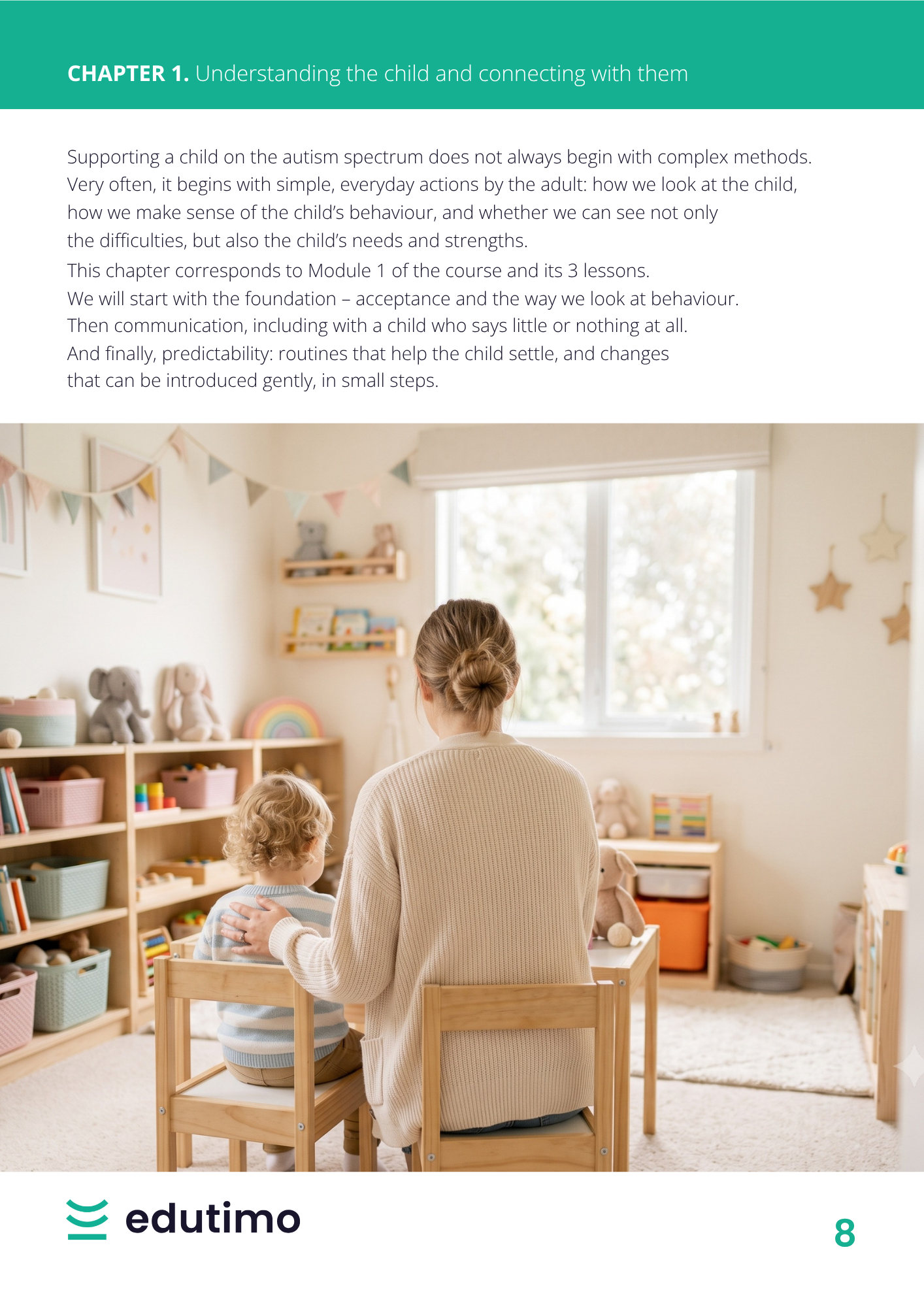
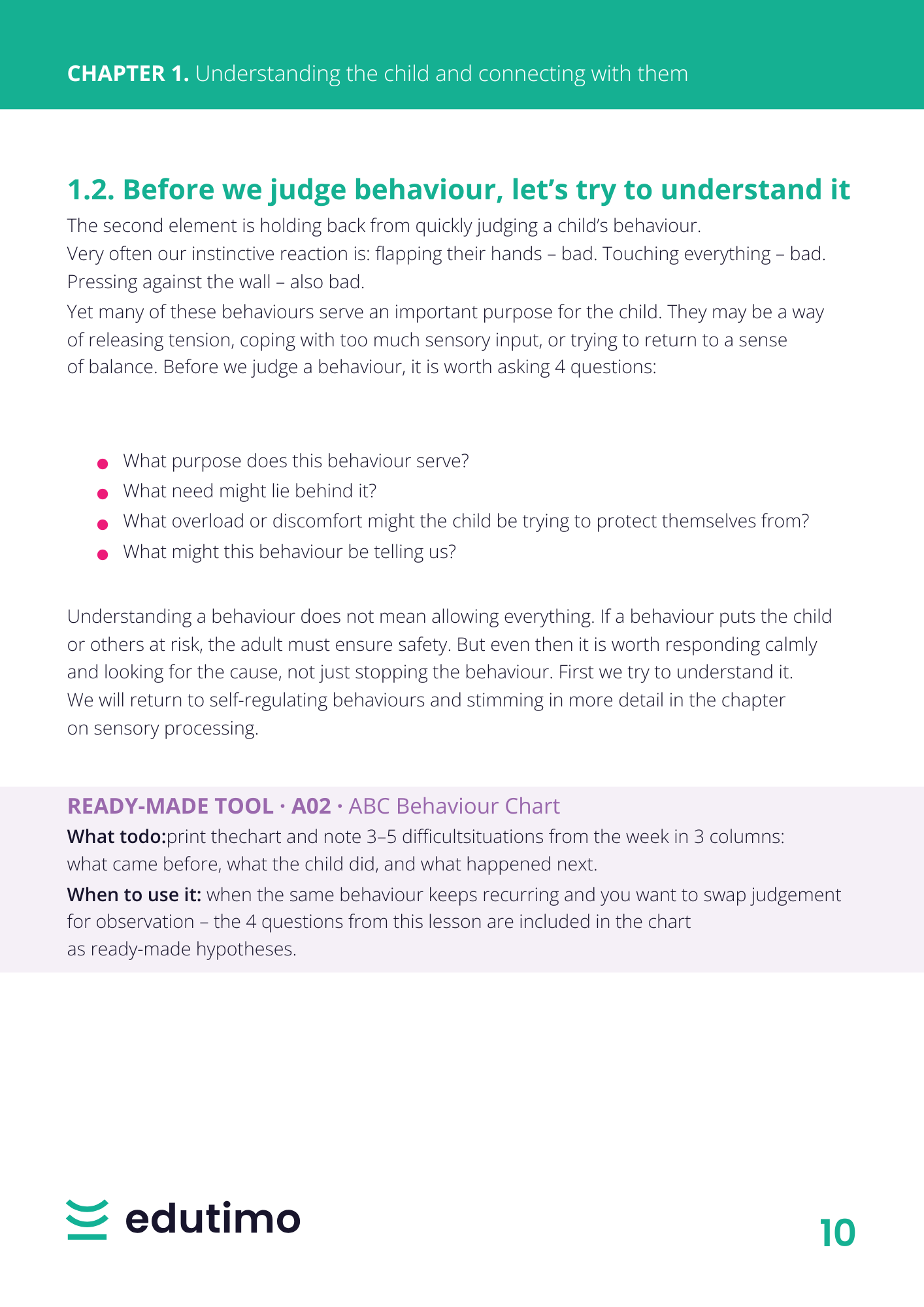
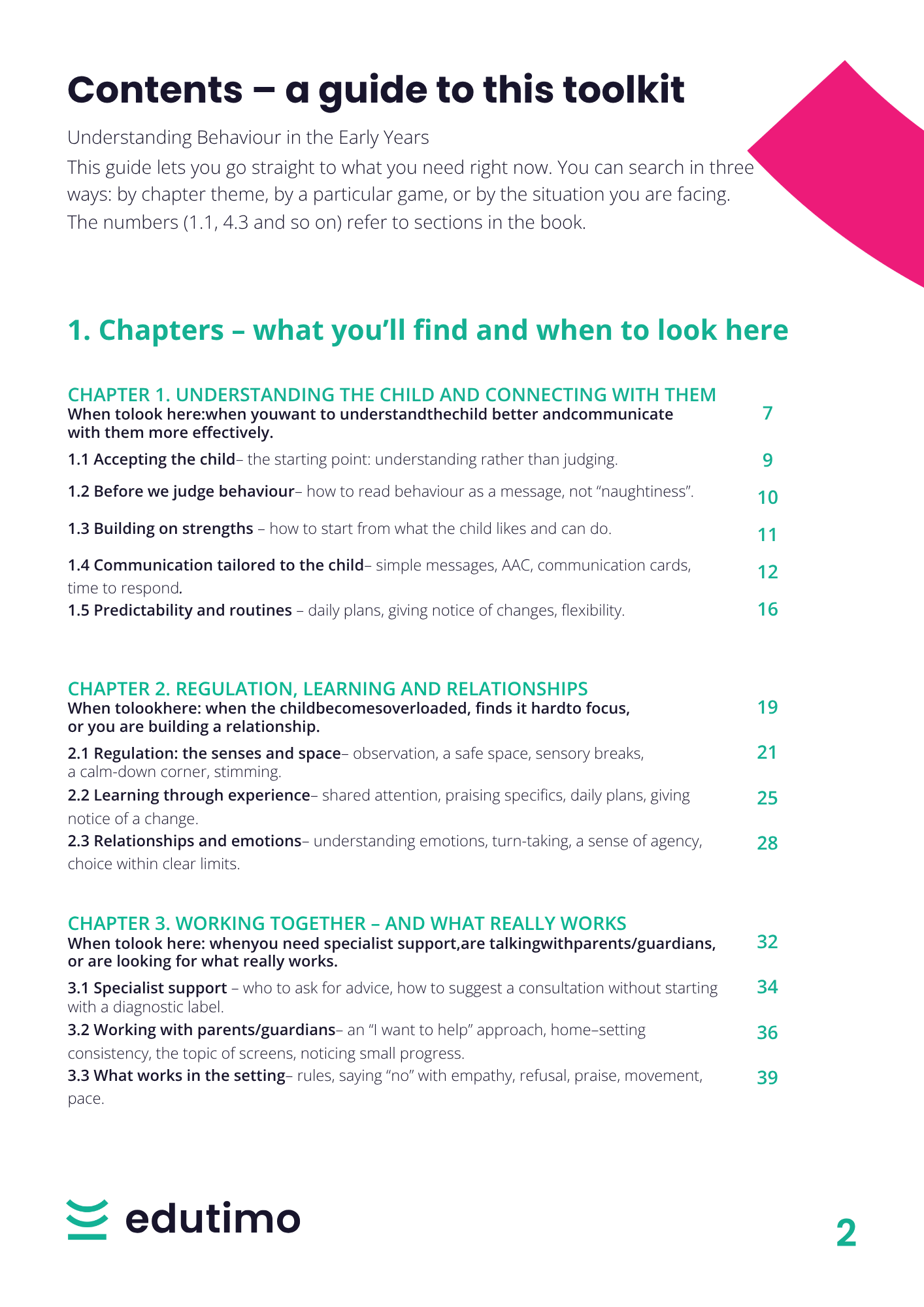
    Learn how to begin with acceptance, interpret behaviour as information and build support around the child’s strengths. You will also explore communication adapted to the child and predictable routines that can make everyday situations feel safer and easier to understand.
    Lessons in this module
    1. Understanding and acceptance
    2. Communication
    3. Predictability, routines and flexibility
  2. 2
    Regulation, learning and relationships
    14 min
    Available after purchase
    Explore how sensory processing, emotional regulation and the environment can affect the child’s ability to participate, learn and connect. You will learn how to reduce overload, develop shared attention, use specific praise and support emotional understanding, turn-taking and agency.
    Lessons in this module
    1. Regulating emotions and sensory input
    2. Learning and play through hands-on experience
    3. Relationships and emotions
  3. 3
    Working together and what really helps
    19 min
    Available after purchase
    Learn when specialist advice may be needed, how to discuss your observations with parents and carers without making a diagnosis and how to create greater consistency between home and the setting. This module also brings together the boundaries, language, movement breaks and pacing that support the child in everyday situations.
    Lessons in this module
    1. Specialist support
    2. Supporting parents and carers, and working with the home
    3. What really helps in the setting
  4. 4
    Why play matters and how to begin
    18 min
    Available after purchase
    Understand why play is a foundation for early development and why a child on the autism spectrum may need an adult to show how shared play can begin. Follow a practical sequence: observe, stay nearby, model the play, involve another child and gradually step back.
    Lessons in this module
    1. Play - why and how
    2. Movement games
  5. 5
    Table-top games and games with sound
    21 min
    Available after purchase
    Discover practical activities supporting fine-motor skills, visual analysis, attention, turn-taking, imitation and early learning. The module includes construction activities, art and craft ideas and music and rhythm games that can be adapted to the child’s interests, abilities and sensory needs.
    Lessons in this module
    1. Fine-motor and construction games
    2. Art and craft activities
    3. Music and rhythm games
  6. 6
    Sensory games and conclusion
    19 min
    Available after purchase
    Explore simple sensory activities using materials commonly available in early years settings, including paints, modelling materials, water, rice, dry grains, different textures and sound. The programme concludes by returning to its central principle: effective support begins with a calm adult who is willing to understand the child.
    Lessons in this module
    1. Sensory games
    2. Understanding the child and staying calm

Teacher's Toolkit

91-page implementation guide · PDF
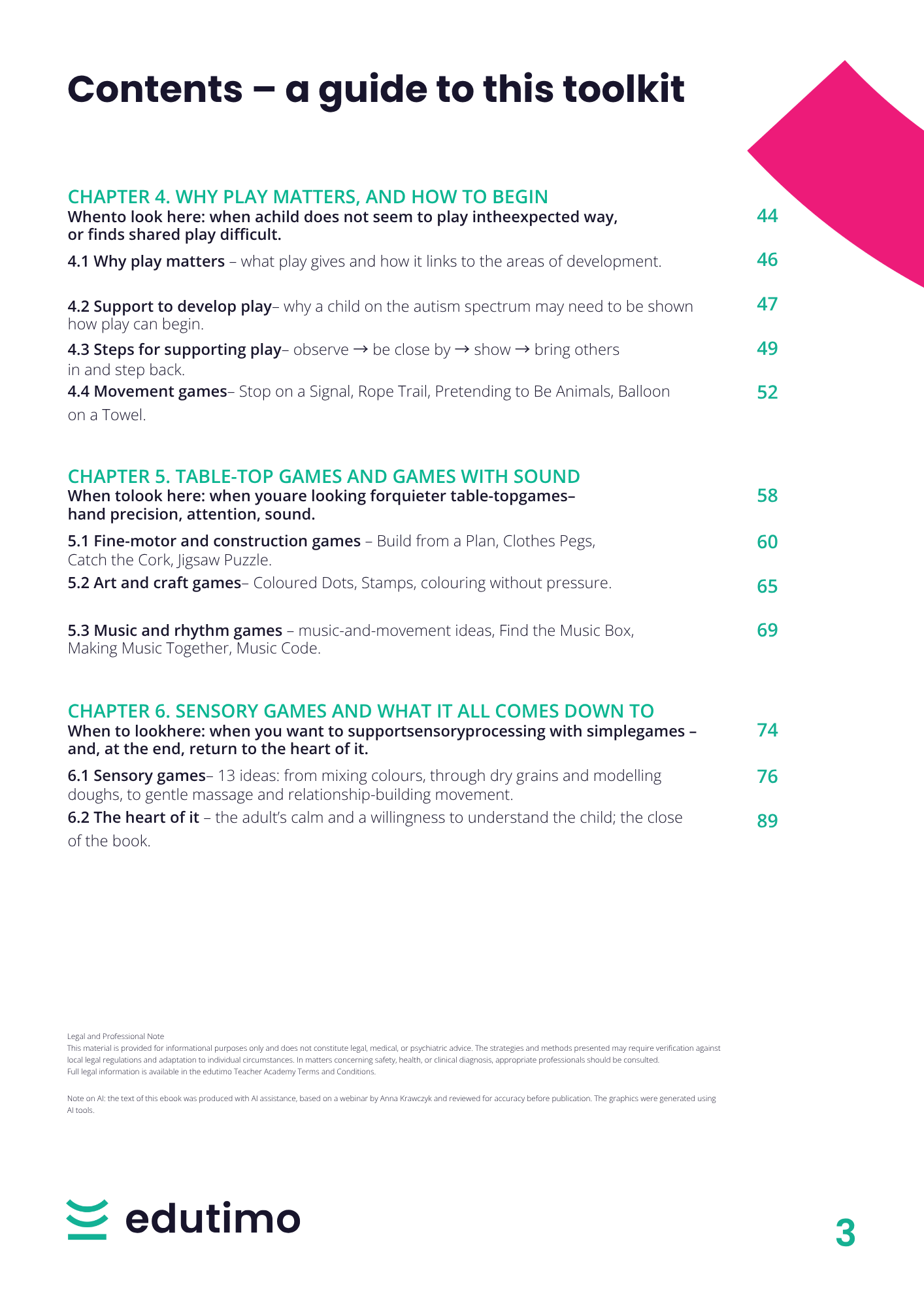
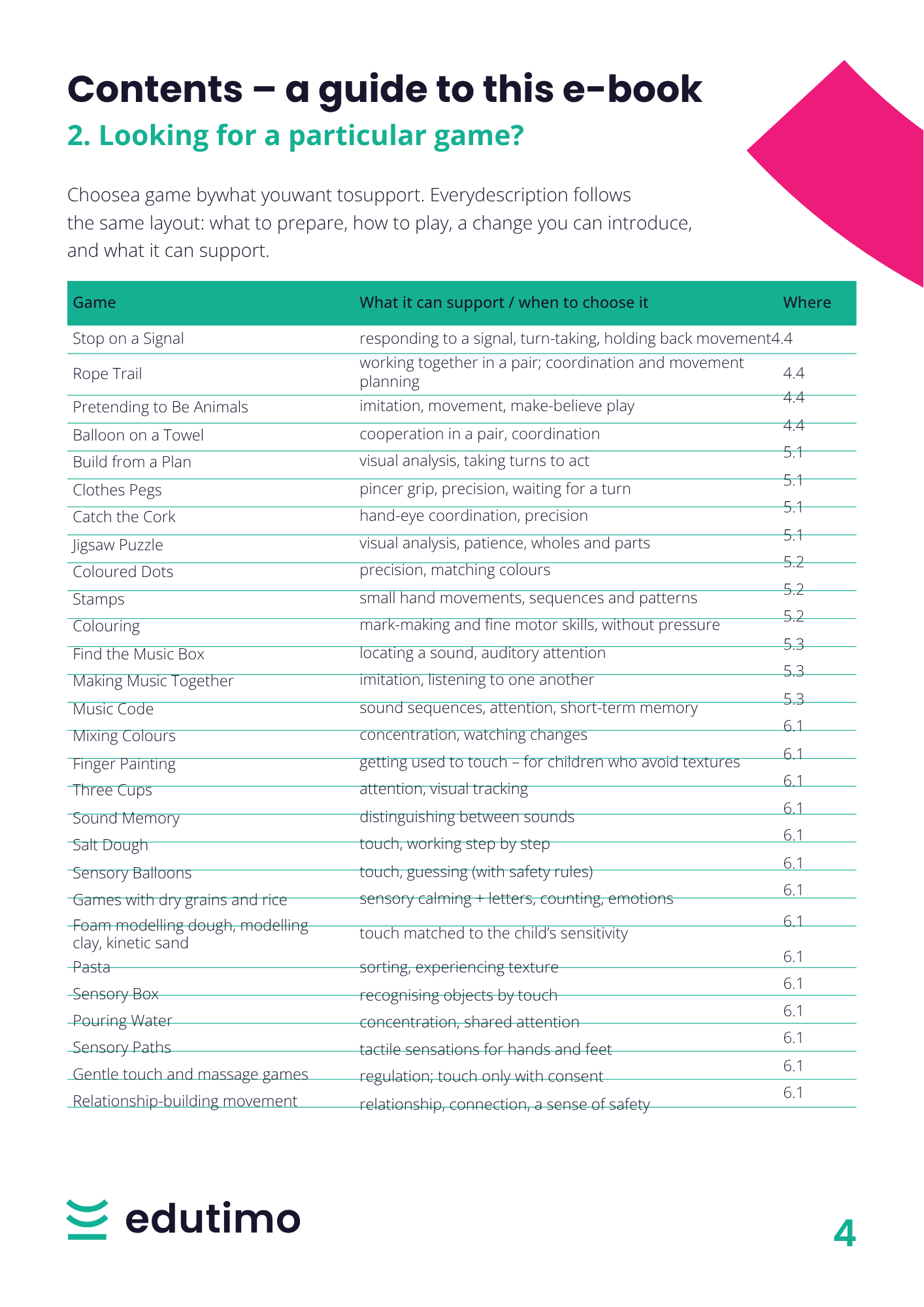
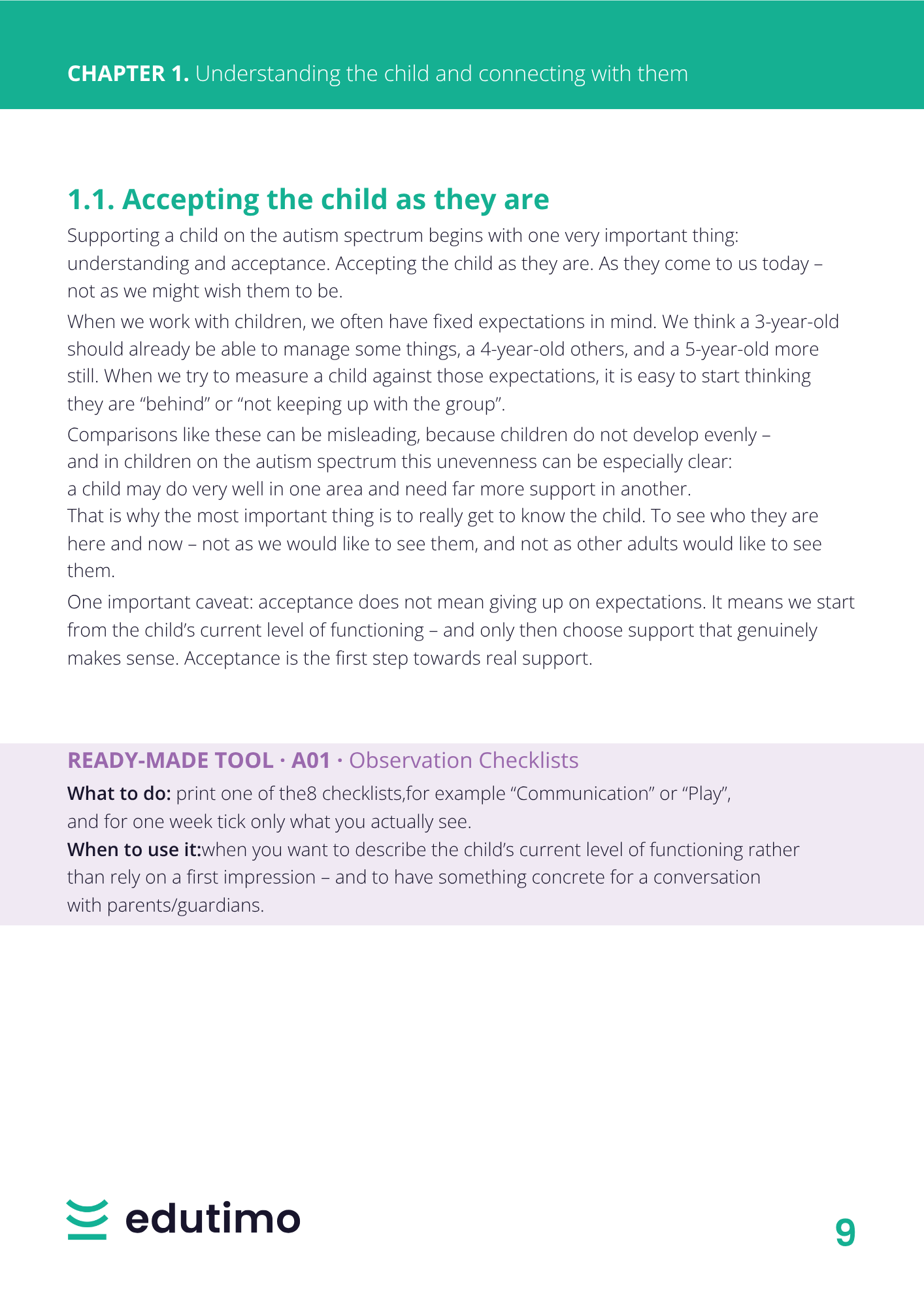
The Teacher’s Toolkit follows the same six-part structure as the video training and can be used alongside the modules or as an independent reference guide. It helps you quickly find practical guidance for a particular behaviour, difficulty or everyday situation.
  • Guidance organised by behaviour, difficulty and everyday situation.
  • Communication, regulation and home–setting support.
  • Over 30 movement, table-top, music and sensory activities.
  • Step-by-step instructions, adaptations and safety guidance.
  • “What if…” scenarios and ready-to-use next steps.
See sample pages

Classroom Resource Library

Practical resources for real classroom situations

The Professional version gives you access to the complete library of practical resources created specifically for this programme. Inside, you’ll find ready-to-use materials that support classroom practice, behaviour analysis, communication, planning and implementation. Selected resources are available to preview for free, so you can see the format and approach before accessing the full library.

  • 55
    materials total
  • 3
    free for everyone
  • 55
    in Professional
  • Observation and understanding behaviour
    2 materials
    • ABC Behaviour Chart
      A practical chart for identifying what happens before a behaviour, what the child does and what follows.
    • Observation Checklists
      Eight focused checklists for recording the child’s communication, sensory responses, play, transitions, relationships and distress.
      Open
  • Communication
    3 materials
    • Ready-to-Use Scripts for Adults
      Short, consistent phrases for common situations such as giving instructions, offering choices, setting boundaries and supporting regulation.
    • Communication Cards
      More than 30 printable cards helping children communicate needs, feelings, choices, transitions and requests for support.
      Open
    • Communication Support Session
      A worked individual session plan for developing communication and social interaction through play.
      Open
  • Getting started
    1 materials
    • Four-Week Implementation Plan
      A four-week roadmap for observing the child, choosing one priority, introducing one strategy and reviewing its impact.
      Open
  • Support plans and de-escalation
    4 materials
    • Behaviour and De-escalation Plan
      A worked example showing how to identify triggers, prevent escalation and respond at each stage of a difficult situation.
      Open
    • Distress and Behaviour Strategies
      A collection of practical strategies and ready-to-use language for preventing distress, responding safely and reconnecting afterwards.
      Open
    • Short Intervention Plan
      A concise worked plan for managing one recurring difficult situation from prevention through to follow-up.
      Open
    • Child’s Mini Support Plan
      A one-child plan bringing together strengths, communication, sensory needs, routines, play and one priority strategy.
      Open
  • Individual sessions
    1 materials
    • Individual Session Plan
      A flexible template for planning individual sessions supporting communication, interaction and thinking skills.
      Open
  • Predictability and daily structure
    3 materials
    • First–Then Boards and a Mini Daily Plan
      Printable visual boards and daily plans helping children understand routines, transitions and what happens next.
      Open
    • Weekly Plan of Support Activities: Ages 4–5
      A weekly example combining communication, movement, sensory and play activities for children aged four to five.
      Open
    • Weekly Plan of Support Activities: Age 6
      A weekly activity plan for children ready for a greater level of challenge, with options for adaptation.
      Open
  • Calm and self-regulation
    1 materials
    • Calming and Self-Regulation Toolkit
      A set of breathing, grounding, sensory and relaxation activities for use in the setting or at home.
      Open
  • Play and development
    1 materials
    • Play Activities to Support Development
      Ready-to-use activities supporting communication, interaction, movement and thinking through play.
      Open
  • Working with parents and carers
    2 materials
    • Parent and Carer Conversation Guides
      Six practical frameworks for conversations about communication, sensory needs, behaviour, screen use and progress.
      Open
    • Home–Setting Cooperation Sheet
      A structured form for agreeing shared goals, routines, messages and responses across home and the setting.
      Open
  • Printable activity cards
    15 materials
    • Modelling Clay Play
      A sensory and fine-motor activity based on squeezing, rolling and shaping modelling materials.
      Open
    • Trace the Lines: Balloons
      A pencil-control activity in which the child traces lines connecting children with their balloons.
      Open
    • Match the Pictures
      A visual-perception activity for finding and joining identical pictures.
      Open
    • Cutting Practice: Cats
      A cutting activity for practising scissor control along clearly marked lines.
      Open
    • Picture Sequences: Set 1
      A sequencing activity for arranging photographs in the correct order.
      Open
    • Sorting: Food and Animals
      A categorisation activity for sorting pictures into food and animal groups.
      Open
    • Colour to Match
      A visual-attention activity in which the child colours a picture to match the model.
      Open
    • Picture Sequences: Set 2
      A second set of photographs for practising sequencing and describing events.
      Open
    • Match the Pictures: Set 2
      An additional visual-matching activity using a new set of pictures.
      Open
    • What Do People Need?
      A vocabulary and thinking activity for matching people with the objects they need.
      Open
    • Circle the Food
      A visual-search activity for identifying and circling food items.
      Open
    • Trace the Lines
      A pencil-control activity for tracing paths without lifting the pencil.
      Open
    • What Goes in the Fridge?
      A categorisation activity for deciding which foods and objects belong in a fridge.
      Open
    • Body Parts
      A vocabulary and body-awareness activity for recognising and naming body parts.
      Open
    • Cut-Out Jigsaw
      A cutting and visual-analysis activity in which the child reconstructs a picture from pieces.
      Open
  • Dot-to-dot worksheets
    22 materials
    • Dot-to-Dot: Cat
    • Dot-to-Dot: Christmas Tree
      Open
    • Dot-to-Dot: Clock
      Open
    • Dot-to-Dot: Clown
      Open
    • Dot-to-Dot: Crown
      Open
    • Dot-to-Dot: Easter Egg
      Open
    • Dot-to-Dot: Fence
      Open
    • Dot-to-Dot: Fish
      Open
    • Dot-to-Dot: House
      Open
    • Dot-to-Dot: Kite
      Open
    • Ladybird
      Open
    • Dot-to-Dot: Leaf
      Open
    • Dot-to-Dot: Lollipop
      Open
    • Dot-to-Dot: Mouse and Cheese
      Open
    • Dot-to-Dot: Present
      Open
    • Dot-to-Dot: Rocket
      Open
    • Dot-to-Dot: Socks
      Open
    • Dot-to-Dot: Spider’s Web
      Open
    • Dot-to-Dot: Star
      Open
    • Dot-to-Dot: Sun
      Open
    • Dot-to-Dot: Toadstool
      Open
    • Dot-to-Dot: Toys
      Open

Knowledge Booster

The Professional version includes the Knowledge Booster, which helps you return to the programme after completing the video course - step by step, without trying to implement everything at once. Inspired by Ebbinghaus’s forgetting curve, it uses short emails sent at the right intervals to help you remember and apply what you learn.

Professional: 11 emails over 30 days
  1. 1
    Day 1
    Start with the child, not the label
  2. 2
    Day 4
    Behaviour as a message
  3. 3
    Day 7
    Strengths, communication and AAC
  4. 4
    Day 10
    Predictability and routines
  5. 5
    Day 13
    Sensory regulation, calm-down spaces and stimming
  6. 6
    Day 16
    Shared attention, emotions and agency
  7. 7
    Day 19
    Specialist support, families and screens
  8. 8
    Day 22
    Saying “no” with empathy
  9. 9
    Day 25
    Why play matters
  10. 10
    Day 28
    Movement, table-top, sound and sensory games
  11. 11
    Day 30
    The heart of effective support
You control when it starts. Activate from your account whenever you're ready - it won't start automatically.

Certificate of completion

Each Edutimo programme includes a short end-of-programme test. After completing the modules, take the test to confirm what you have learned and download your certificate of completion. The test is included in the programme and can be retaken if needed.

Ready? Take the test and get your certificate.

10 questions · approx. 10 min · available after completing all modules

Your trainer

Anna Krawczyk

Preschool teacher, SEN specialist and therapist supporting autistic children and sensory processing needs with practical classroom expertise.

  • preschool education
  • students with SEN
  • autism spectrum support
  • parent-teacher collaboration
  • therapeutic approaches
  • classroom discipline
What teachers say?

Trusted by teachers across Europe

Miriam Gibreel
primary school educator
"Highly Recommended CPD for Educators – Exceptional Neurodiversity and Practical Strategy Courses that are both relevant and impactful in modern day classrooms. Having spent 16 years teaching children aged 5 to 11 in London-based primary school settings, I am incredibly judicious about the professional development I invest my time in. I am thoroughly impressed by the extensive range of courses offered on Edutimo. In particular, Joanna Nienałtowska-Padło’s modules focusing on neurodiverse conditions are exceptional, providing deep insights alongside highly practical classroom advice. The strategies for navigating challenging situations and de-escalating them effectively have given me concrete, actionable tools that actually work in a live classroom environment. Additionally, the recommended resources and guidelines for creating personalised student toolkits are fantastic for helping children navigate day-to-day school life. As an experienced professional, I know that having up-to-date courses available is instrumental in confidently establishing well-prepared lessons and a welcoming classroom environment for the upcoming school year."
Shannon Carter
Assistant Headteacher
"What I found particularly valuable about Edutimo was how closely the programme connected professional learning with what actually happens in the classroom. The training is clear and practical, with real classroom examples and strategies that I can use straight away. I often found myself going back to particular modules when planning lessons, and some of the approaches have now become part of my everyday teaching. The Challenging Behaviour training has completely changed the way I approach difficult situations in the classroom. I found it particularly useful to understand what sits behind challenging behaviour and how to respond calmly when situations escalate. It has given me more confidence in knowing what to do and what to say when things become difficult. It genuinely feels like a programme created by people who understand the realities of teaching. Rather than just giving you theory, Edutimo gives you ideas that you can actually take into your classroom and put into practice straight away."
Hedwig S.
Teacher
"Comments and examples "taken from real life." Experience, wisdom, calmness, and a courageous look at reality from Jolanta."
Questions about this programme

FAQ

  • What's the difference between Essential and Professional?

    Essential includes the full video programme, the Teacher’s Toolkit ebook and a certificate of completion. Professional includes everything in Essential, plus the complete Classroom Resource Library and the Knowledge Booster.

  • How long do I have access?

    You receive 12 months of access to the programme after purchase.

  • Does the programme include ready-to-use materials?

    Yes. Depending on your package, you receive templates, scripts, cards, procedures, case studies and classroom tools.

  • What is the Knowledge Booster?

    It is a 30-day email sequence that helps you revisit the most important ideas from the programme and apply them step by step.

  • Do I receive a certificate?

    Yes. After completing the programme, you can download your certificate of completion.

Available now

Featured programmes

Each programme includes video, materials, case studies and a certificate.

Edutimo
97 Królowej Jadwigi St.
30-209 Krakow
Poland
Information
Copyright © 2026 Edutimo