1. Programmes
  2. Students with ADHD and ADD in the Classroom: Supporting Focus, Emotional Regulation, and Everyday Learning
Joanna Nienałtowska-Padło
Specialist in autism spectrum support

Students with ADHD and ADD in the Classroom: Supporting Focus, Emotional Regulation, and Everyday Learning

A student understands the task but never starts. Another loses focus halfway through. Someone else interrupts constantly, while a quiet student struggles unnoticed. How do you know what is really happening, and which response will help? This three-part programme shows you how ADHD can affect attention, organisation, emotions and learning, and how to respond to these difficulties in everyday classroom situations. Learn to recognise different patterns of functioning, adapt instructions and tasks, support emotional regulation and make learning more accessible without automatically lowering expectations.

Essential

£49.00

One-time · 12 months access
  • 12 video modules
  • 3 Teacher's Toolkit (163 pages)
  • Certificate
  • Classroom materials
  • Case studies
  • Knowledge Booster
Professional Recommended

£69.00

One-time · 12 months access
  • 12 video modules
  • 3 Teacher's Toolkit (163 pages)
  • Certificate
  • Classroom materials with 80 scenarios
  • 3 case studies
  • Knowledge Booster (30 days)

Is this for you?

We use AI as a tool to support production, but we do not hand over responsibility for the content. Our materials are based on real webinars by our trainers and are reviewed and approved by a person before publication. The videos feature an AI-generated avatar and voice of the trainer, used with her consent.

What you'll implement?

What's inside this programme?

Video modules

14 modules · approx. 257 min total · one film per module
  1. 1
    Part I, Introduction to the Training
    3 min
    Available after purchase
    Meet Joanna Nienałtowska-Padło and discover how the three-part programme connects the mechanisms behind concentration difficulties with practical classroom support. Learn why observing behaviour, understanding possible causes and responding to individual needs are the starting points for effective teaching.
  2. 2
    Part I, Module 1: Understanding Difficulties with Concentration
    21 min
    Available after purchase
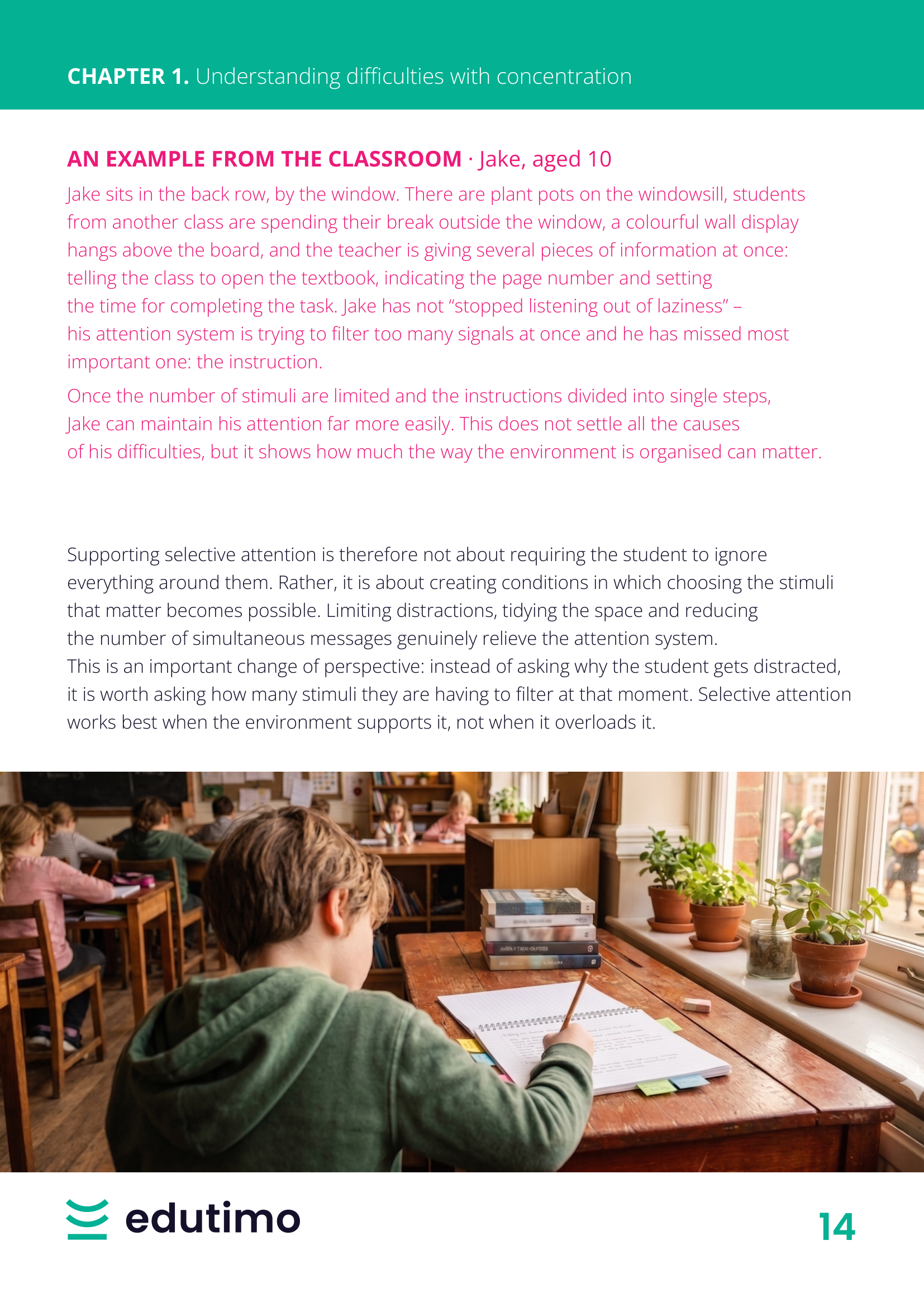
    Why does a student focus on one activity but lose track within minutes during another? Explore how attention selects information, interacts with memory and fluctuates over time, and why noise, emotions and competing stimuli can make concentration harder.
    Lessons in this module
    1. What concentration is and how attention works
    2. Attention, concentration and memory
    3. Selective attention and filtering stimuli
    4. The rhythm of concentration and natural fluctuations of attention
  3. 3
    Part I, Module 2: ADHD and ADD: The Wider Picture
    26 min
    Available after purchase
    Understand the recognised presentations of ADHD, including predominantly inattentive difficulties that may go unnoticed. Explore how symptoms change with age and how attention, impulsivity and emotional regulation affect school performance and relationships.
    Lessons in this module
    1. ADHD and ADD as sets of symptoms
    2. Core symptoms and presentations of ADHD
    3. ADHD and ADD across development
    4. Emotional and social functioning
    5. The persistence of ADHD and ADD symptoms across development
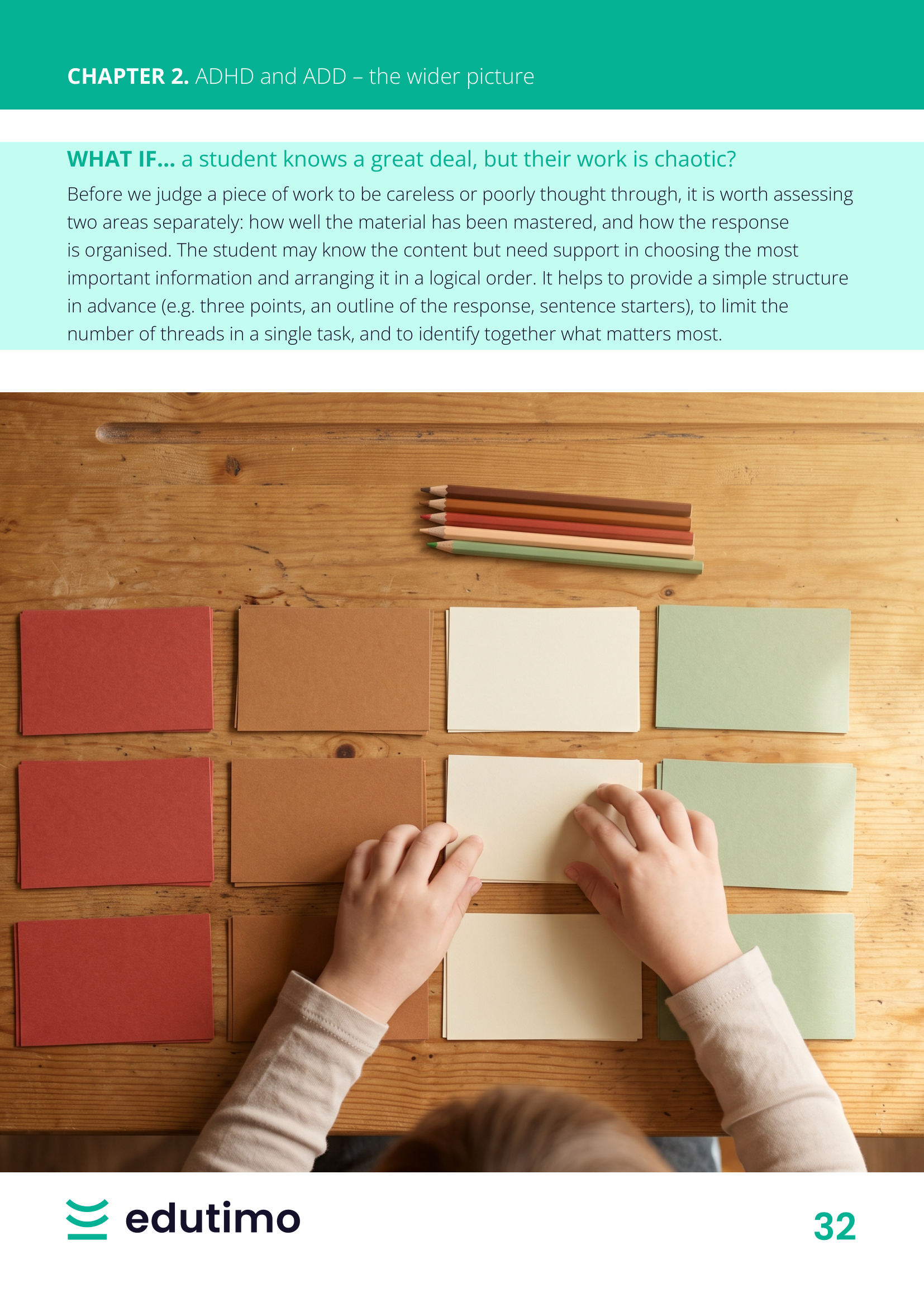
    6. Integrating information and cognitive chaos
  4. 4
    Part I, Module 3: Patterns of Functioning in ADHD
    20 min
    Available after purchase
    Why is one student constantly moving while another withdraws, worries excessively or struggles with changes? Explore different descriptive patterns of functioning and hyperfocus, and learn to consider what may be contributing to a student's behaviour without treating these patterns as diagnostic categories.
    Lessons in this module
    1. Patterns of functioning in ADHD: a metaphorical approach
    2. The high-energy, hyperactive style
    3. The rigid, overfocused style
    4. The withdrawn, low-energy style
    5. The anxious style
    6. The predominantly inattentive style
    7. Hyperfocus: mechanism, potential and risks
  5. 5
    Part I, Module 4: Cognitive and Language Functioning and Differences in Ways of Learning
    20 min
    Available after purchase
    A student knows the answer but cannot organise their thoughts. Another forgets instructions halfway through an activity. Understand how difficulties with attention and working memory can affect speaking, writing, processing information and completing multi-step tasks.
    Lessons in this module
    1. Attention and thinking
    2. Language and narrative difficulties
    3. Difficulties with writing and learning
    4. Memory and concentration
    5. Differences in information processing and ways of working
    6. The Centipede and Grasshopper patterns: difficulties with starting, organising and finishing tasks
  6. 6
    Part II, Module 5: Executive Functions and Self-Regulation
    20 min
    Available after purchase
    Why can a student explain exactly what they need to do but still fail to begin? Understand the role of executive functions in planning, time management, persistence and impulse control, and learn how temporary adult support can help students gradually develop greater independence.
    Lessons in this module
    1. Executive functions
    2. Planning and organisation
    3. Controlling emotions and impulses
    4. Time management and persistence
    5. Self-regulation of attention, emotions and energy
    6. The adult's role as an external structure
  7. 7
    Part II, Module 6: Ordering Tasks, Priorities and Energy
    23 min
    Available after purchase
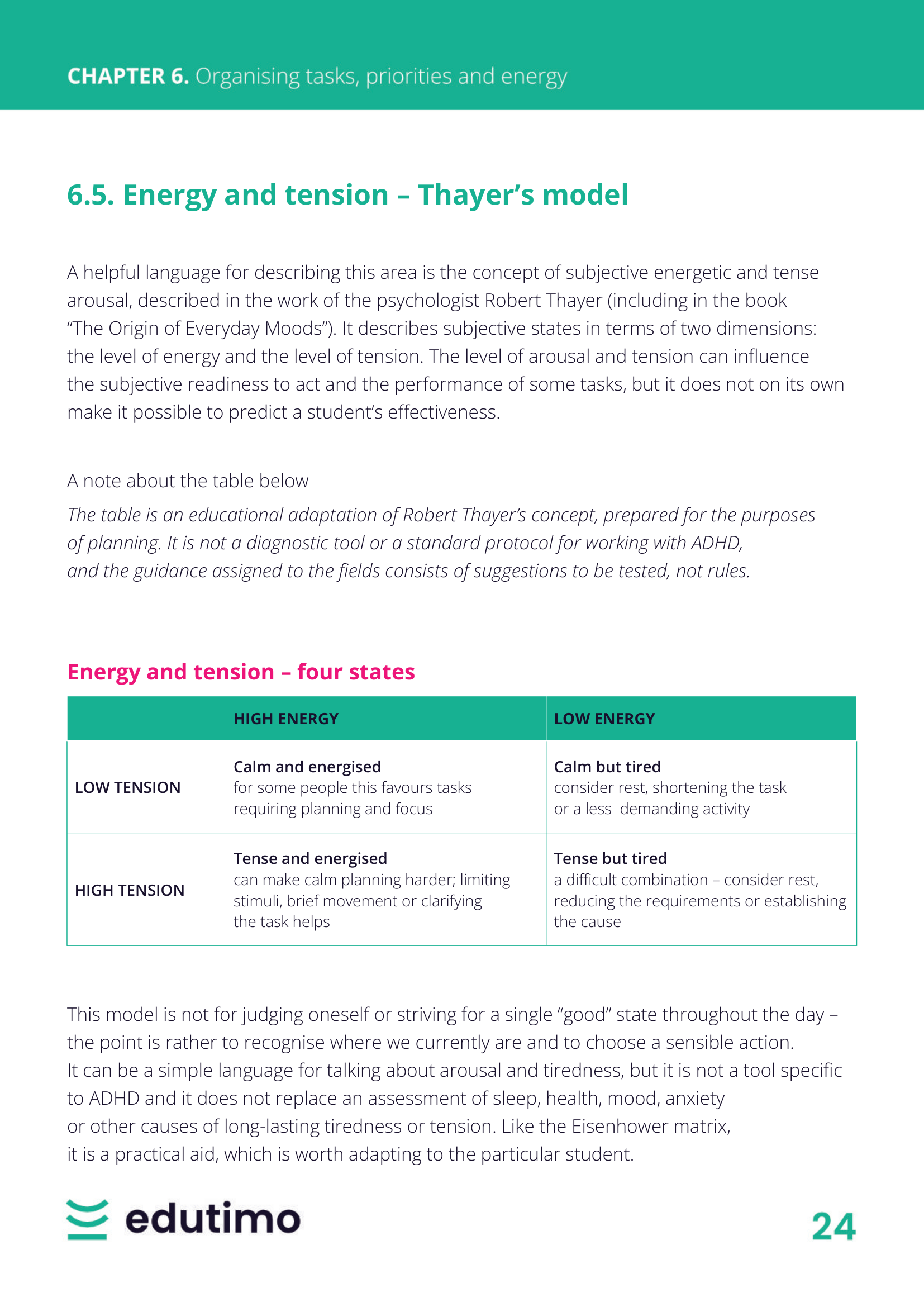
    Discover why long to-do lists can overwhelm students instead of helping them. Explore practical ways to make tasks manageable, distinguish urgent from important work and use tools such as the Eisenhower and Thayer matrices to support planning.
    Lessons in this module
    1. Priority lists: principles and pitfalls
    2. Problems with to-do lists in ADHD and ADD
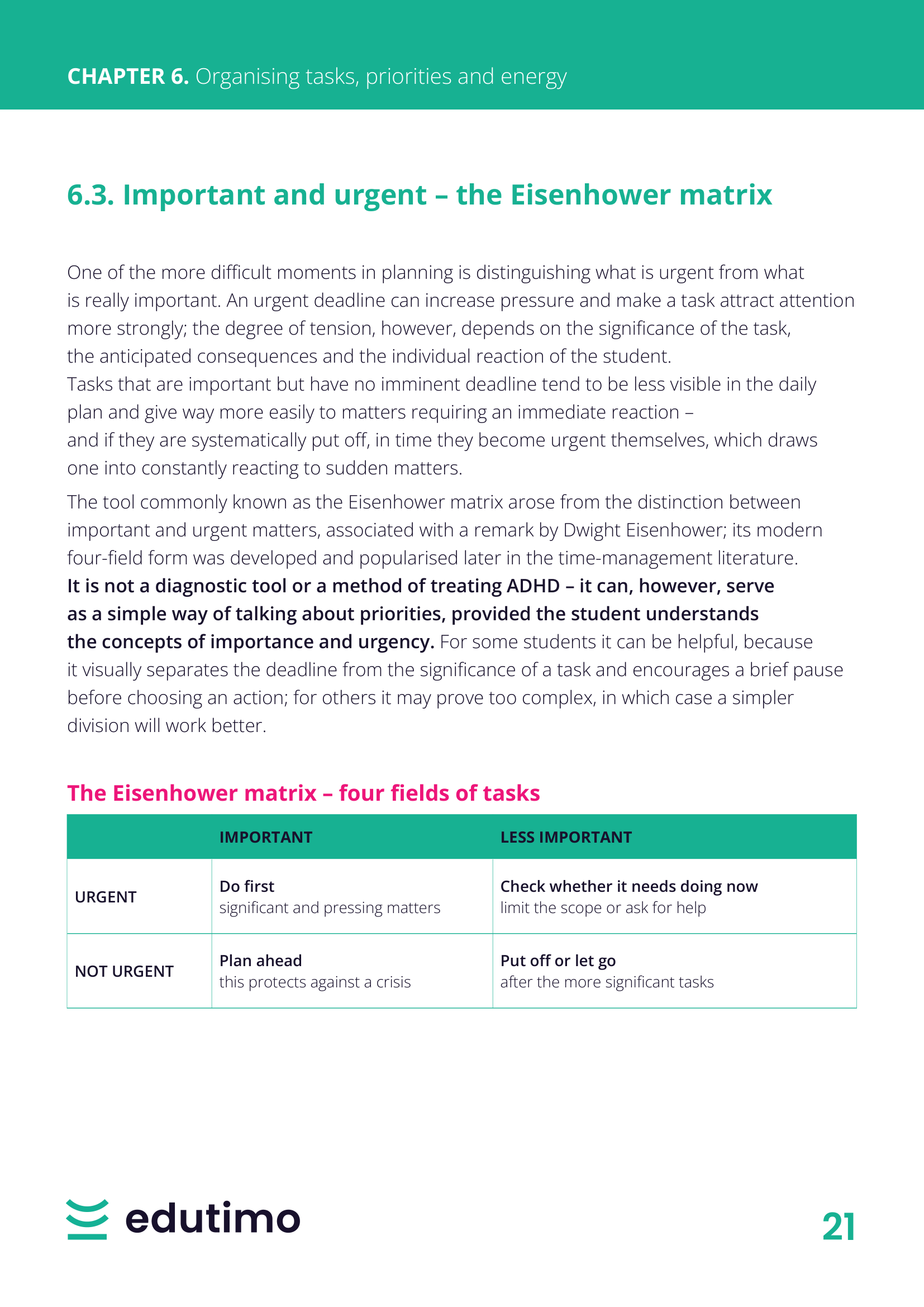
    3. The Eisenhower matrix: the important and the urgent
    4. Energy and tension across the day
    5. The Thayer matrix: self-regulation of energy and stress
    6. Self-regulation as a condition of effective action
    7. The consequences of not ordering tasks and energy
  8. 8
    Part II, Module 7: Concentration in School Practice
    23 min
    Available after purchase
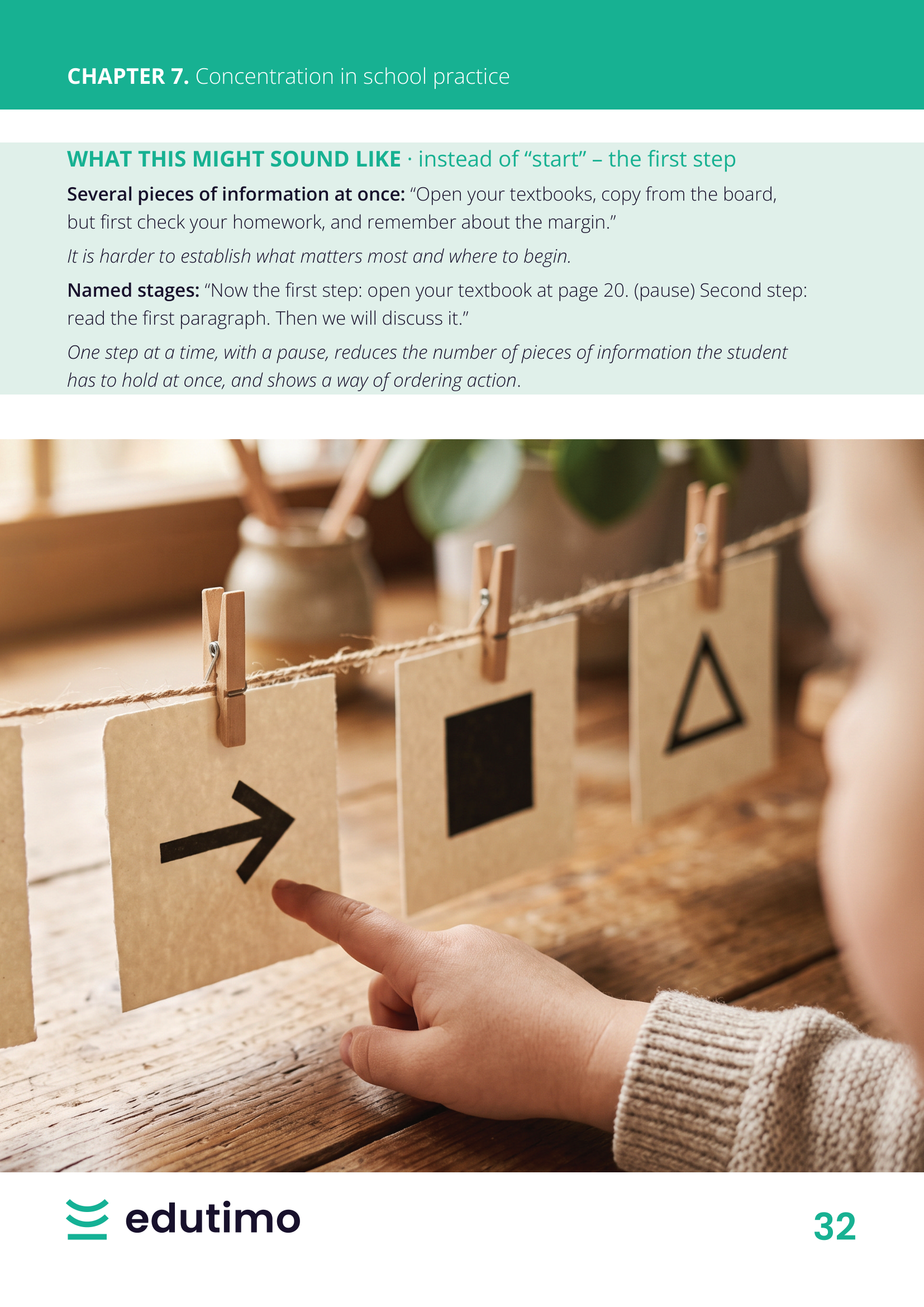
    Learn how to structure a lesson so students know what comes next, give instructions they can follow and reduce unnecessary distractions. Explore practical adjustments to seating, classroom organisation, transitions and the pace of work.
    Lessons in this module
    1. Concentration in the teacher's work
    2. Organising teaching sessions
    3. Organising the student's work
    4. Rules, instructions and directions
    5. Lesson structure and predictability
    6. The educational environment and everyday practice that supports concentration
  9. 9
    Part II, Module 8: Educational Strategies and Interventions
    23 min
    Available after purchase
    What should you do when a student refuses a task, becomes impulsive or repeatedly fails to finish their work? Explore ways to adapt tasks, assessment and feedback, consider possible reasons for behaviour, support motivation and build more consistent cooperation between school and home.
    Lessons in this module
    1. Basic strategies for working with students with ADHD and ADD
    2. Adjusting requirements, assessment and feedback
    3. Behaviour as a message and regulatory interventions
    4. Motivation and the reward system in ADHD and ADD
    5. Cooperation between adults
  10. 10
    Part III, Module 9: The Biology and Environment of Concentration
    17 min
    Available after purchase
    Why does the same student manage well one day and struggle with a familiar task the next? Explore the possible effects of sleep, fatigue, movement, hydration, sensory input and stress, and learn what to consider before interpreting a lapse in concentration.
    Lessons in this module
    1. Concentration and physiology
    2. Sleep, circadian rhythm, movement and recovery
    3. Hydration, food and the study environment
    4. Stress, safety and how the brain works
  11. 11
    Part III. Module 10: Concentration Exercises and Training
    17 min
    Available after purchase
    Explore short attention, perception and persistence activities, alongside games, memory techniques and relaxation practices. Learn how to select manageable exercises and connect the strategies practised during an activity with real schoolwork.
    Lessons in this module
    1. Concentration as a skill that can be developed
    2. Training attention, persistence and visual perception
    3. Games, playful activities and memory techniques as tools for strengthening concentration
    4. Relaxation, mindfulness and cognitive hygiene as conditions for lasting concentration
  12. 12
    Part III, Module 11: Brain Development and Stress
    20 min
    Available after purchase
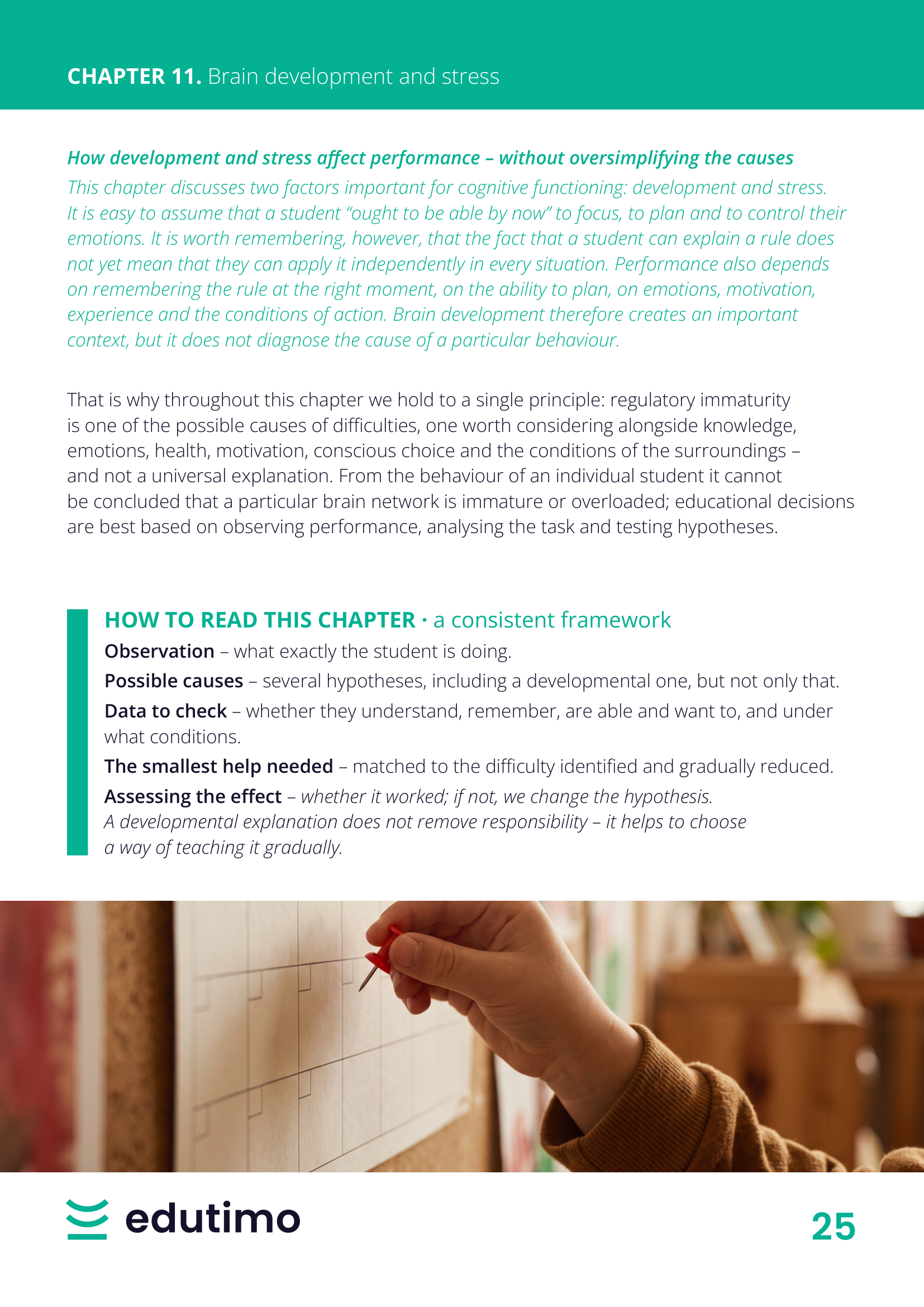
    Understand why students may know a rule but struggle to apply it consistently, especially under pressure. Explore the gradual development of executive functions, the effects of stress on thinking and impulse control, and practical ways to reduce cognitive overload.
    Lessons in this module
    1. Brain development in children and teenagers
    2. The maturation of the frontal lobes
    3. Stress, survival mode and their impact on cognitive functioning
    4. Teenagers, school and cognitive load
    5. Supporting stress regulation in educational practice
  13. 13
    Part III, Module 12: Illustrative Context and Examples
    19 min
    Available after purchase
    Learn how to discuss attention difficulties without labelling students or making assumptions about their abilities. Explore metaphors, everyday classroom examples and ways of communicating that help students understand their experiences and take part in finding appropriate support.
    Lessons in this module
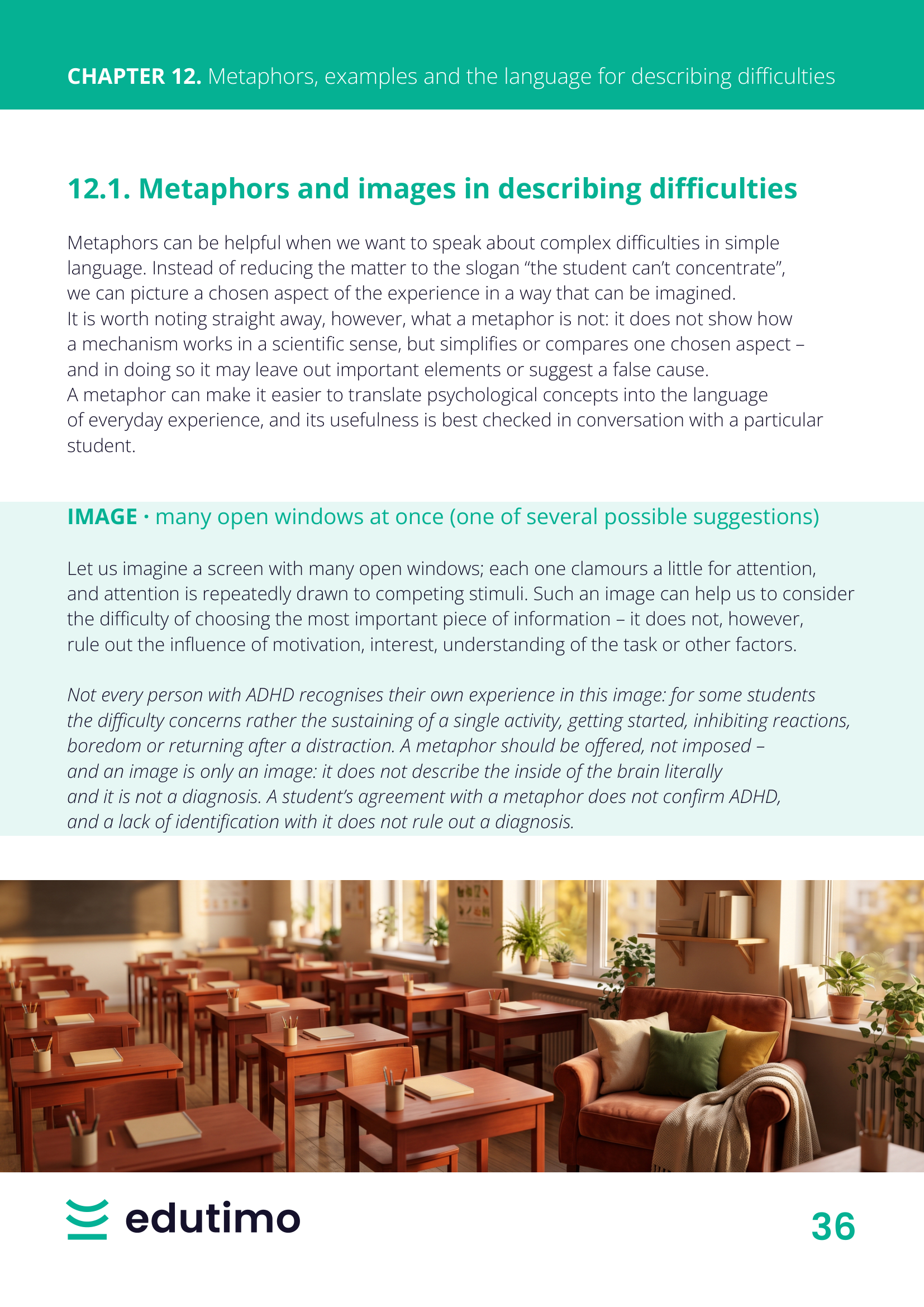
    1. Metaphors
    2. Quotations and cultural examples
    3. Public figures who have spoken openly about ADHD and ADD
    4. Examples from educational practice
    5. A change of perspective
  14. 14
    Part III, Closing Remarks
    5 min
    Available after purchase
    Bring together the key ideas from all three parts and reflect on how to apply them in everyday teaching. Revisit the importance of clear instructions, predictable routines, appropriate task demands and supportive communication, and learn why understanding the circumstances behind a student's difficulties can help you choose more effective responses.

Teacher's Toolkit

163-page guide across 3 volumes · PDF
The written companion to the video training. It helps you understand ADHD and concentration difficulties, explore the reasons behind everyday classroom challenges and return to practical strategies for supporting pupils whenever you need them.
  • Clear explanations of ADHD, ADD, attention, memory and different patterns of functioning
  • Executive functions, self-regulation, impulsivity and emotional difficulties
  • Practical strategies for planning, prioritising, managing time and completing tasks
  • Classroom approaches to instructions, lesson structure, assessment and feedback
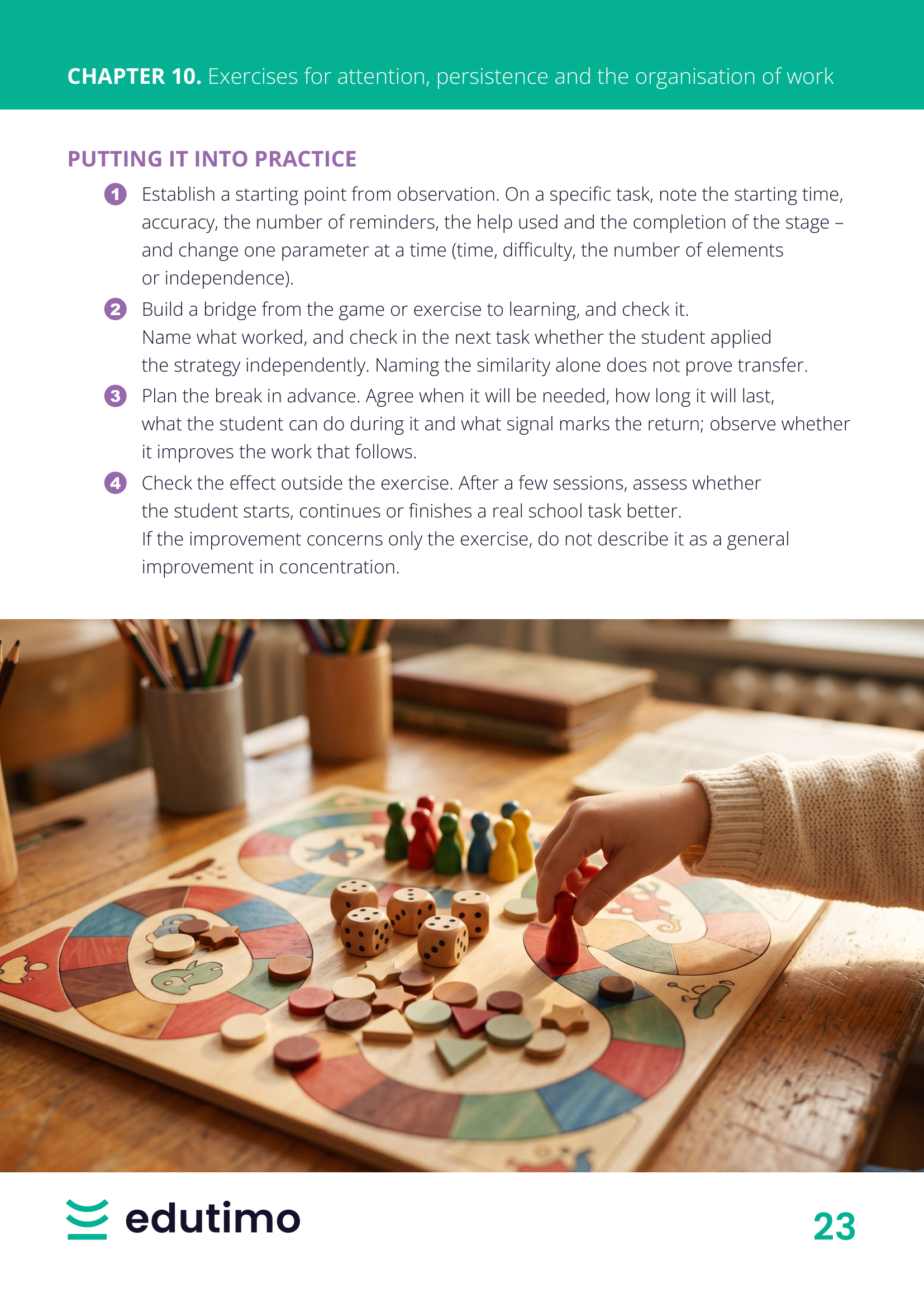
  • Exercises and activities for developing attention, persistence and work organisation
  • The influence of sleep, stress, movement and the learning environment on concentration
  • Classroom examples and practical guidance for understanding behaviour and adapting support
See sample pages

Classroom Resource Library

Practical resources for real classroom situations

The Professional version gives you access to the complete library of practical resources created specifically for this programme. Inside, you’ll find ready-to-use materials that support classroom practice, behaviour analysis, communication, planning and implementation. Selected resources are available to preview for free, so you can see the format and approach before accessing the full library.

  • 13
    materials total
  • 0
    free for everyone
  • 13
    in Professional
  • Practical Classroom Tools
    8 materials
    • Quick Analysis of a Difficult Situation
      A practical five-step guide to analysing challenging behaviour. Record what happened, consider possible explanations, choose an appropriate response and check whether it helped. Includes a checklist of factors to consider before drawing conclusions.
      Open
    • Message Bank: “How It Could Sound”
      Ready-to-use phrases for giving instructions, helping students start tasks, responding to tension and providing feedback. Includes examples of what to say instead of comments that may cause frustration, embarrassment or conflict.
      Open
    • Classroom Layout and the Student's Seat
      A classroom checklist and planning sheet for reviewing seating arrangements, noise, lighting, visual distractions and access to resources. Helps you choose specific changes and assess whether they improve a student's ability to work.
      Open
    • Menu of Short Breaks and Regulation Activities
      A selection of short movement, calming and attention-regulation activities for students who struggle to continue or return to work. Includes guidance on when a break may help, how to introduce it and how to check whether it improves task engagement.
      Open
    • Educational Adjustments: An Overview
      A practical overview of possible classroom adjustments, including task organisation, instructions, extra time, working conditions and assessment. Includes checklists and a planning sheet to help you match adjustments to identified needs and review their effectiveness.
      Open
    • Day and Week Visual Schedule
      Printable daily and weekly planning templates with cut-out activity labels. Help students follow routines, understand the order of activities and prepare for changes while gradually developing greater independence.
      Open
    • A Moment of Calm: A Short Exercise (Optional)
      A ready-to-read script for a short, voluntary calming activity. Offers alternatives such as gentle breathing, focusing on the surroundings and simple movement, with guidance on adapting the exercise to individual needs.
      Open
    • Living Library Worksheets
      A collection of 12 practical worksheets and a supplementary troubleshooting card. Includes tools for observing behaviour, identifying distractions, planning tasks and written work, supporting daily routines, communicating with parents and reviewing classroom strategies.
      Open
  • Intervention Cards & Conversation Scenarios
    5 materials
    • Intervention Cards
      100 ready-to-use intervention cards covering attention, impulsivity, hyperactivity, executive functions, working memory, emotions, sensory overload, motivation, relationships and transitions. Each card describes a specific classroom situation, suggests immediate actions, identifies responses to avoid and explains when further consultation may be needed.
      Open
    • Teacher Conversations in Everyday Practice: Part I. Conversations with the Student
      20 detailed conversation scenarios for everyday and challenging situations involving students with ADHD. Includes suggested phrases, step-by-step approaches, ways to respond when tension escalates and follow-up actions for situations such as task refusal, disruptive behaviour and emotional outbursts.
      Open
    • Teacher Conversations in Everyday Practice: Part II. Conversations with Parents
      60 detailed scenarios for conversations with parents, including initial discussions about difficulties, disagreements, emotional reactions and challenging meetings. Each scenario provides example phrases, a conversation structure, common mistakes to avoid and guidance on agreeing practical next steps.
      Open
    • Teacher Conversations in Everyday Practice: Part IV. Conversations with the Class
      20 complete scenarios – classroom culture and cooperation. Covers conversations with the whole class – about the rules of working together, emotions, diversity and mutual respect, as well as responding after difficult situations.
      Open
    • Case Studies
      7 school situations to analyse – how to understand attention difficulties and choose the right support.
      Open

Knowledge Booster

The Professional version includes the Knowledge Booster, which helps you return to the programme after completing the video course - step by step, without trying to implement everything at once. Inspired by Ebbinghaus’s forgetting curve, it uses short emails sent at the right intervals to help you remember and apply what you learn.

Professional: 11 emails over 30 days
  1. 1
    Day 1
    Welcome to Your Knowledge Booster
  2. 2
    Day 3
    Understanding Concentration Difficulties
  3. 3
    Day 6
    Recognising Inattentive ADHD
  4. 4
    Day 9
    Understanding Behaviour Patterns
  5. 5
    Day 12
    Supporting Speaking and Writing
  6. 6
    Day 15
    Helping Students Get Started
  7. 7
    Day 18
    Making Task Lists Work
  8. 8
    Day 21
    Giving Clearer Instructions
  9. 9
    Day 24
    Responding to Challenging Behaviour
  10. 10
    Day 27
    Creating Better Conditions for Concentration
  11. 11
    Day 30
    Putting It All Together
You control when it starts. Activate from your account whenever you're ready - it won't start automatically.

Certificate of completion

Each Edutimo programme includes a short end-of-programme test. After completing the modules, take the test to confirm what you have learned and download your certificate of completion. The test is included in the programme and can be retaken if needed.

Ready? Take the test and get your certificate.

12 questions · approx. 10 min · available after completing all modules

Your trainer

Joanna Nienałtowska-Padło

Educator, psychoprevention specialist, sociotherapist and trainer, valued for warmth, authenticity and practical tools for teachers and parents.

  • autism spectrum support
  • challenging behaviours
  • students with SEND
  • parent-teacher collaboration
  • motivation
  • teaching methodology
What teachers say?

Trusted by teachers across Europe

Margaret M.
Teacher
"Clear and well-explained step by step - what may cause various behaviours and how to deal with them."
Hedwig S.
Teacher
"Comments and examples "taken from real life." Experience, wisdom, calmness, and a courageous look at reality from Jolanta."
Isabella A.
Teacher
"The trainer has a calming voice and manner. I will use paraphrasing in conversations with students and approach "comebacks" more boldly :) I will also try out the teddy bear method in the first grade."
Questions about this programme

FAQ

  • What's the difference between Essential and Professional?

    Essential includes the full video programme, the Teacher’s Toolkit ebook and a certificate of completion. Professional includes everything in Essential, plus the complete Classroom Resource Library and the Knowledge Booster.

  • How long do I have access?

    You receive 12 months of access to the programme after purchase.

  • Does the programme include ready-to-use materials?

    Yes. Depending on your package, you receive templates, scripts, cards, procedures, case studies and classroom tools.

  • What is the Knowledge Booster?

    It is a 30-day email sequence that helps you revisit the most important ideas from the programme and apply them step by step.

  • Do I receive a certificate?

    Yes. After completing the programme, you can download your certificate of completion.

Available now

Featured programmes

Each programme includes video, materials, case studies and a certificate.

Edutimo
97 Królowej Jadwigi St.
30-209 Krakow
Poland
Information
Copyright © 2026 Edutimo