To celebrate our launch – all programmes on special offer until end of September.

  1. Programmes
  2. Hand Therapy in Nursery and Primary Settings
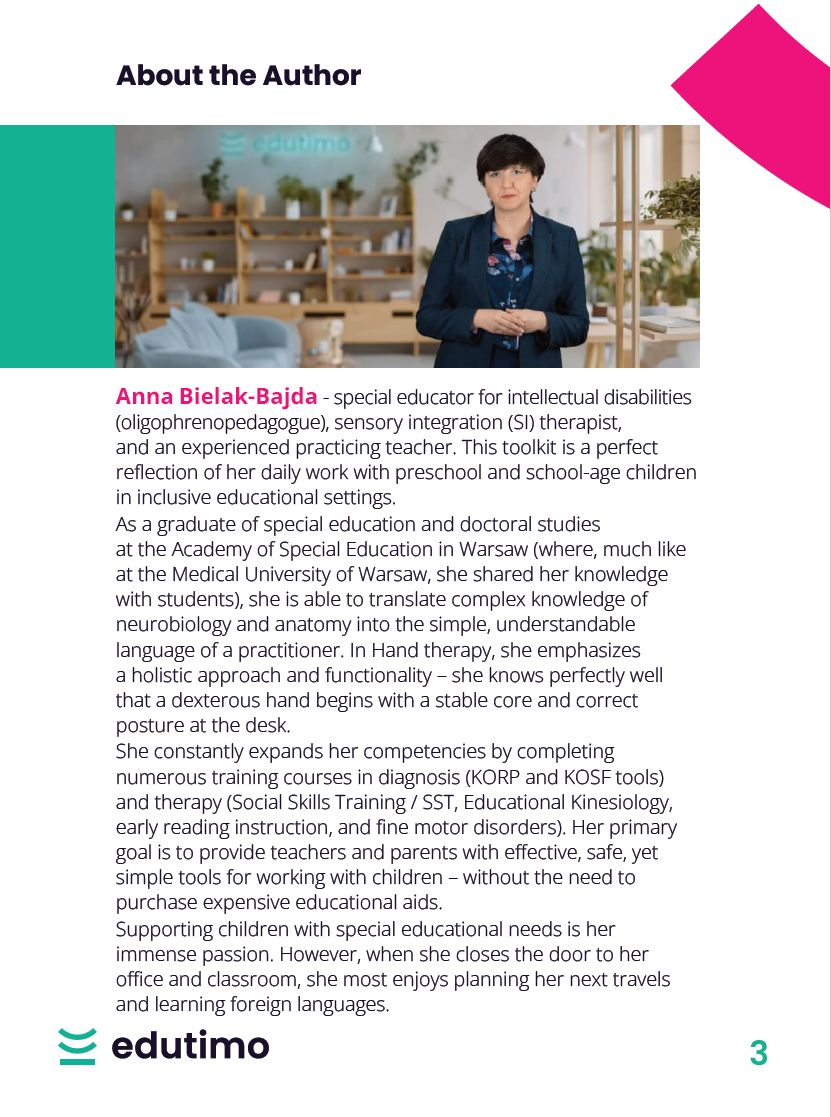
Anna Bielak-Bajda
Specialist in therapeutic approaches

Hand Therapy in Nursery and Primary Settings

A practical training programme for teachers and early years practitioners supporting children with fine motor difficulties, weak posture, poor pencil grip, sensory challenges and graphomotor problems through simple exercises, activities and ready-to-use session plans.

Essential

£59.00

£89.00
One-time · 12 months access
  • 5 video modules
  • 13 classroom materials
  • 1 case studies
  • Certificate
  • Teacher's Toolkit
  • Full materials library
Professional Recommended

£89.00

£129.00
One-time · 12 months access
  • 5 video modules
  • 29 classroom materials
  • 9 case studies
  • Certificate
  • Teacher's Toolkit (98 pages)
  • Knowledge Booster (30 days)

Is this for you?

This programme is not for you if you are looking only for handwriting worksheets or isolated pencil-grip correction without a broader developmental approach.

What you'll implement?

What's inside this programme?

Video modules

5 modules · approx. 79 min total · one film per module
  1. 1
    Introduction
    3 min
    Free preview
    A short opening video introducing the purpose of the programme, the trainer’s approach and the key areas of the course: foundations, development, practice and session scenarios.
  2. 2
    The theoretical foundations of hand therapy
    40 min
    Available after purchase
    Why hand therapy is not only about fingers, pencil grip or tracing lines — and how manual dexterity depends on posture, muscle tone, sensory integration and whole-body movement.
    Lessons in this module
    1. What is hand therapy and who is it for?
    2. The development of fine motor skills - from movement to writing
    3. Developmental principles and the planning of hand therapy
    4. Muscle tone and its impact on the child’s functioning
    5. Postural stabilisation as the foundation of hand therapy
    6. Stabilisation of the shoulder girdle and the hand
    7. Sensory integration and the development of fine motor skills
    8. Observation and assessment in hand therapy
  3. 3
    Exercises in hand therapy
    16 min
    Available after purchase
    How to structure safe hand therapy sessions and select exercises in the right order: from postural stabilisation to shoulder girdle work, proprioception, manual exercises and graphomotor preparation.
    Lessons in this module
    1. The structure of hand therapy sessions
    2. Postural stabilisation exercises
    3. Shoulder girdle stabilisation exercises
    4. Proprioception and deep-pressure activities
    5. Manual exercises
    6. Manipulative and graphomotor exercises
  4. 4
    Activities to support hand therapy
    8 min
    Available after purchase
    Sensory, fine motor and movement-based activities that support hand therapy through play and can be used in everyday educational settings without expensive equipment.
    Lessons in this module
    1. Sensory play activities
    2. Activities to develop fine motor skills
    3. Movement activities to support hand therapy
  5. 5
    Hand therapy session plans
    12 min
    Available after purchase
    Ready-to-use individual and group session plans for children with low muscle tone, tactile hypersensitivity, graphomotor difficulties and school-age support needs.
    Lessons in this module
    1. Session plan for a child with low muscle tone
    2. Session plan for a child with tactile hypersensitivity
    3. Session plan for a child with graphomotor difficulties
    4. Group session plan for a nursery or reception class
    5. Individual session plan for a school-age pupil

Teacher's Toolkit

98-page implementation guide · PDF · Professional package only
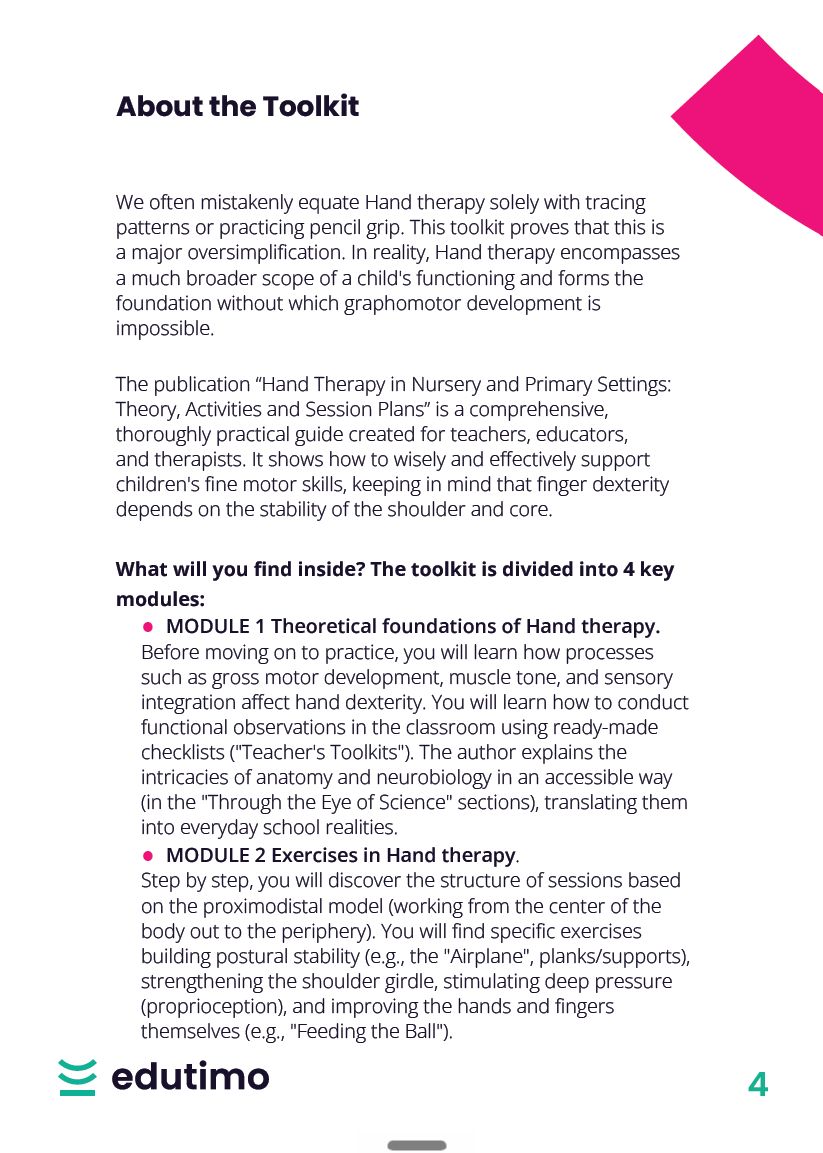
The written backbone of the programme. The Teacher’s Toolkit expands the video content with theory, observation tools, exercises, activities and ready-to-use session plans.
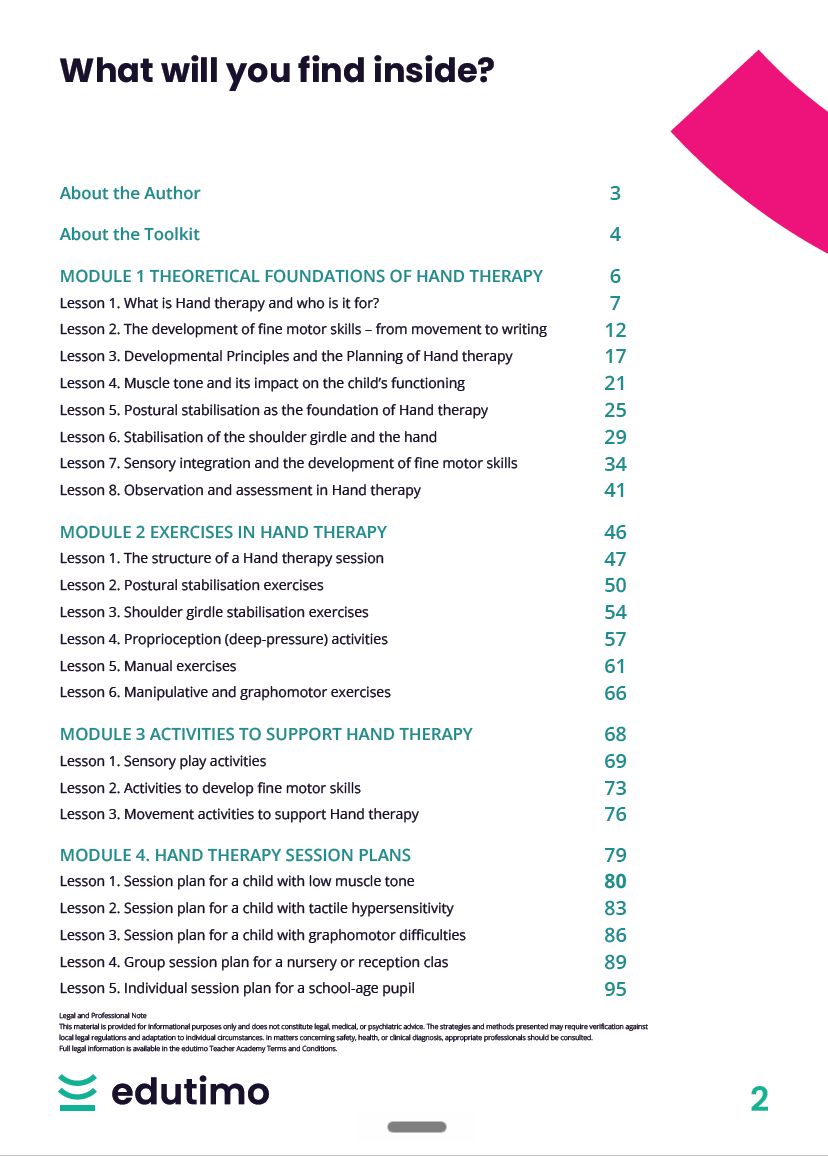
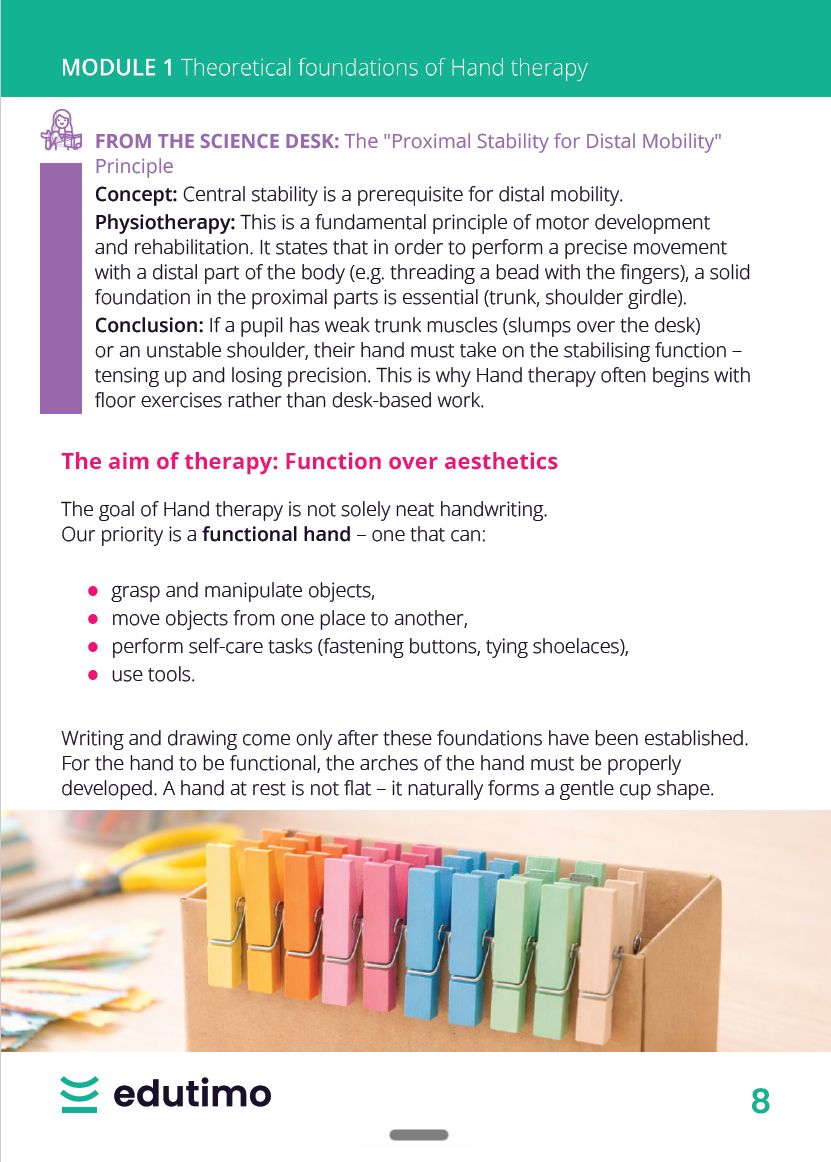
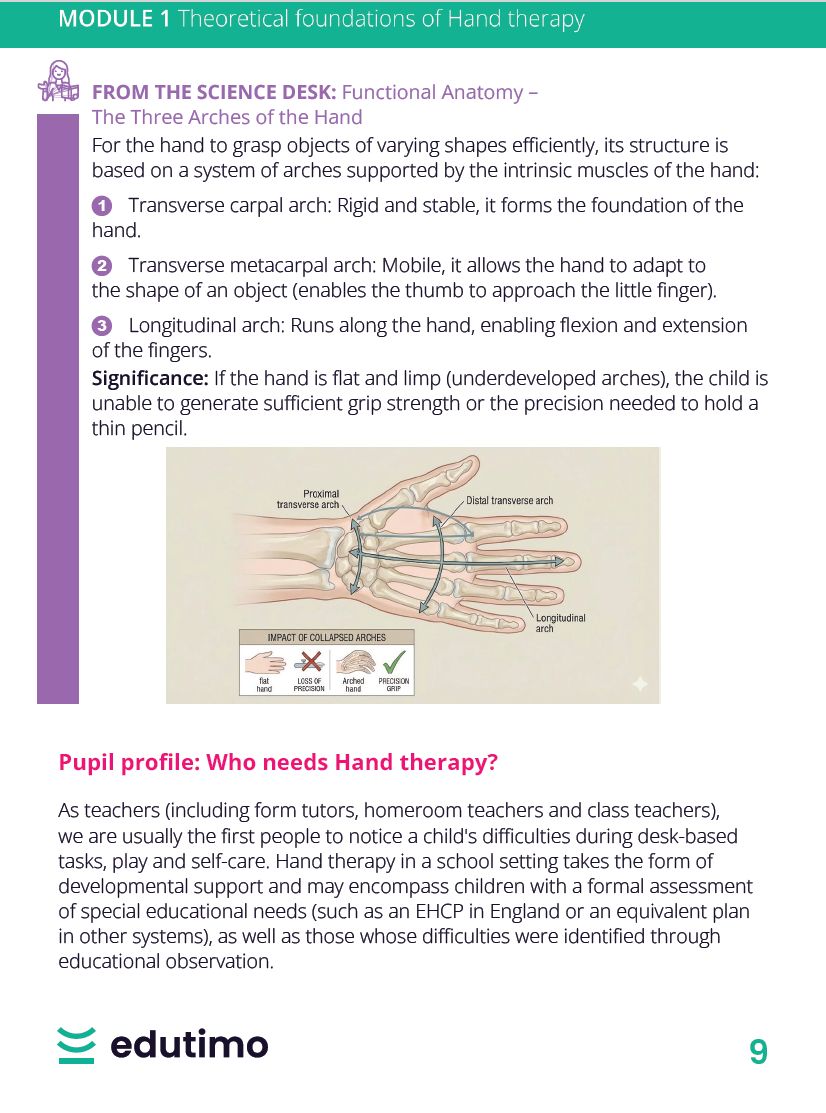
  • Theoretical foundations of hand therapy
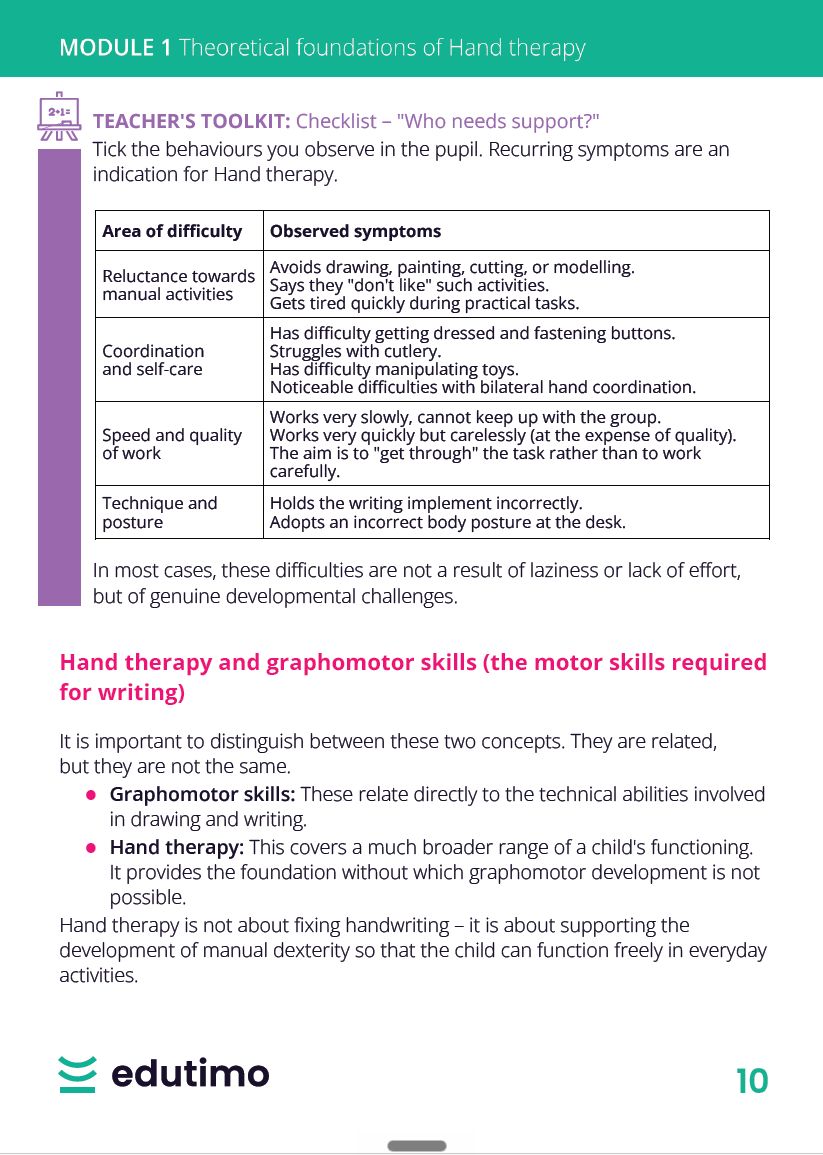
  • Observation and assessment tools
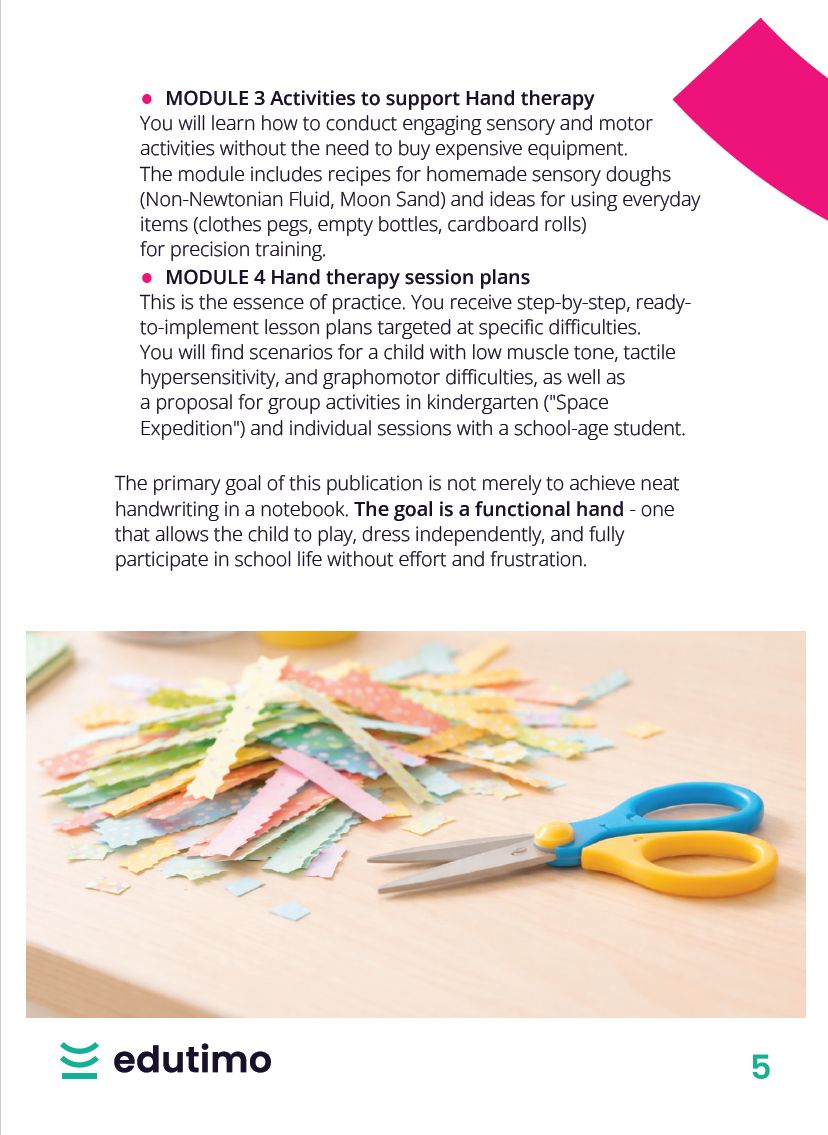
  • Practical exercises and sensory activities
  • Individual and group session scenarios
See sample pages

The Living Library

A resource library that grows with the programme

From the start, you get immediate access to selected classroom-ready materials - printable, fillable or ready to display. Additional resources are unlocked according to your access option: Essential or Professional. Some materials are available right away, while others are added gradually according to the programme schedule. And this is not the final version of the library. It is a living, evolving space - we are continuously working on new tools, templates and classroom resources to support your everyday teaching.

  • 38
    materials total
  • 3
    free for everyone
  • 14
    in Essential
  • 38
    in Professional
  • Diagnostic tools
    5 materials
    • Finger Isolation Test
      Observation checklist assessing finger dissociation through practical tasks such as finger tapping, pincer grip and the Coin Trick.
      Essential Open
    • Hypotonia Detector
      Postural checklist covering symptoms of low muscle tone across desk work, grip, gross motor skills and self-care.
      Essential Open
    • Workstation Audit: The 90-90-90 Rule
      Ergonomics checklist for checking feet, knees, hips, back, desk height, elbows, lighting and paper angle.
      Professional Open
    • Red Flags: When to Refer
      Table of symptoms that may require medical or specialist consultation, with referral direction and a model for parent conversations.
      Professional Open
    • Pupil Observation Record
      School documentation form covering posture, ergonomics, grip, handwriting endurance, sensory responses, gross motor skills and recommendations.
      Professional Open
  • Knowledge and practical resources
    5 materials
    • Checklist: What Can I Do from Tomorrow?
      Eight immediate principles for classroom implementation, including the proximal-to-distal sequence, 90-90-90 rule, therapy safety and one change at a time.
      Free Open
    • Glossary of Hand Therapy Terms
      25 key terms explained in accessible language, including biokinematic chain, hypotonia, finger dissociation, tenodesis effect, ATNR and stereognosis.
      Free Open
    • Hand Therapy Safety Card
      Four key safety rules: never force, do not start from the end, do not treat a grip aid as a cure and always check for allergies.
      Free Open
    • If–Then Procedures
      Seven ready-made responses for common situations such as slouching, refusing messy materials, breaking pencils, palmar grasp, rapid fatigue and fidgeting.
      Essential Open
    • Language Bank: From Label to Fact
      Examples of replacing evaluative labels with factual descriptions for reports, documentation and parent conversations.
      Professional Open
  • Exercise bank and recipes
    7 materials
    • Coin Trick and Cotton Method
      Two simple tools for grip correction and pre-writing warm-up.
      Essential Open
    • Sensory Recipe Book
      Recipes for non-Newtonian fluid, moon sand, colour milk, sensory bags and fluffy slime, with therapeutic purpose and safety notes.
      Professional Open
    • Zero Budget Resources
      Everyday classroom, kitchen and recycling items that can replace specialist therapeutic equipment.
      Essential Open
    • Corridor Obstacle Course
      A therapeutic course using masking tape, with five stations: straight line, zigzag, islands, lazy eight and crawling tunnel.
      Professional Open
    • Exercise Bank: Complete Set
      More than 30 exercises in six categories: postural stabilisation, shoulder girdle, proprioception, hand strength and precision, sensory activities and graphomotor skills.
      Essential Open
    • Individual Session Plan
      Ready-to-use 35-minute session structure with warm-up, main section, wind-down and materials list.
      Essential Open
    • Super Hand Card
      Printable motivation system rewarding effort, not only the final result.
      Professional Open
  • Parent communication
    2 materials
    • Parent Conversation Scripts
      Three complete scripts for difficult conversations: the denying parent, the helpless parent and the demanding parent.
      Professional Open
    • Parent Meeting Checklist
      A five-minute pre-meeting form helping the teacher organise facts, explain the mechanism, suggest one tool and end with collaboration.
      Essential Open
  • Activity cards
    10 materials
    • Who’s Walking Here?
      A barefoot sensory walk across different textures, supporting postural stability and sensory regulation.
      Professional Open
    • Balloon Rally
      A balloon activity supporting bilateral coordination, visual tracking, motor planning and arousal regulation.
      Essential Open
    • Back Writing
      Drawing shapes, digits and letters on a partner’s back to support tactile discrimination and stereognosis.
      Professional Open
    • Catch Your Shadow
      Movement mirroring activities supporting body schema, motor planning and body awareness.
      Professional Open
    • Fingertip Post
      Desk tasks with tweezers, tongs and small items to develop pincer grip, finger isolation and eye-hand coordination.
      Professional Open
    • Frozen Letters
      Forming letters with the whole body, individually or in groups, to combine movement, letter learning and body awareness.
      Professional Open
    • Kneading Station
      A five-minute sensory break using salt dough, modelling clay, cream or a stress ball to regulate hand muscle tone before writing.
      Essential Open
    • Newspaper Tunnel
      Crawling and group movement tasks using newspaper to strengthen the shoulder girdle, core muscles and bilateral coordination.
      Professional Open
    • Musical Massage
      A short partner massage sequence to music, supporting emotional and postural regulation through safe, consent-based touch.
      Professional Open
    • Bridge Building
      A group engineering challenge using newspaper and tape, combining bilateral coordination, planning, collaboration and cause-and-effect thinking.
      Professional Open
  • Case studies
    9 materials
    • Simon, Age 7 - Hypotonia at School
      A pupil who rests his chest on the desk from the first minute. The case explains hypotonia, distal compensation, tight grip and W-sitting.
      Professional Open
    • Zoe, Age 5 - Tactile Hypersensitivity
      A child who avoids sensory play and refuses messy materials. The case shows how to introduce tactile input gradually.
      Professional Read
    • Kyle, Age 6 - The Nervous System Is Not Ready
      A pupil whose writing does not improve despite repeated practice. The case explains why more handwriting exercises are not always the answer.
      Professional Open
    • Olivia, Age 8 - Grip Correction That Is Not Working
      A pupil whose incorrect grip does not improve despite reminders and grip aids. The case shows when the cause lies deeper than habit.
      Professional Open
    • Tom, Age 9 - Proprioceptive Dysregulation
      A pupil who breaks pencils and pierces paper. The case shows how proprioceptive difficulties may be mistaken for behavioural problems.
      Professional Open
    • Maya, Age 7 - A Difficult Conversation with a Parent
      A step-by-step case showing how to use the FACT–MECHANISM–TOOL–POSITIVE model in a parent conversation.
      Professional Open
    • Space Mission - Group Therapy
      A group case study showing how to introduce hand therapy through a narrative-based session with 18 children.
      Professional Open
    • Ridgeway Primary - From Training to Lasting Change
      A leadership case study showing how to move from training to sustained implementation in school practice.
      Professional Open
    • Case Study Cards: 4 Profiles
      Four quick pupil profile cards: hypotonic, hypersensitive, graphomotor delay and sensory seeker. Each card connects what the teacher sees with what may be happening in the child’s body.
      Essential Open

Knowledge Booster

The Knowledge Booster helps you return to the programme after completing the video course - step by step, without trying to implement everything at once. Inspired by Ebbinghaus’s forgetting curve: short emails sent at the right intervals to help you remember and apply what you learn.

  1. 1
    Day 1
    Welcome
  2. 2
    Day 4
    The hand does not start at the hand
  3. 3
    Day 7
    Why order matters more than the exercise
  4. 4
    Day 10
    They’re not being lazy
  5. 5
    Day 13
    A box under the feet
  6. 6
    Day 16
    The hand’s most important neighbour is the shoulder
  7. 7
    Day 19
    The child who won’t touch paint
  8. 8
    Day 22
    The sentence that opens a parent’s ears
  9. 9
    Day 25
    Why your session structure is important
  10. 10
    Day 28
    Five materials, made in the kitchen
  11. 11
    Day 30
    The last email
You control when it starts. Activate from your account whenever you're ready - it won't start automatically.

Certificate of completion

Each Edutimo programme includes a short end-of-programme test. After completing the modules, take the test to confirm what you have learned and download your certificate of completion. The test is included in the programme and can be retaken if needed.

Ready? Take the test and get your certificate.

10 questions · approx. 10 min · available after completing all modules

Your trainer

Anna Bielak-Bajda

Special education teacher, therapist and PhD candidate, valued for practical SEN support and turning theory into real help for students.

  • therapeutic approaches
  • students with SEN
  • autism spectrum support
  • preschool education
What teachers say?

Trusted by teachers across Europe

Elzbieta D.
Teacher
"A very valuable and well-structured training course, full of practical insights that I will definitely use in my work. The trainer shared her knowledge clearly and gave very useful guidance for action."
Anna C.
Teacher
"Excellent training course, with many interesting ideas and practical solutions to use."
Aleksandra W.
Teacher
"The trainer was fantastic. Very warm, highly knowledgeable, and a pleasure to listen to. I was truly impressed."
Compare your options

Pricing

Essential

  • Video modules
    ✔️
  • Teacher's Toolkit
    -
  • Living Library
    Partial access
  • Case Studies
    Partial access
  • Knowledge Booster
    -
  • Certificate
    ✔️
£59.00
one-time

Professional

  • Video modules
    ✔️
  • Teacher's Toolkit
    ✔️
  • Living Library
    Full access
  • Case Studies
    Full access
  • Knowledge Booster
    11 emails / 30 days
  • Certificate
    ✔️
£89.00
one-time

Subscription

  • Video modules
    All programmes
  • Teacher's Toolkit
    All programmes
  • Living Library
    All programmes
  • Case Studies
    All programmes
  • Knowledge Booster
    All programmes
  • Certificate
    ✔️
from £21.00 month
all programmes
Questions about this programme

FAQ

  • What's the difference between Essential and Professional?

    Essential includes the core programme and selected practical materials. Professional gives you access to the full implementation library, extended materials and case studies.

  • How long do I have access?

    You receive 12 months of access to the programme after purchase.

  • Does the programme include ready-to-use materials?

    Yes. Depending on your package, you receive templates, scripts, cards, procedures, case studies and classroom tools.

  • What is the Knowledge Booster?

    It is a 30-day email sequence that helps you revisit the most important ideas from the programme and apply them step by step.

  • Do I receive a certificate?

    Yes. After completing the programme, you can download your certificate of completion.

Available now

Featured programmes

Each programme includes video, materials, case studies and a certificate.

Edutimo
97 Królowej Jadwigi St.
30-209 Krakow
Poland
Information
Copyright © 2026 Edutimo