1. Programmes
  2. Challenging Behaviour in Autistic Pupils
Anna Bielak-Bajda
Specialist in therapeutic approaches

Challenging Behaviour in Autistic Pupils

A practical training programme for teachers and early years practitioners working with autistic pupils whose behaviour may include aggression, self-injury, sensory overload, withdrawal or sudden emotional escalation with clear tools for understanding causes, using observation and ABC analysis, and responding in a calm, structured way.

Essential

£59.00

£89.00
One-time · 12 months access
  • 8 video modules
  • 10 classroom materials
  • Certificate
  • Teacher's Toolkit
  • Full materials library
Professional Recommended

£89.00

£129.00
One-time · 12 months access
  • 8 video modules
  • 24 classroom materials
  • 7 case studies
  • Certificate
  • Teacher's Toolkit (89 pages)
  • Knowledge Booster (30 days)

Is this for you?

This programme is not designed as clinical training in autism diagnosis, feeding therapy, sensory integration therapy or restrictive physical intervention. It supports everyday educational practice and does not replace specialist assessment, safeguarding procedures or your setting’s individual behaviour and safety plans.

What you'll implement?

What's inside this programme?

Video modules

8 modules · approx. 138 min total · one film per module
  1. 1
    Introduction
    5 min
    Available after purchase
    Meet the trainer and discover the programme’s three interconnected areas: understanding, analysis and response. The introduction explains how the course will help you recognise challenging behaviour, investigate its causes and functions, and choose proactive and reactive strategies for early years and school settings. We use AI as a tool to support production, but we do not hand over responsibility for the content. Our materials are based on real webinars by our trainers and are reviewed and approved by a person before publication. The videos feature an AI-generated avatar and voice of the trainer, used with her consent.
  2. 2
    Autism Spectrum and Challenging Behaviour: Diagnosis, Definition and Types
    6 min
    Available after purchase
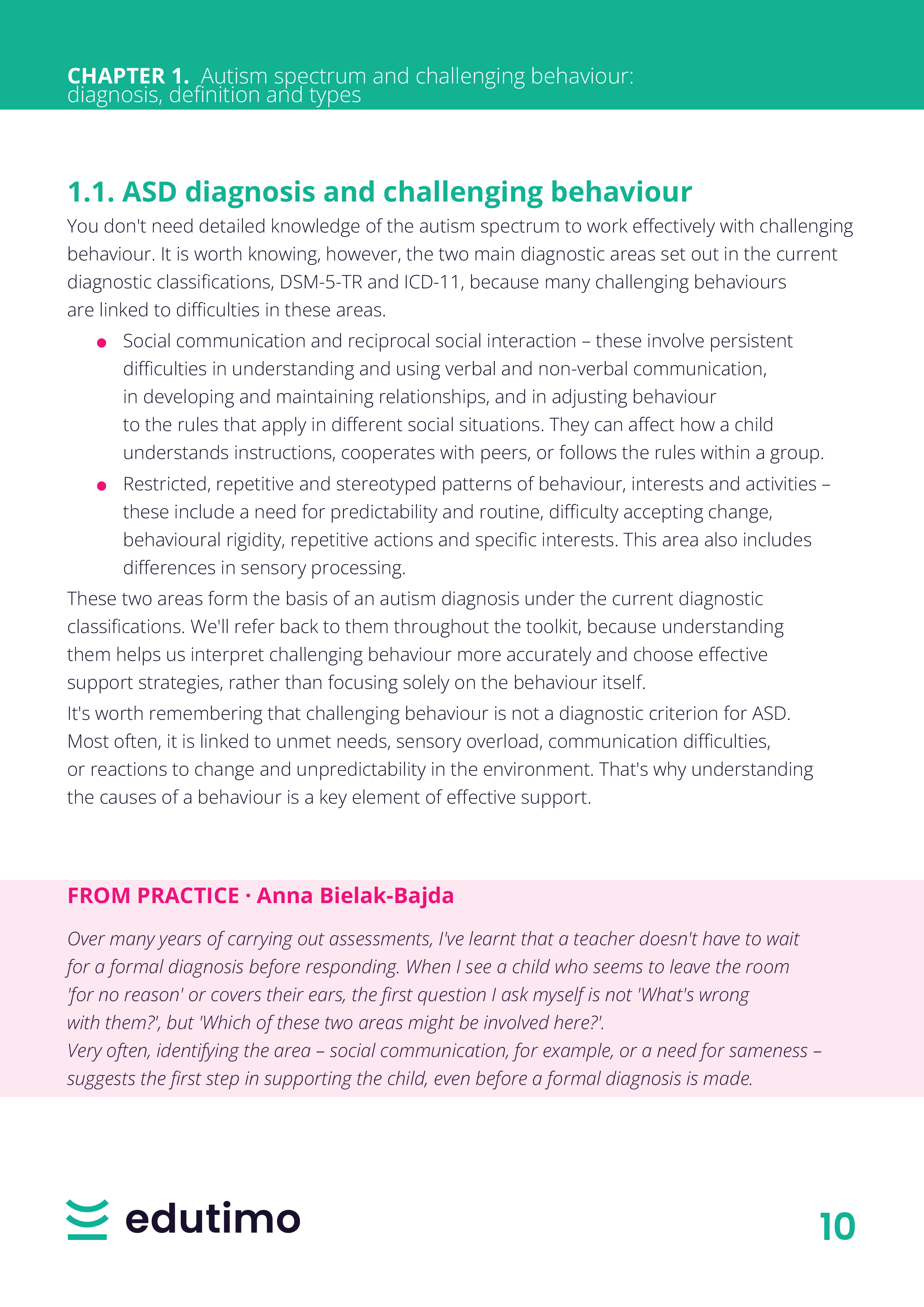
    Understand what challenging behaviour is, when the term is appropriate and how autism-related differences in communication, predictability and sensory processing may affect a pupil’s behaviour. You will also examine why most aggressive behaviour observed in educational settings is defensive rather than deliberately planned.
    Lessons in this module
    1. ASD diagnosis and challenging behaviour
    2. When we call a behaviour challenging
    3. Types of challenging behaviour
    4. Aggressive behaviour: predatory and defensive
  3. 3
    Observation and the Causes of Challenging Behaviour
    25 min
    Available after purchase
    Learn how to begin with relationship-building and systematic observation rather than immediately selecting a technique. The module introduces six areas that may contribute to recurring behaviour and shows why the real cause may lie in the environment, communication demands, the pupil’s health or events outside the classroom.
    Lessons in this module
    1. Where to begin: observation and behavioural analysis
    2. The causes of challenging behaviour
  4. 4
    The Sensory Basis of Challenging Behaviour
    19 min
    Available after purchase
    Explore self-stimulation, sensory overload, the window of tolerance and the mechanisms of over-responsivity, under-responsivity and sensory seeking. Practical examples show how the same pupil may avoid certain stimuli while actively seeking others, and why delayed responses can make a trigger difficult to recognise.
    Lessons in this module
    1. Stereotyped and compulsive behaviours, and self-stimulation
    2. Sensory integration and the window of tolerance
    3. Over-responsivity, under-responsivity and sensory seeking
    4. Examples of over-responsivity in practice
    5. Behaviours that disrupt the environment
  5. 5
    The Functions of Behaviour and the Positive Behaviour Support Model
    14 min
    Available after purchase
    Add a second question to your analysis: what purpose might the behaviour be serving? You will examine six common functions, learn how adult responses can unintentionally reinforce both desirable and undesirable behaviour, and discover why proactive strategies are the foundation of Positive Behaviour Support.
    Lessons in this module
    1. The functions of challenging behaviour
    2. Reinforcing and extinguishing behaviour
    3. The PBS model and proactive strategies
  6. 6
    Behaviour Analysis in Practice: From Observation to the ABC Model
    19 min
    Available after purchase
    Turn classroom observations into an organised plan. Learn how to describe the behaviour and the pupil’s wider profile, identify recurring antecedents and consequences, formulate a functional hypothesis, coordinate the staff team and measure whether an agreed strategy is producing meaningful change.
    Lessons in this module
    1. How to describe challenging behaviour and the child’s profile
    2. A plan for working on the behaviour
    3. Analysing behaviour step by step
    4. Evaluating behaviour and observation logs
    5. The ABC model
    6. Case study: ABC analysis in a computing lesson
  7. 7
    Responding Safely and De-escalation
    25 min
    Available after purchase
    Learn how the adult’s posture, distance, facial expression, eye contact, voice and amount of language can affect escalation. The module presents a repertoire of reactive strategies and explains where everyday de-escalation ends and the setting’s agreed safety and safeguarding procedures must begin.
    Lessons in this module
    1. Principles for responding during an outburst
    2. Strategies for action in practice
    3. Safe strategies for responding when behaviour escalates
  8. 8
    Tools for Working with Challenging Behaviour and Teachers’ Questions
    25 min
    Available after purchase
    Explore practical tools for teaching safer ways to express anger and regulate tension. Learn how to create an anger plan, organise a safe space and introduce a token system with specific, measurable target behaviours. The module also addresses questions about the wider class, school trips, property damage, documentation and alternative ways of organising learning.
    Lessons in this module
    1. The anger plan and consequences
    2. Ways of releasing anger and the safe space
    3. The token system
    4. Teachers’ most frequent questions

Teacher's Toolkit

89-page implementation guide · PDF · Professional package only
The Teacher’s Toolkit mirrors the seven video modules and can be used alongside the course or as a practical reference guide. It helps you understand challenging behaviour, analyse it systematically and choose safe, effective responses. Each chapter includes practical examples, ready-to-use guidance and a “Try It Tomorrow” section.
  • clear explanations of challenging behaviour, sensory processing, behavioural functions, PBS and ABC analysis
  • worked examples showing how the same principles apply in early years and school settings
  • practical scripts showing how a teacher’s response might sound
  • answers to common “What if…?” questions
  • prompts that help adults regulate themselves before approaching a pupil
  • guidance on safety, teamwork, documentation and collaboration with parents or carers
  • a “Try It Tomorrow” section at the end of every chapter
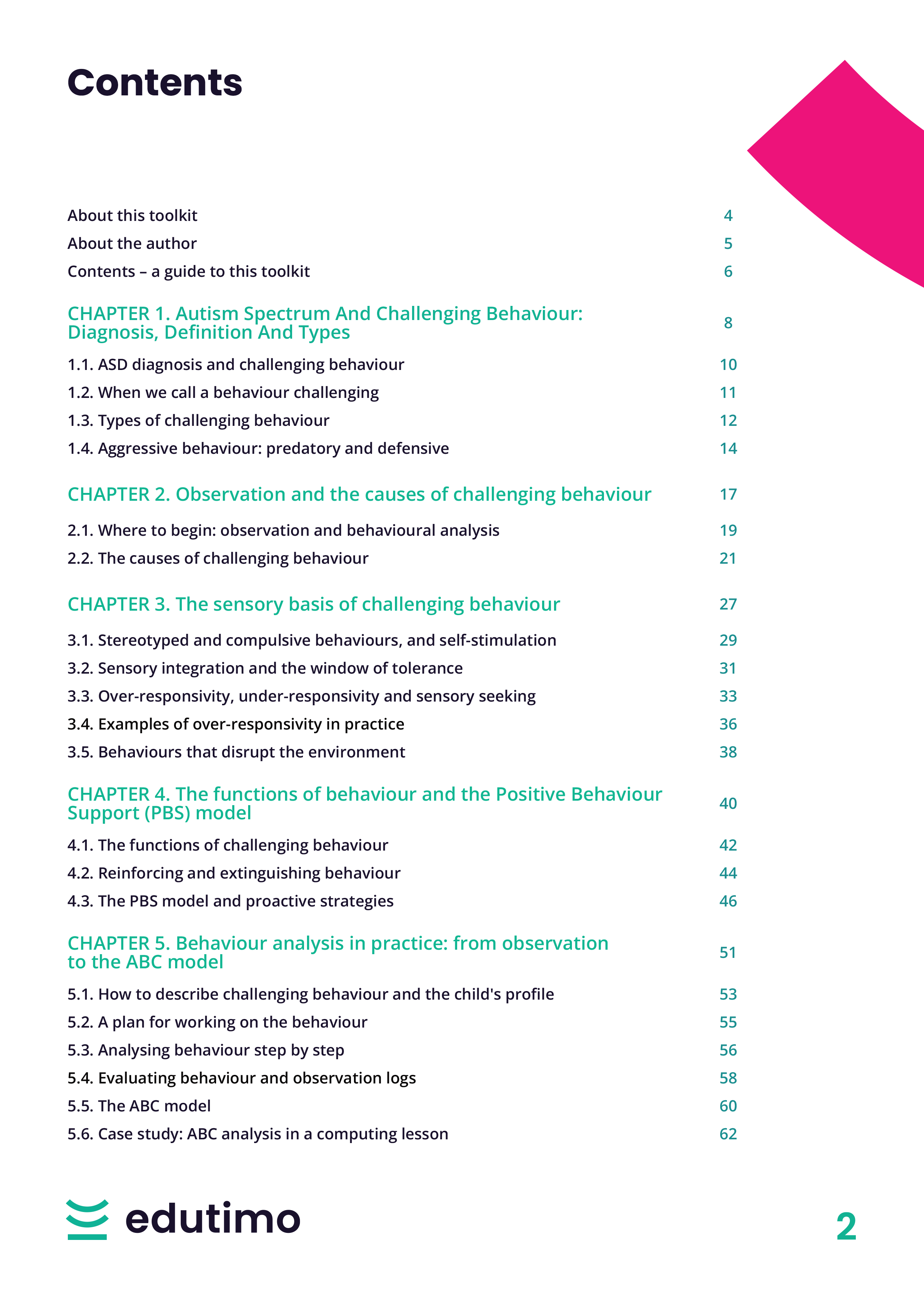
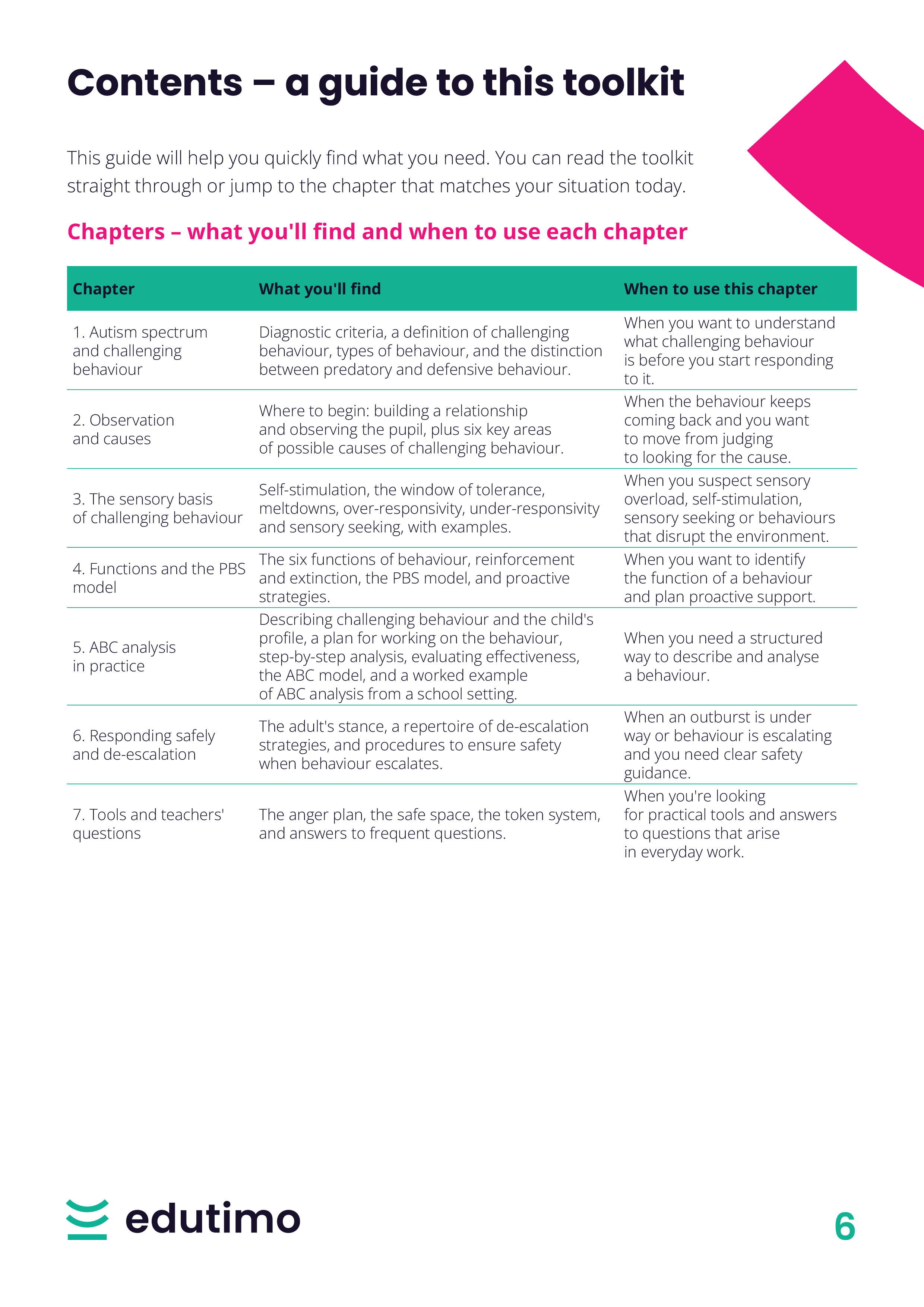
  • a contents guide that directs you to the right chapter for a specific classroom situation
See sample pages

The Living Library

A resource library that grows with the programme

From the start, you get immediate access to selected classroom-ready materials - printable, fillable or ready to display. Additional resources are unlocked according to your access option: Essential or Professional. Some materials are available right away, while others are added gradually according to the programme schedule. And this is not the final version of the library. It is a living, evolving space - we are continuously working on new tools, templates and classroom resources to support your everyday teaching.

  • 31
    materials total
  • 3
    free for everyone
  • 10
    in Essential
  • 31
    in Professional
  • Observation and functional analysis
    5 materials
    • Observation Sheet — “Count It Before You Call It Challenging”
      A one-page observation sheet that helps you check whether a behaviour really is a recurring pattern - before you label it.
      Free Open
    • ABC Sheet — Event Log
      The heart of the toolkit: a structured record of a single event — what happened just before (A), exactly what the child did (B) and what followed (C).
      Essential Open
    • “6 Areas of Possible Causes” Sheet
      A quick, systematic review of six areas that may lie behind a recurring behaviour: sensory factors, structure, change, communication, health and demands.
      Essential Open
    • Behaviour Function Sheet
      Takes you from “what purpose might it serve?” to one proactive action. A ready matching table suggests, for each hypothesised function, a menu of proactive strategies to try first.
      Essential Open
    • Progress Monitoring Sheet
      A weekly record of one behaviour: frequency, duration, intensity, time to re-engage and use of the replacement behaviour. It shows you in black and white whether your strategy is working.
      Essential Open
  • Respond safely and de-escalate
    5 materials
    • “If–Then” Quick Guide
      A one-page guide for the toughest moments: an outburst, rising tension, a child who needs space, a risk to safety.
      Free Open
    • Phrase Bank
      Ready-made, classroom-tested sentences for de-escalation: calm presence, active listening, redirecting attention and the clean-slate return to work.
      Essential Open
    • Phrase Bank: Choices and a Sense of Control
      An advanced phrase bank for the hardest conversations: anticipating refusal, responding after “no”, offering simple choices and handling resistance to tasks - all while keeping boundaries firm.
      Professional Open
    • Rules for Responding During an Outburst - Poster
      Eight rules for responding safely during an outburst, designed as a poster for the support room and the staff room.
      Professional Open
    • Teacher Self-Regulation Sheet
      “Put on your own oxygen mask first”: a short routine for checking your own state before you approach - a longer out-breath, an anchor phrase, hands on the desk.
      Essential Open
  • Plan support, learn and align the team
    4 materials
    • “What Can I Start Doing Tomorrow?” Checklist
      Eight practices you can start using tomorrow - the essence of the whole training on one page.
      Free Open
    • Positive Support Plan
      A working Positive Behaviour Support (PBS) plan template for the whole team: the behaviour, its triggers, the hypothesised function, the replacement behaviour, proactive strategies, consistent responses, reinforcement, baseline and review dates - on a single page.
      Professional Open
    • Script for a Conversation with a Parent or Carer
      A step-by-step script for a meeting with a parent or carer: how to open, how to describe behaviour in the language of facts instead of labels, what to ask about (always voluntarily) and how to close with joint agreements.
      Professional Open
    • Glossary of Terms
      The key terms of the training explained in brief — from the window of tolerance, sensory processing and meltdown to PBS, extinction and planned ignoring.
      Essential Open
  • For parents and carers
    4 materials
    • Home Observation Sheet
      A gentle observation diary for parents and carers: sleep, food, wellbeing, important changes and events.
      Professional Open
    • The Language of Facts, Not Labels - Leaflet
      A one-page leaflet for parents and carers: how to describe a child’s behaviour factually, with ready examples and four simple questions.
      Professional Open
    • Challenging Behaviour - Understanding and Responding at Home
      A compact guide for families: what challenging behaviour is and where it comes from, how to respond calmly at home, the anger code and a safe space, what really motivates, and when to look for additional support.
      Professional Open
    • Working with the School and Specialists - Guide
      Explains to parents and carers who may be involved in supporting their child, what they can share (and that sharing is voluntary), and how agreements are documented.
      Professional Open
  • For students
    5 materials
    • My Tension Levels
      A child-friendly “thermometer” (green–yellow–red) filled in together with the child: how I feel at each level and what I can do.
      Professional Open
    • I Can Ask for a Break
      Professional Open
    • When I Feel Angry - My First Step Card
      A simple picture card completed with the child: “When I feel angry, I can…”. One small, practised first step instead of an outburst - chosen, drawn and owned by the child.
      Professional Open
    • My Plan for the Day - Visual Timetable
      A visual timetable the child can see and tick off, with space for marking changes of plan and the next two steps.
      Professional Open
    • Calming Strategies Wheel
      The flagship of the pack: a spinner game with eight calming strategies - from paper-based activities and drawing to movement, fidget tools and the calm place - each with a short rationale for adults.
      Professional Open
  • On the wall
    1 materials
    • Poster Series (4 posters)
      Four ready-to-print posters: the Window of Tolerance, the Six Areas of Possible Causes, ABC Analysis and My Tension Levels.
      Professional Open
  • Case studies
    7 materials
    • Module 1: A defensive reaction or deliberately planned behaviour?
      A 5-year-old hits out when his model is suddenly taken away. A worked example of interpreting behaviour, testing several hypotheses and teaching a simple replacement phrase - with reflection questions for your own class.
      Professional Read
    • Module 2: Tension building throughout the day
      Fine in the morning, struggling in the afternoon. How one teacher used an observation notebook and the six areas to find the pattern and the one small change that made the difference.
      Professional Read
    • Module 3: Different sensory responses in one child
      He covers his ears, yet seeks intense movement. A step-by-step example of responding to different sensory responses - without forcing exposure, and starting with the smallest change.
      Professional Read
    • Module 4: “Finished — now what?”
      A student who finishes early and disrupts the class. Separating two behaviour patterns, matching one action to each hypothesised function, and using positive reinforcement.
      Professional Read
    • Module 5: A full ABC analysis
      One small mistake — and he left the room. A complete ABC analysis in practice: recurring records, an agreed break signal and a less public format for the initial presentation.
      Professional Read
    • Module 6: Safe responses and de-escalation
      An outburst after being told no. Safe responses step by step — body language, distance, few words - plus proactive strategies that build a sense of control for the future.
      Professional Read
    • Module 7: Teaching safe ways to express anger
      A strong reaction to losing a game. Introducing the anger code, the safe space and a token system in stages — so you know what is working. Ideal, like the whole series, for staff meetings, team training and self-study.
      Professional Read

Knowledge Booster

The Knowledge Booster helps you return to the programme after completing the video course - step by step, without trying to implement everything at once. Inspired by Ebbinghaus’s forgetting curve: short emails sent at the right intervals to help you remember and apply what you learn.

Professional: 11 emails over 30 days
  1. 1
    Day 1
    Welcome - how the sequence works
  2. 2
    Day 3
    One bad morning does not necessarily make a pattern
  3. 3
    Day 5
    Assume defensive first
  4. 4
    Day 7
    The pattern is in your notebook, not in your memory
  5. 5
    Day 10
    The cause you cannot see from the classroom
  6. 6
    Day 13
    The window of tolerance and what a meltdown really is
  7. 7
    Day 16
    What function might this behaviour be serving?
  8. 8
    Day 19
    You may be reinforcing something
  9. 9
    Day 22
    A, B and C - three parts of a pattern
  10. 10
    Day 26
    Say less. Stand side-on. Lower your voice
  11. 11
    Day 30
    Three tools, four measures, one change
You control when it starts. Activate from your account whenever you're ready - it won't start automatically.

Certificate of completion

Each Edutimo programme includes a short end-of-programme test. After completing the modules, take the test to confirm what you have learned and download your certificate of completion. The test is included in the programme and can be retaken if needed.

Ready? Take the test and get your certificate.

10 questions · approx. 10 min · available after completing all modules

Your trainer

Anna Bielak-Bajda

Special education teacher, therapist and PhD candidate, valued for practical SEN support and turning theory into real help for students.

  • therapeutic approaches
  • students with SEN
  • autism spectrum support
  • preschool education
What teachers say?

Trusted by teachers across Europe

Marcin L.
Teacher
"Interesting, with very good ideas. Well worth paying attention to and recommending to others."
Joanna S.
Teacher
"A huge number of useful tips, presented in a very clear and accessible way. Thank you."
Klaudia M.
Teacher
"The way the training was delivered, the clear and understandable communication, and the high substantive level of the information shared were all excellent."
Compare your options

Pricing

Essential

  • Video modules
    ✔️
  • Teacher's Toolkit
    -
  • Living Library
    Partial access
  • Case Studies
    Partial access
  • Knowledge Booster
    -
  • Certificate
    ✔️
£59.00
one-time

Professional

  • Video modules
    ✔️
  • Teacher's Toolkit
    ✔️
  • Living Library
    Full access
  • Case Studies
    Full access
  • Knowledge Booster
    11 emails / 30 days
  • Certificate
    ✔️
£89.00
one-time

Subscription

  • Video modules
    All programmes
  • Teacher's Toolkit
    All programmes
  • Living Library
    All programmes
  • Case Studies
    All programmes
  • Knowledge Booster
    All programmes
  • Certificate
    ✔️
from £21.00 month
all programmes
Questions about this programme

FAQ

  • What's the difference between Essential and Professional?

    Essential includes the core programme and selected practical materials. Professional gives you access to the full implementation library, extended materials and case studies.

  • How long do I have access?

    You receive 12 months of access to the programme after purchase.

  • Does the programme include ready-to-use materials?

    Yes. Depending on your package, you receive templates, scripts, cards, procedures, case studies and classroom tools.

  • What is the Knowledge Booster?

    It is a 30-day email sequence that helps you revisit the most important ideas from the programme and apply them step by step.

  • Do I receive a certificate?

    Yes. After completing the programme, you can download your certificate of completion.

Available now

Featured programmes

Each programme includes video, materials, case studies and a certificate.

Edutimo
97 Królowej Jadwigi St.
30-209 Krakow
Poland
Information
Copyright © 2026 Edutimo