To celebrate our launch – all programmes on special offer until end of September.

  1. Programmes
  2. Depression in Teenagers and Suicidal Behaviours
Jolanta Kawaler
Specialist in challenging behaviors

Depression in Teenagers and Suicidal Behaviours

A practical training programme for teachers working with pupils who show signs of depression, self-harm, withdrawal, digital risk, suicidal thoughts, emotional crisis or sudden behavioural change.

Essential

£59.00

£89.00
One-time · 12 months access
  • 8 video modules
  • 17 classroom materials
  • 4 case study
  • Certificate
  • Teacher's Toolkit
  • Full materials library
Professional Recommended

£89.00

£129.00
One-time · 12 months access
  • 8 video modules
  • 27 classroom materials
  • 8 case studies
  • Certificate
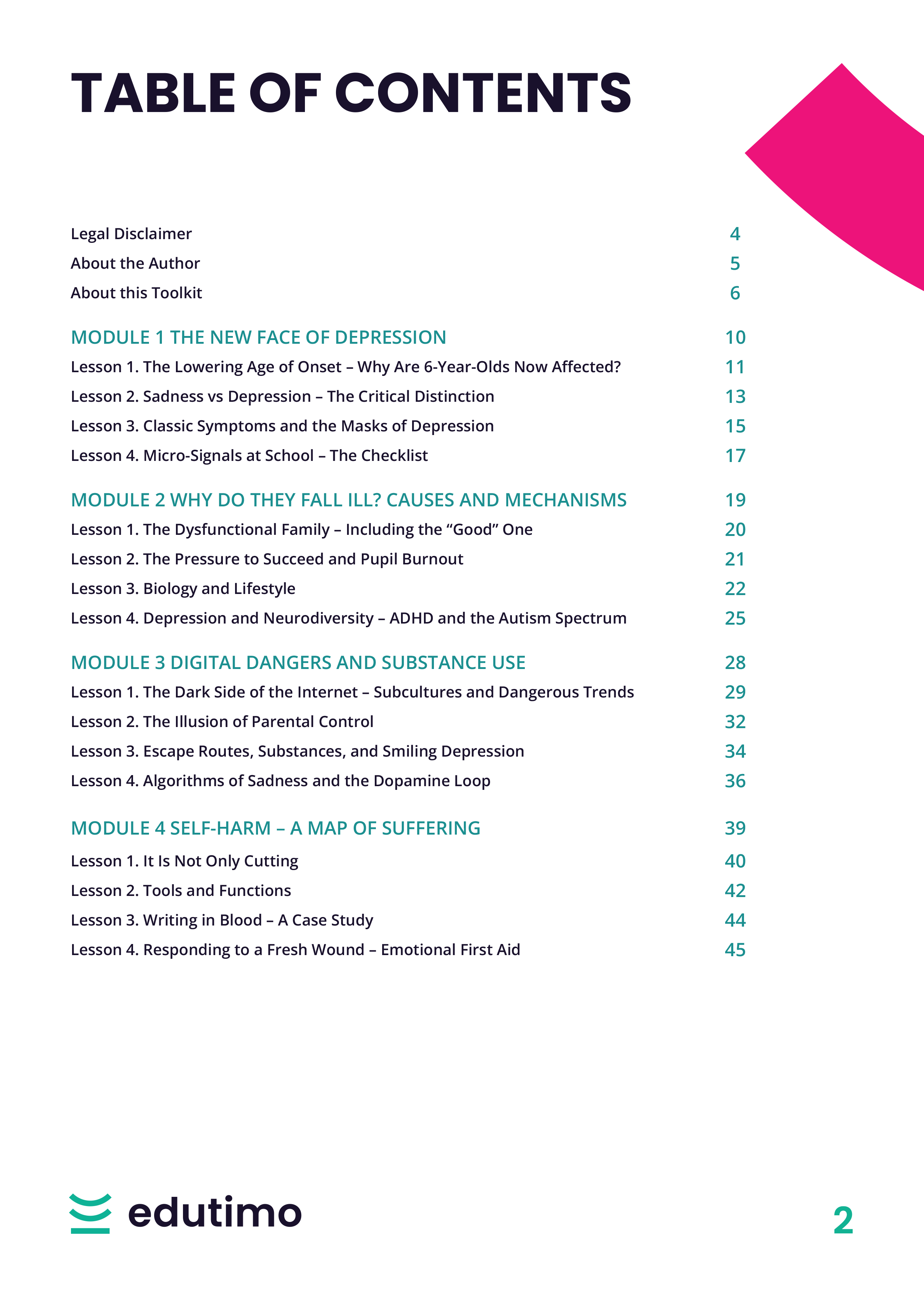
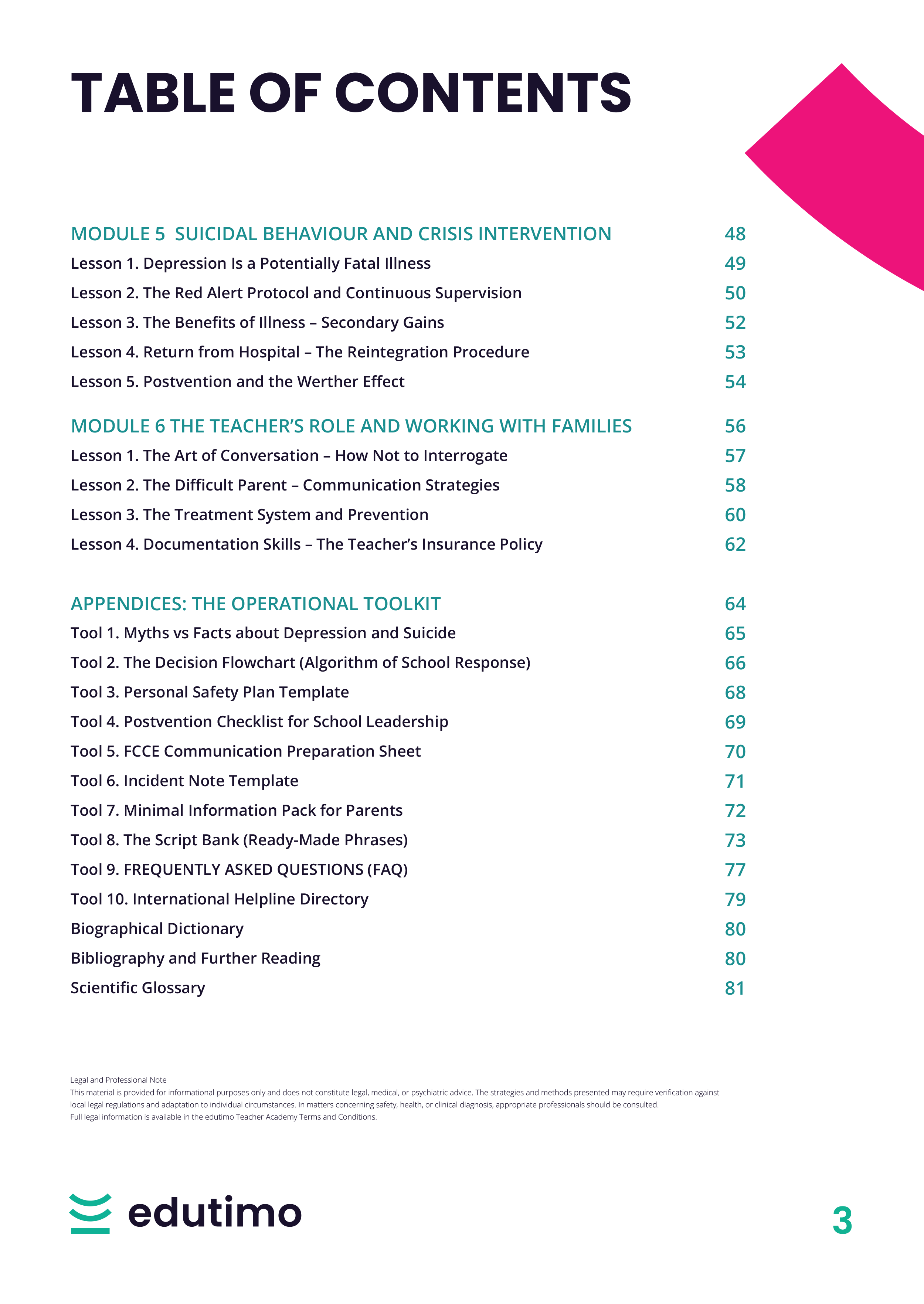
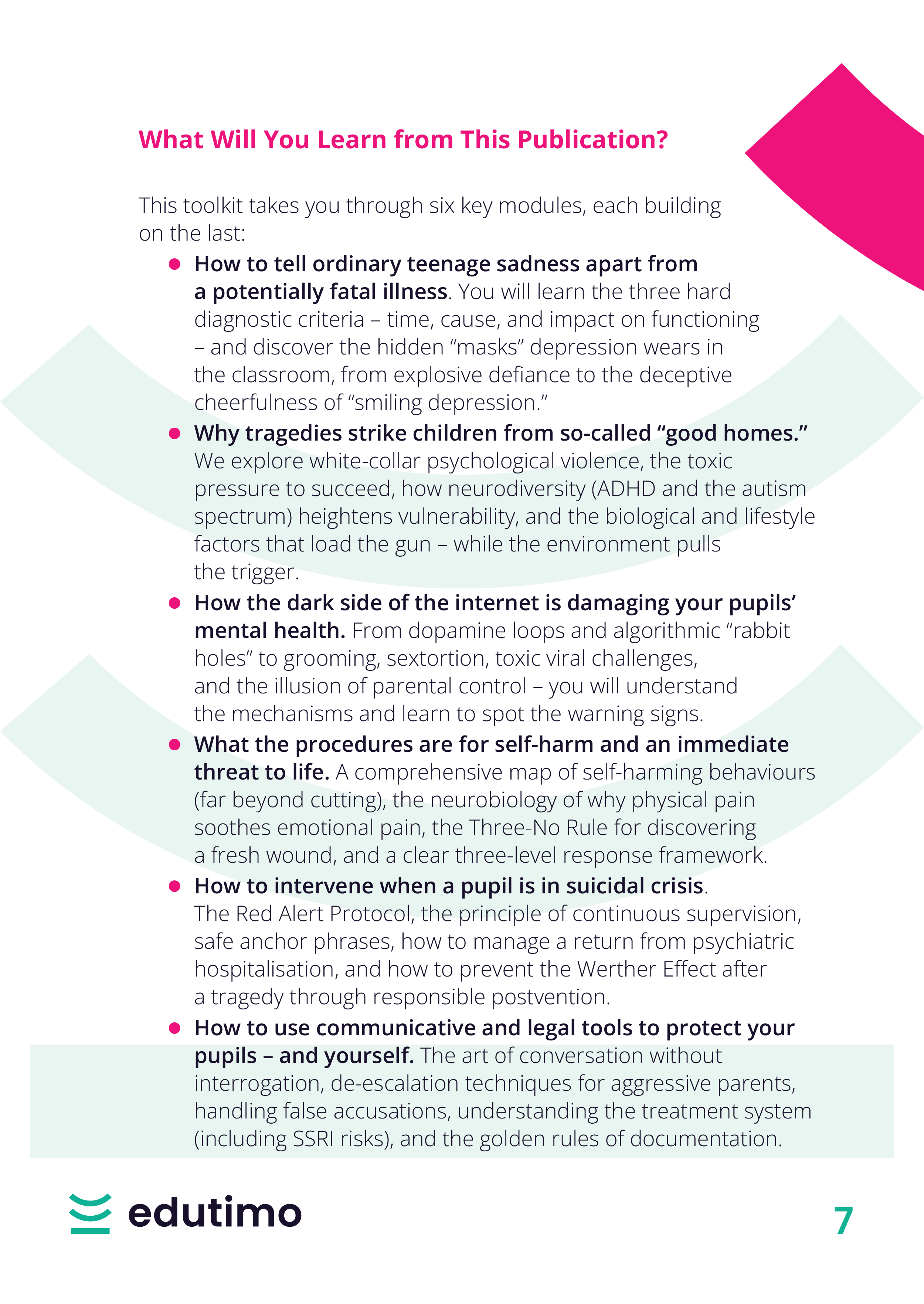
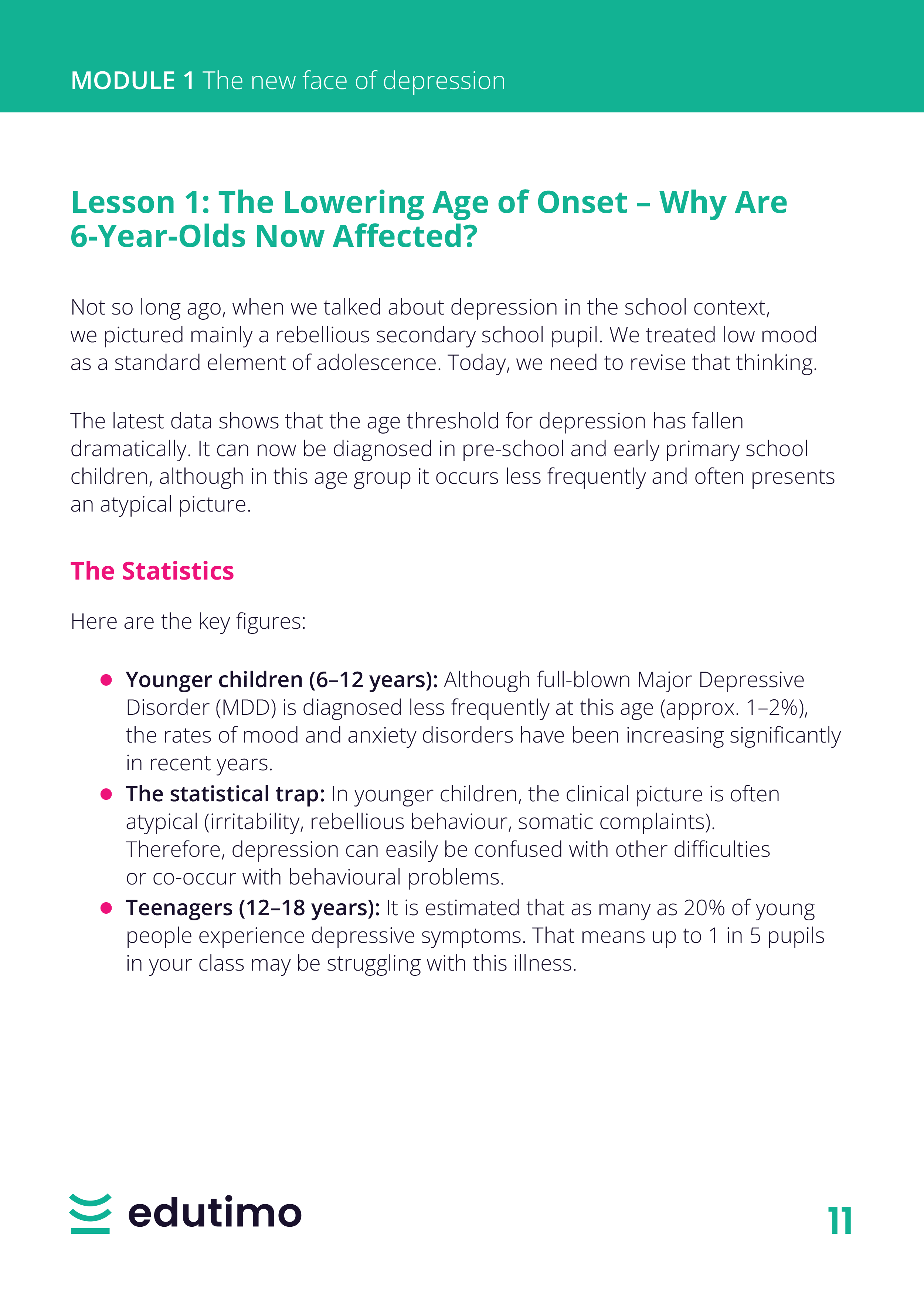
  • Teacher's Toolkit (81 pages)
  • Knowledge Booster (30 days)

Is this for you?

This programme is not for you if you are looking for clinical training that replaces medical, psychological or safeguarding support.

What you'll implement?

What's inside this programme?

Video modules

8 modules · approx. 71 min total · one film per module
  1. 1
    Introduction
    4 min
    Free preview
    A short opening video introducing the purpose of the programme, the trainer’s experience and the key areas of the course: recognition, risk factors, crisis response, communication with families and professional documentation. You will see why the aim is not to alarm teachers, but to equip them with clear procedures and practical tools for difficult school situations.
  2. 2
    The New Face of Depression
    11 min
    Available after purchase
    How to recognise depression in pupils when it does not look like sadness. This module explains why younger children are now affected, how to distinguish ordinary sadness from clinical depression, and what hidden warning signs teachers can see in everyday school life.
    Lessons in this module
    1. A Downward Epidemic – Why Are Six-Year-Olds Now Affected?
    2. Sadness vs Depression – The Critical Distinction
    3. Classic Symptoms and the Masks of Depression
    4. Micro-Signals at School – What You Can See in the Exercise Book and at Break Time
  3. 3
    Why Do They Fall Ill? Causes and Mechanisms
    9 min
    Available after purchase
    What can increase a pupil’s risk of depression — including hidden family pressure, emotional coldness, pupil burnout, biology, lifestyle and neurodiversity. The module helps teachers understand what may be happening behind the behaviour they see at school.
    Lessons in this module
    1. The Dysfunctional Family – Including the “Good” One
    2. The Pressure to Succeed and Pupil Burnout
    3. Biology and Lifestyle
    4. Depression and Neurodiversity – ADHD and the Autism Spectrum
  4. 4
    Digital Dangers and Substance Use
    8 min
    Available after purchase
    How the online world can deepen a pupil’s crisis. This module covers harmful online communities, viral challenges, grooming, sextortion, parental control myths, phone confiscation, substance use, smiling depression and the mechanisms that keep pupils trapped in negative digital content.
    Lessons in this module
    1. The Dark Side of the Internet – Subcultures and Challenges
    2. The Illusion of Parental Control
    3. Escape Routes, Substances and Smiling Depression
    4. Algorithms of Sadness and the Dopamine Loop
  5. 5
    Self-Harm – A Map of Suffering
    8 min
    Available after purchase
    A practical module on recognising and responding to self-harm. You will learn why self-harm is not only cutting, what teachers may notice at school, what objects pupils may use, and how to respond calmly when you discover a fresh wound.
    Lessons in this module
    1. It Is Not Only Cutting
    2. Tools and Functions
    3. Writing in Blood – A Case Study
    4. Responding to a Fresh Wound – Emotional First Aid
  6. 6
    Suicidal Behaviour and Crisis Intervention
    16 min
    Available after purchase
    What to do when a pupil mentions death, says they do not want to live or may be at immediate risk. This module introduces safe anchor phrases, the Red Alert Protocol, continuous supervision, reintegration after hospitalisation and postvention after a suicide.
    Lessons in this module
    1. Depression Is a Potentially Fatal Illness - What Can We Say About It?
    2. The Red Alert Protocol and the Principle of Continuous Supervision
    3. The Benefits of Illness - Secondary Gains
    4. Return from Hospital - The Reintegration Procedure
    5. Postvention and the Werther Effect
  7. 7
    The Teacher’s Role and Working with Families
    12 min
    Available after purchase
    How to speak with pupils and parents when emotions are high and safety is at stake. This module covers conversation without interrogation, difficult parent meetings, treatment and prevention, and documentation that protects both the pupil and the teacher.
    Lessons in this module
    1. The Art of Conversation – How Not to Interrogate
    2. The Difficult Parent – Communication Strategies
    3. The Treatment System and Prevention
    4. Documentation Skills – The Teacher’s Insurance Policy
  8. 8
    Final video
    3 min
    Available after purchase
    A closing session that brings the programme together and reminds teachers that their own wellbeing matters too. You will revisit the key message of the course: teachers are not clinicians, but they can notice warning signs, follow procedures, speak safely, document clearly and avoid carrying the emotional weight alone.

Teacher's Toolkit

81-page implementation guide · PDF · Professional package only
Theory, procedures and practical guidance - designed to help you return to the programme when you need to recognise warning signs, prepare for a difficult conversation or respond to a crisis.
  • Module summaries and key takeaways
  • Recognition and risk-factor frameworks
  • Self-harm and crisis response guidance
  • Communication scripts for pupils and parents
  • Documentation templates and professional notes
  • Safety planning, postvention and helpline resources
See sample pages

The Living Library

A resource library that grows with the programme

From the start, you get immediate access to selected classroom-ready materials - printable, fillable or ready to display. Additional resources are unlocked according to your access option: Essential or Professional. Some materials are available right away, while others are added gradually according to the programme schedule. And this is not the final version of the library. It is a living, evolving space - we are continuously working on new tools, templates and classroom resources to support your everyday teaching.

  • 35
    materials total
  • 5
    free for everyone
  • 21
    in Essential
  • 35
    in Professional
  • Crisis procedures and response
    5 materials
    • Red Alert Procedure
      School response algorithm for two situations: immediate threat to life and self-harm or depression without suicidal intent.
      Essential Open
    • The Three-No Rule
      A practical emotional first aid card for discovering self-harm: do not shout, do not show disgust, do not judge.
      Essential Open
    • Emergency Pocket Card
      A double-sided A5 card with anchor phrases, immediate actions and three levels of response: concerning signals, self-harm and threat to life.
      Essential Open
    • Reintegration Procedure
      A four-stage procedure for a pupil’s return after psychiatric hospitalisation, including class preparation, first-week monitoring and continued observation.
      Professional Open
    • Postvention Procedure
      A school procedure for the first 24 hours and first week after a pupil’s suicide, including communication scripts and actions to reduce copycat risk.
      Professional Open
  • Identification and observation
    5 materials
    • Observation Checklist: Sadness vs Depression
      A structured comparison tool covering duration, triggers, functioning, appetite, sleep, energy, appearance, social contact and declarations.
      Essential Open
    • Body Map: Self-Harm
      A visual guide to common self-harm locations beyond the wrists, with warning signs visible at school.
      Free Open
    • 10 Warning Signs Poster
      A staffroom poster with ten school-visible micro-signals, including handwriting changes, dark drawings, isolation, eating changes, PE avoidance and hopeless statements.
      Free Open
    • Weekly Observation Log
      A daily observation sheet covering appearance, hygiene, schoolwork, break-time behaviour, social contact and actions taken.
      Essential Open
    • Risk vs Protective Factors Assessment
      A structured assessment of twenty risk factors and twenty protective factors across family, individual, lifestyle and school domains.
      Professional Open
  • Communication and conversations
    4 materials
    • Anchor Phrases Bank
      Ready-made phrases for first contact with a pupil, mentions of death, requests for secrecy, denial and withdrawal.
      Essential Open
    • Conversation Scenarios: Pupil
      Three step-by-step scripts for difficult pupil conversations: silence, suicidal statements and fresh self-harm wounds.
      Essential Open
    • Conversation Scenarios: Parent
      Three scripts for challenging parent meetings: denial, aggression and refusal of an ambulance.
      Essential Open
    • FCCE Communication Sheet
      A meeting preparation sheet based on Facts, Consequences, Concerns or feelings, and Expectations, with a five-point intervention agenda.
      Professional Open
  • Documentation and pupil safety
    3 materials
    • Incident Note Template
      A structured incident note template for recording behavioural facts, chronological actions, persons informed, decisions made, refusal clauses and signatures.
      Essential Open
    • Personal Safety Plan
      A five-step safety plan completed with the pupil, covering warning signs, self-help strategies, trusted people, professional contacts and a safer environment.
      Professional Open
    • SSRI Monitoring Sheet
      A 12-week observation sheet for pupils on antidepressants, covering energy, sleep, appetite, agitation, anxiety, mood, concerning statements and social engagement.
      Professional Open
  • Digital dangers and working with parents
    4 materials
    • Digital Dangers Dictionary
      A glossary of key online risks and terms, including sad-fishing, doomscrolling, FOMO, JOMO, cutting communities, the dopamine loop and rabbit hole effect.
      Free Open
    • Myths vs Facts Poster
      A poster challenging dangerous myths about depression, suicide and self-harm, such as “those who talk won’t do it” or “asking plants the idea”.
      Free Open
    • Helpline Directory
      A directory of emergency numbers, youth support lines, parent and teacher support, and professional suicide prevention resources.
      Free Open
    • Parent Guide: Digital Safety
      A parent-facing guide explaining why confiscating the phone does not work, how the dopamine loop operates and how to build safer digital routines without simple bans.
      Professional Open
  • Team, training and development
    5 materials
    • Staff Meeting Checklist
      A checklist of seven whole-school standards to agree before a crisis occurs, including who responds, who calls for help, who documents and who supports staff.
      Essential Open
    • Staff Training Presentation
      An 11-slide, 45-minute presentation for staff training on warning signs, emotional first aid, the Red Alert Protocol, anchor phrases, documentation and grounding.
      Essential Open
    • Video Module Summary Cards
      Six printable cards summarising key statistics, concepts, warning signs, procedures and tools from each module.
      Professional Open
    • Self-Assessment Quiz
      A 30-question quiz across six modules, with answer key and explanations to help teachers check what they retained.
      Professional Open
    • CPD Reflection Log
      A guided reflection log for each module, with space for key learning, planned changes and a 30-day action plan.
      Professional Open
  • Teacher wellbeing
    1 materials
    • Grounding Technique 5-4-3-2-1
      A 60-second grounding technique for teachers to use after a difficult conversation or crisis intervention.
      Essential Open
  • Case studies
    8 materials
    • Liam, Year 7 – The Somatic Mask
      A case study of a 12-year-old whose recurrent stomach pains are medically cleared and follow a psychosomatic pattern.
      Essential Read
    • Sophia, Year 10 – The Ideal Home
      A case study of a high-achieving pupil whose despair is hidden behind composure and an outwardly successful family image.
      Professional Read
    • Marcus, Year 11 – The Child-Project
      A case study of a 16-year-old elite athlete whose collapse is linked to pressure, conditional love and parental expectations.
      Professional Read
    • Zara, Year 8 – ADHD and the Depression Loop
      A case study of a pupil with ADHD whose inconsistent support and repeated negative feedback deepen into depression-related beliefs.
      Professional Read
    • Ella, Year 9 – The Algorithmic Rabbit Hole
      A case study of a pupil whose TikTok feed creates a personalised depressive environment and intensifies withdrawal.
      Essential Read
    • Daniel, Year 10 – Sextortion
      A case study of a 15-year-old whose sudden deterioration and panic around phone notifications are linked to digital blackmail.
      Essential Read
    • Ms Cartwright, PE – A Fresh Wound in the Changing Room
      A case study showing the first seconds after a teacher discovers fresh self-harm wounds and how the Three-No Rule works in practice.
      Essential Read
    • Hillcroft Academy – Postvention
      An SLT-level case study covering the first 24 hours after a pupil’s suicide, the Werther Effect, at-risk pupils and postvention decisions.
      Professional Read

Knowledge Booster

The Knowledge Booster helps you return to the programme after completing the video course - step by step, without trying to implement everything at once. Inspired by Ebbinghaus’s forgetting curve: short emails sent at the right intervals to help you remember and apply what you learn.

Professional: 11 emails over 30 days
  1. 1
    Day 1
    Welcome - course philosophy
  2. 2
    Day 4
    Age of onset + sadness vs depression
  3. 3
    Day 7
    Masks of depression
  4. 4
    Day 10
    "Good homes" + pressure to succeed
  5. 5
    Day 13
    Biology, sleep, exercise
  6. 6
    Day 16
    Digital dangers
  7. 7
    Day 19
    Self-harm map + Three-No Rule
  8. 8
    Day 22
    Anchor phrases + Red Alert Protocol
  9. 9
    Day 25
    Secondary gains + reintegration procedure
  10. 10
    Day 28
    Art of conversation
  11. 11
    Day 30
    SSRI warning + documentation
You control when it starts. Activate from your account whenever you're ready - it won't start automatically.

Certificate of completion

Each Edutimo programme includes a short end-of-programme test. After completing the modules, take the test to confirm what you have learned and download your certificate of completion. The test is included in the programme and can be retaken if needed.

Ready? Take the test and get your certificate.

10 questions · approx. 10 min · available after completing all modules

Your trainer

Jolanta Kawaler

Teacher, trainer, mediator and deputy counselling centre director, valued for practical behavioural strategies, creativity and humour.

  • challenging behaviors
  • motivation
  • teaching methodology
  • addiction prevention
  • classroom discipline
What teachers say?

Trusted by teachers across Europe

Paulina from Cracow
Teacher
"I really enjoyed training courses. The instructor was very nice, the presentation was clear, and the examples were interesting. This won't be the last training course I decide to take."
Hedwig S.
Teacher
"Comments and examples "taken from real life." Experience, wisdom, calmness, and a courageous look at reality from Jolanta."
Joanna P.
Teacher
"A highly competent trainer, clear language, and excellent rapport with the participants."
Compare your options

Pricing

Essential

  • Video modules
    ✔️
  • Teacher's Toolkit
    -
  • Living Library
    Partial access
  • Case Studies
    Partial access
  • Knowledge Booster
    -
  • Certificate
    ✔️
£59.00
one-time

Professional

  • Video modules
    ✔️
  • Teacher's Toolkit
    ✔️
  • Living Library
    Full access
  • Case Studies
    Full access
  • Knowledge Booster
    11 emails / 30 days
  • Certificate
    ✔️
£89.00
one-time

Subscription

  • Video modules
    All programmes
  • Teacher's Toolkit
    All programmes
  • Living Library
    All programmes
  • Case Studies
    All programmes
  • Knowledge Booster
    All programmes
  • Certificate
    ✔️
from £21.00 month
all programmes
Questions about this programme

FAQ

  • What's the difference between Essential and Professional?

    Essential includes the core programme and selected practical materials. Professional gives you access to the full implementation library, extended materials and case studies.

  • How long do I have access?

    You receive 12 months of access to the programme after purchase.

  • Does the programme include ready-to-use materials?

    Yes. Depending on your package, you receive templates, scripts, cards, procedures, case studies and classroom tools.

  • What is the Knowledge Booster?

    It is a 30-day email sequence that helps you revisit the most important ideas from the programme and apply them step by step.

  • Do I receive a certificate?

    Yes. After completing the programme, you can download your certificate of completion.

Available now

Featured programmes

Each programme includes video, materials, case studies and a certificate.

Edutimo
97 Królowej Jadwigi St.
30-209 Krakow
Poland
Information
Copyright © 2026 Edutimo