1. Programmes
  2. Why Won’t This Child Speak? Understanding Selective Mutism in the Classroom
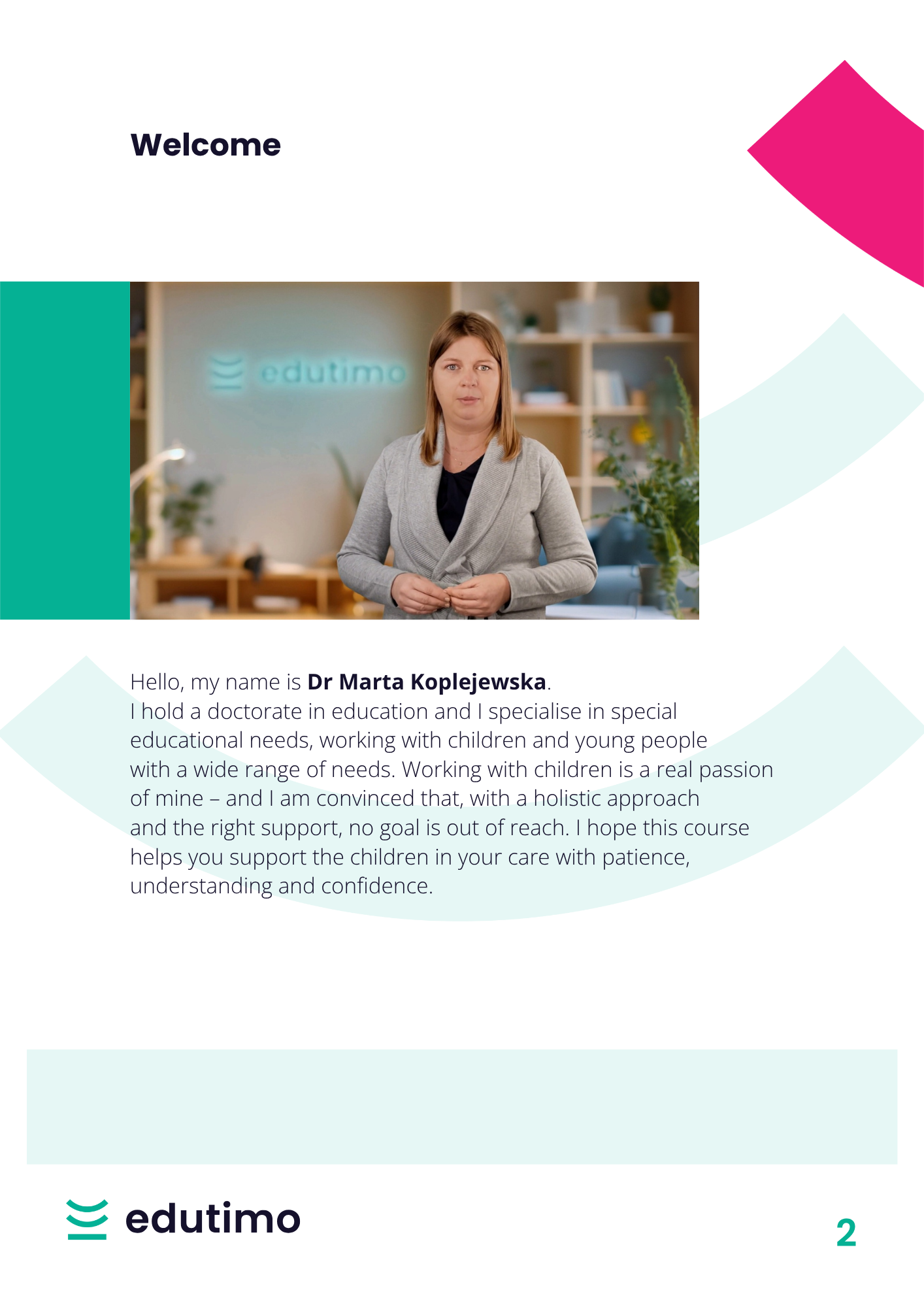
Marta Koplejewska
Specialist in students with SEN

Why Won’t This Child Speak? Understanding Selective Mutism in the Classroom

A practical training programme for teachers working with students who remain silent or speak very little in selected school situations - helping you understand selective mutism, recognise its symptoms and respond in a way that supports safety, trust and communication.

Essential

£59.00

£89.00
One-time · 12 months access
  • 7 video modules
  • 7 classroom materials
  • Certificate
  • Teacher's Toolkit
  • Full materials library
Professional Recommended

£89.00

£129.00
One-time · 12 months access
  • 7 video modules
  • 18 classroom materials
  • Certificate
  • Teacher's Toolkit (46 pages)
  • Knowledge Booster (30 days)

Is this for you?

This programme is not a clinical course in diagnosing or independently treating selective mutism. It is designed for teachers and school staff who need practical, responsible ways to reduce pressure, support communication and work effectively with parents, carers and specialists.

What you'll implement?

What's inside this programme?

Video modules

7 modules · approx. 72 min total · one film per module
  1. 1
    What selective mutism is
    10 min
    Available after purchase
    Understand selective mutism as an anxiety-based communication block rather than a conscious choice. Explore how the condition is defined, where common misconceptions come from and which factors may predispose, trigger or maintain the difficulty. We use AI as a tool to support production, but we do not hand over responsibility for the content. Our materials are based on real webinars by our trainers and are reviewed and approved by a person before publication. The videos feature an AI-generated avatar and voice of the trainer, used with her consent.
    Lessons in this module
    1. Introduction
    2. Definition and classification
    3. A short history and the myth of “conscious choice”
    4. Causes — three groups of factors
  2. 2
    How to recognise a child with selective mutism
    19 min
    Available after purchase
    Learn what teachers may observe without stepping into the role of a diagnostician. Examine diagnostic criteria, common signs, the impact of silence on everyday functioning and the distinctions between selective mutism, shyness, language barriers, aphasia and autism-related communication differences.
    Lessons in this module
    1. Diagnostic criteria
    2. The child’s presentation — symptoms
    3. Statistics and risk groups
    4. The most common behaviours of a child with selective mutism
    5. Selective mutism and the autism spectrum — telling them apart
    6. Diagnostic elements and the teacher’s observation log
  3. 3
    Working with the child: general principles
    8 min
    Available after purchase
    Turn understanding into everyday classroom practice. Learn how to reduce communicative pressure, begin interactions safely, move gradually from comments to questions and build a constructive partnership with parents or carers.
    Lessons in this module
    1. The golden rule - not expecting the child to speak
    2. How to lead a conversation
    3. Talking with parents or carers
  4. 4
    Therapeutic methods
    18 min
    Available after purchase
    Explore the principles behind sliding in, shaping, externalisation and cognitive behavioural therapy. Understand the boundaries between the teacher’s and specialist’s roles and learn how school staff can support an agreed plan without attempting to conduct therapy independently.
    Lessons in this module
    1. Sliding in - the method of small steps
    2. Modelling speech through shaping
    3. Externalisation
    4. Cognitive behavioural therapy — working with thoughts
  5. 5
    Self-regulation tools and a safe classroom
    4 min
    Available after purchase
    Learn simple breathing, grounding and tension-release techniques that can become part of a whole-class routine. Discover how different ways of responding can be normalised so that the child is included without being singled out.
    Lessons in this module
    1. Breathing and grounding techniques
    2. A safe classroom - normalising silence and whispering
  6. 6
    The long-term perspective
    4 min
    Available after purchase
    Understand how selective mutism can change as social and educational expectations increase. Explore the needs of younger children, older pupils and teenagers, with particular attention to assessment, school transitions, examinations and the importance of early support.
    Lessons in this module
    1. Selective mutism from a developmental perspective
    2. Working with a teenager; transitions and examinations
    3. Why early support matters so much
  7. 7
    Practice and summary
    9 min
    Available after purchase
    Identify the adult reactions that can unintentionally reinforce anxiety and silence. Challenge common myths and understand why free speech is built on earlier goals such as safety, self-esteem, independence, emotional regulation and trust.
    Lessons in this module
    1. Maintaining factors and mistakes that delay progress
    2. Myths about selective mutism
    3. Goals of therapy
    4. Summary

Teacher's Toolkit

46-page implementation guide · PDF · Professional package only
The written companion to the video training. It helps you return to the key concepts, practical strategies and classroom guidance whenever you need to understand a child’s silence, plan the next step or respond without increasing pressure.
  • Understanding selective mutism and why silence is not a choice
  • Recognition, differentiation and objective teacher observation
  • Low-pressure communication and conversations with parents or carers
  • Sliding in, shaping, externalisation and cognitive behavioural approaches
  • Self-regulation tools and safe forms of classroom participation
  • Long-term support, transitions, assessment and common mistakes
See sample pages

The Living Library

A resource library that grows with the programme

From the start, you get immediate access to selected classroom-ready materials - printable, fillable or ready to display. Additional resources are unlocked according to your access option: Essential or Professional. Some materials are available right away, while others are added gradually according to the programme schedule. And this is not the final version of the library. It is a living, evolving space - we are continuously working on new tools, templates and classroom resources to support your everyday teaching.

  • 18
    materials total
  • 3
    free for everyone
  • 7
    in Essential
  • 18
    in Professional
  • Quick-reference cards and guides
    5 materials
    • Staff card: What it is / what it is not
      A one-page introduction that helps every adult understand that selective mutism is an anxiety-based block, not stubbornness, laziness or poor manners.
      Free Open
    • Differentiation table
      A side-by-side comparison that helps teachers organise observations related to selective mutism, shyness, aphasia and the autism spectrum before contacting a specialist.
      Professional Open
    • What to say, what to avoid
      A two-column card showing the phrases and adult responses that reduce pressure and the well-meant reactions that can increase it.
      Free Open
    • First-week quick guide
      A one-page guide to what teachers can do immediately when they first notice a child becoming silent in particular situations.
      Free Open
    • Self-reflection card
      A teacher checklist for reviewing whether everyday responses are helping the child move forward or unintentionally reinforcing withdrawal.
      Professional Open
  • Observation and planning tools
    4 materials
    • Teacher’s observation log
      A printable and editable form for recording facts, contexts, communication attempts and duration without replacing observation with assumptions.
      Essential Open
    • Communicative-load ladder
      A clear progression from gestures and pointing to yes-or-no answers, choices, words, sentences and free communication.
      Essential Open
    • Safe people and situations map
      A form for identifying where, when and with whom the child communicates most freely, providing a practical starting point for further planning.
      Essential Open
    • Settling-in plan
      A first-month template for supporting a child in a new setting without pressure or premature conclusions about their silence.
      Essential Open
  • Collaboration and transition tools
    4 materials
    • Parent and carer conversation guide
      A structured meeting template that begins with the child’s strengths, presents objective observations and helps teachers speak about possible anxiety without blame.
      Professional Open
    • Sliding-in planning sheet
      An eight-stage planning and monitoring tool for gradual work with new people and situations, used together with the specialist leading the child’s support.
      Professional Open
    • Transition plan
      An editable template for passing on what works, what increases pressure and which forms of participation are safe before a change of class or school.
      Professional Open
    • Organising support in the setting
      A multi-page guide to coordinating work between the teacher, parents or carers, specialists and the wider school team.
      Professional Open
  • Classroom activities and participation tools
    4 materials
    • Voice-play cards for shaping
      A set of playful activities that gradually invite breath, sound, whispering, words and phrases without demanding speech.
      Professional Open
    • Self-regulation technique cards
      Ready-to-use cards introducing Balloon breathing, square breathing, grounding and tension-release exercises for the whole class.
      Professional Open
    • “I can respond in different ways” set
      Whole-class activities that make gestures, pointing, cards, whispering and partner responses normal ways of participating.
      Professional Open
    • Alternative forms of participation and assessment card
      A practical list of ways for a child to demonstrate knowledge without being required to speak in front of the whole class.
      Professional Open
  • Goals and progress
    1 materials
    • Therapy goals map
      A visual map showing that verbal communication develops from earlier goals such as reduced anxiety, stronger self-esteem, emotional regulation, independence and social confidence.
      Professional Open

Knowledge Booster

The Knowledge Booster helps you return to the programme after completing the video course - step by step, without trying to implement everything at once. Inspired by Ebbinghaus’s forgetting curve: short emails sent at the right intervals to help you remember and apply what you learn.

Professional: 11 emails over 30 days
  1. 1
    Day 1
    Welcome to the selective mutism booster series
  2. 2
    Day 3
    Inability, not unwillingness
  3. 3
    Day 6
    The golden rule: take the pressure off speaking
  4. 4
    Day 9
    Comment first, ask later
  5. 5
    Day 12
    Small steps: the communicative-load ladder
  6. 6
    Day 15
    What to observe and what not to do
  7. 7
    Day 18
    Don’t overread a single sign
  8. 8
    Day 21
    Talking to parents or carers: strengths first
  9. 9
    Day 24
    Sliding in and shaping - within an agreed plan
  10. 10
    Day 27
    A safe classroom and self-regulation
  11. 11
    Day 30
    The long game: goals, myths and perpetuating factors
You control when it starts. Activate from your account whenever you're ready - it won't start automatically.

Certificate of completion

Each Edutimo programme includes a short end-of-programme test. After completing the modules, take the test to confirm what you have learned and download your certificate of completion. The test is included in the programme and can be retaken if needed.

Ready? Take the test and get your certificate.

10 questions · approx. 10 min · available after completing all modules

Your trainer

Marta Koplejewska

Early childhood and special education specialist, valued for her holistic approach, innovation and ability to motivate children with disabilities.

  • students with SEN
  • autism spectrum support
  • preschool education
What teachers say?

Trusted by teachers across Europe

Marcin L.
Teacher
"Interesting, with very good ideas. Well worth paying attention to and recommending to others."
Karolina
Teacher
"Interesting real-life examples."
Iwona W.
Teacher
"Strong subject knowledge, many personal examples, an engaging way of presenting both the problems and possible solutions, no pretence, and a great sense of humour."
Compare your options

Pricing

Essential

  • Video modules
    ✔️
  • Teacher's Toolkit
    -
  • Living Library
    Partial access
  • Case Studies
    Partial access
  • Knowledge Booster
    -
  • Certificate
    ✔️
£59.00
one-time

Professional

  • Video modules
    ✔️
  • Teacher's Toolkit
    ✔️
  • Living Library
    Full access
  • Case Studies
    Full access
  • Knowledge Booster
    11 emails / 30 days
  • Certificate
    ✔️
£89.00
one-time

Subscription

  • Video modules
    All programmes
  • Teacher's Toolkit
    All programmes
  • Living Library
    All programmes
  • Case Studies
    All programmes
  • Knowledge Booster
    All programmes
  • Certificate
    ✔️
from £21.00 month
all programmes
Questions about this programme

FAQ

  • What's the difference between Essential and Professional?

    Essential includes the core programme and selected practical materials. Professional gives you access to the full implementation library, extended materials and case studies.

  • How long do I have access?

    You receive 12 months of access to the programme after purchase.

  • Does the programme include ready-to-use materials?

    Yes. Depending on your package, you receive templates, scripts, cards, procedures, case studies and classroom tools.

  • What is the Knowledge Booster?

    It is a 30-day email sequence that helps you revisit the most important ideas from the programme and apply them step by step.

  • Do I receive a certificate?

    Yes. After completing the programme, you can download your certificate of completion.

Available now

Featured programmes

Each programme includes video, materials, case studies and a certificate.

Edutimo
97 Królowej Jadwigi St.
30-209 Krakow
Poland
Information
Copyright © 2026 Edutimo