1. Programmes
  2. How to Be a Teacher Pupils Listen To – Proven strategies for classroom discipline
Jolanta Kawaler
Specialist in challenging behaviours

How to Be a Teacher Pupils Listen To – Proven strategies for classroom discipline

When a class will not settle, a pupil makes a show of ignoring you, or the same few pupils disrupt lesson after lesson, negative behaviour points on their own change nothing. This programme shows you how to earn authority through trust and consistency, agree clear class rules and reinforce them, stay calm when a lesson falls apart, and work constructively with difficult pupils and defensive parents. Drawing on almost forty years of teaching and pastoral experience, it offers practical, relationship-based strategies for improving classroom discipline at every phase of education.

Essential

£49.00

One-time · 12 months access
  • 4 video modules
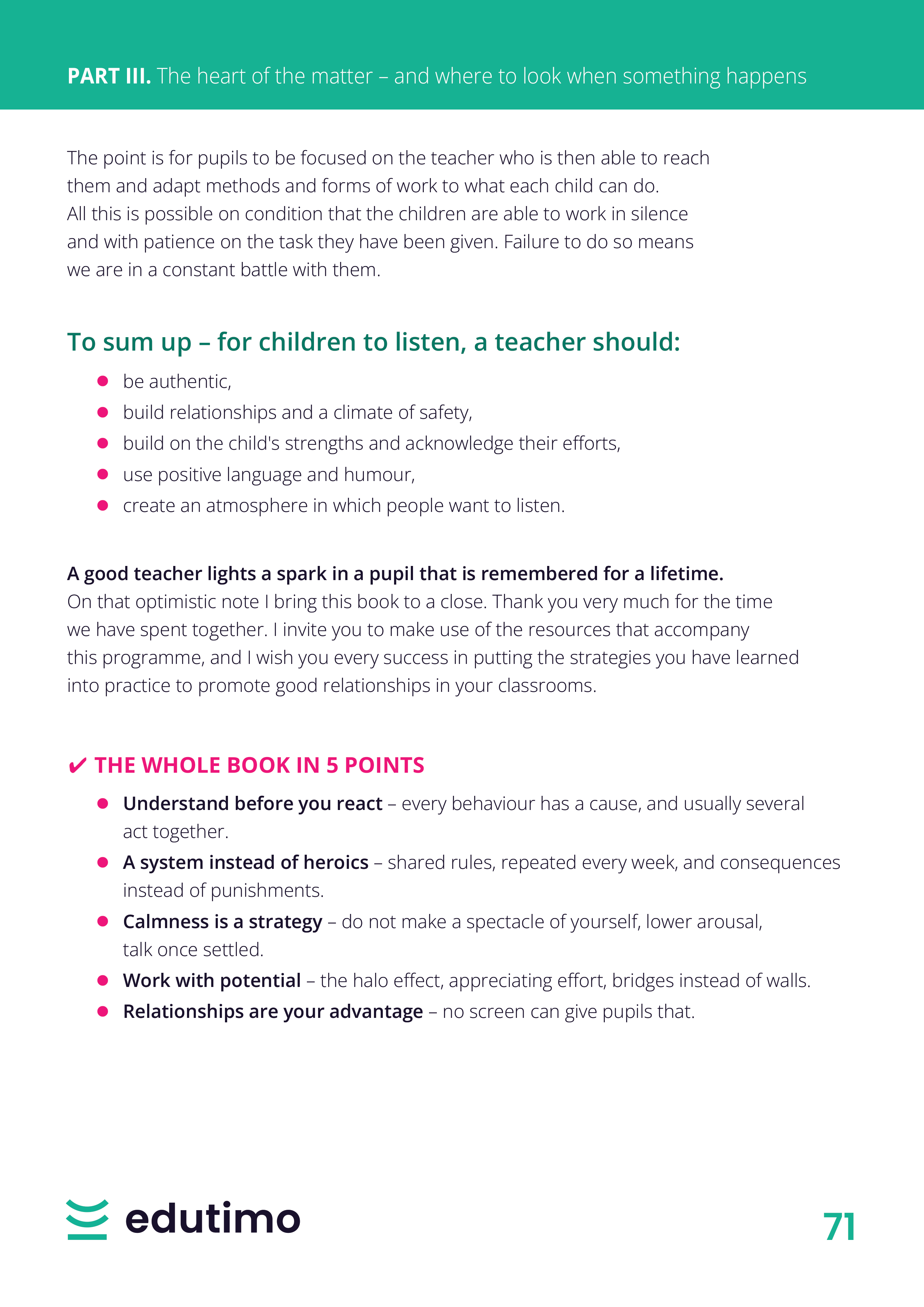
  • Teacher's Toolkit (74 pages)
  • Certificate
  • Classroom materials
  • Case studies
  • Knowledge Booster
Professional Recommended

£69.00

One-time · 12 months access
  • 4 video modules
  • Teacher's Toolkit (74 pages)
  • Certificate
  • 17 classroom materials
  • 3 case studies
  • Knowledge Booster (30 days)

Is this for you?

We use AI as a tool to support production, but we do not hand over responsibility for the content. Our materials are based on real webinars by our trainers and are reviewed and approved by a person before publication. The videos feature an AI-generated avatar and voice of the trainer, used with her consent.

What you'll implement?

What's inside this programme?

Video modules

4 modules · approx. 70 min total · one film per module
  1. 1
    Understanding the pupil and today’s classroom
    11 min
    Available after purchase
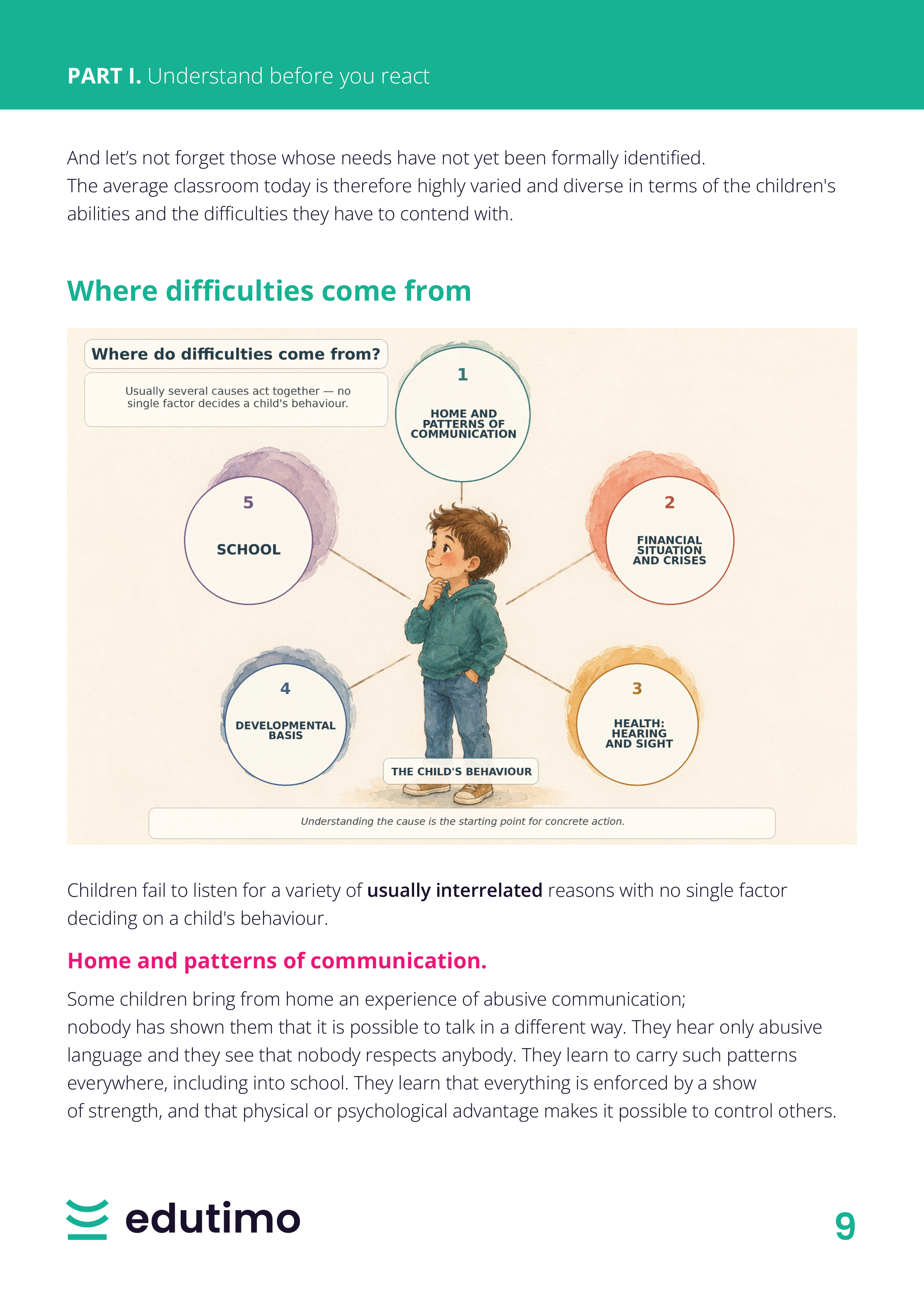
    Who the “naughty pupil” really is, where behavioural difficulties come from, and how growing up without expectations can affect classroom behaviour.
    Lessons in this module
    1. Introduction – The aims of this training course
    2. What exactly is a ‘naughty pupil’?
    3. Where difficulties come from
    4. Upbringing without expectations and its consequences
  2. 2
    Authority and the classroom environment
    16 min
    Available after purchase
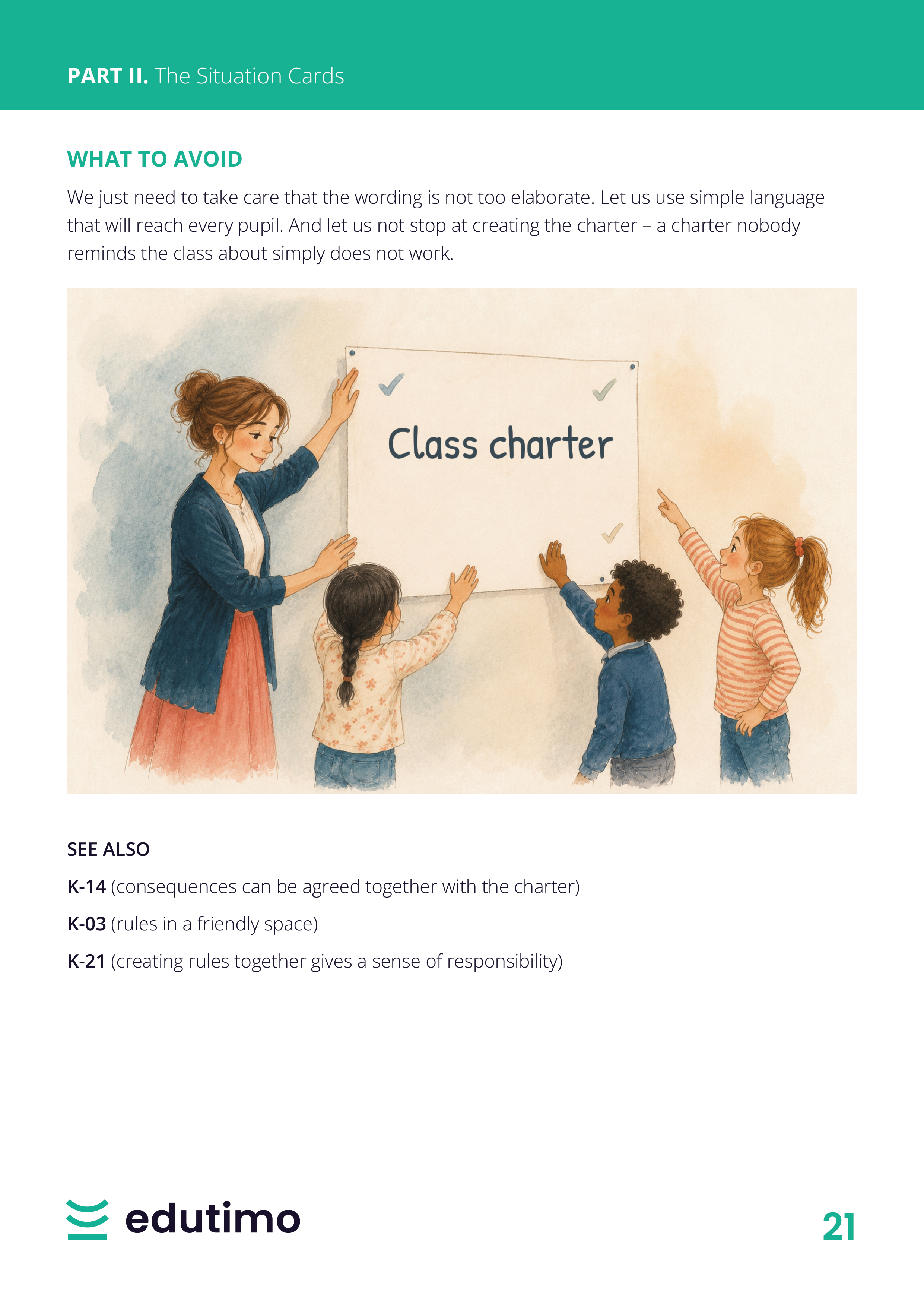
    How authority is earned through consistent rules, what a class of ten-year-olds taught the author, how school and childhood have changed, and how to agree and reinforce a class charter.
    Lessons in this module
    1. Authority is built with rules
    2. What a class of ten-year-olds taught me
    3. School then and now
    4. A classroom that invites listening
    5. The class charter and responsibility
  3. 3
    Relationships, positive psychology and difficult situations
    22 min
    Available after purchase
    Why children do not listen, the PERMA model, and how to work with pupils who swear, manipulate or wreck every lesson, pupils with special educational needs, and the difficult parent.
    Lessons in this module
    1. Why children do not listen
    2. Positive psychology in the classroom
    3. The difficult class: potential instead of battle
    4. The pupil who manipulates
    5. The difficult parent
    6. Children with special educational needs and procedures
    7. The pupil who wrecks lessons
  4. 4
    Communication, consequences and building bridges
    21 min
    Available after purchase
    The authentic teacher, six rules of good communication, consequences in practice, appreciating effort and the pasta jar, and how to lower a pupil’s arousal and build bridges instead of walls.
    Lessons in this module
    1. The authentic teacher
    2. Getting to know pupils: the dragon and shared lessons
    3. Six rules of good communication
    4. Consequences in practice and appreciation
    5. Reducing aggression and building bridges

Teacher's Toolkit

74-page implementation guide · PDF
Theory, situation cards and ready-made steps – designed to help you find the right page at the moment something happens in class.
  • A short foundation: where difficult behaviour comes from and the positive-psychology approach behind every card
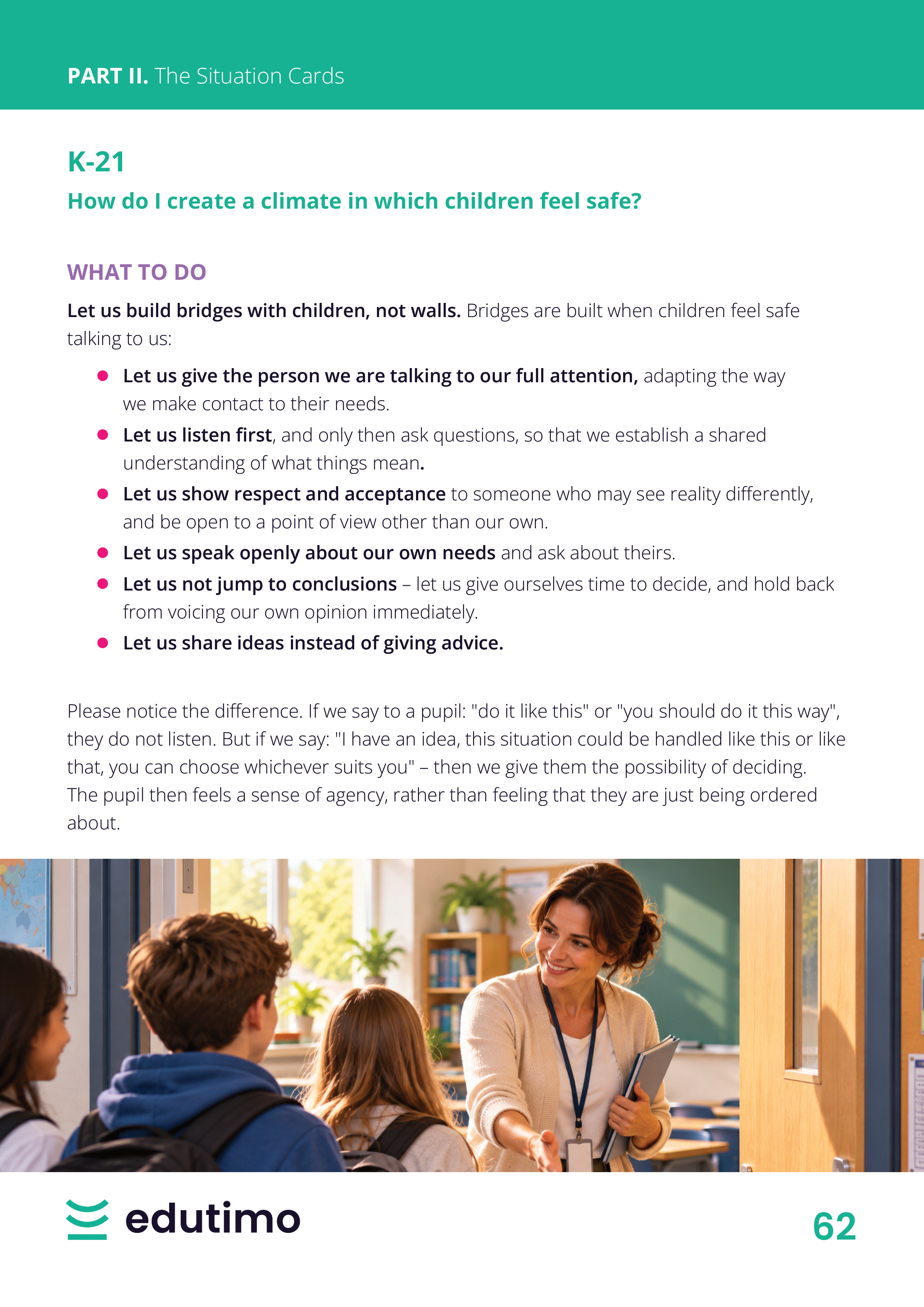
  • 22 situation cards in seven groups – from the classroom system to parents
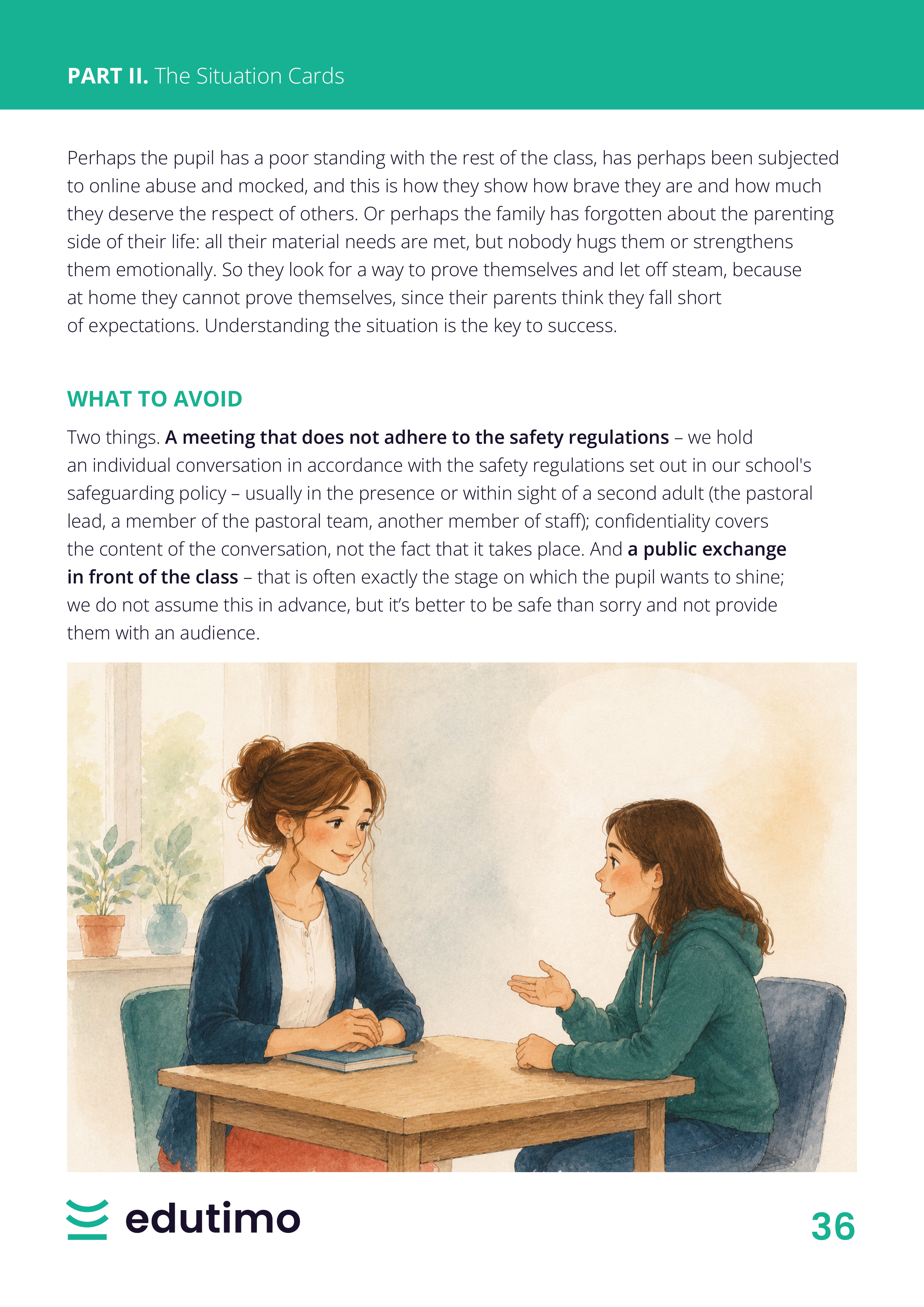
  • Most cards follow the same layout: Before you react · What to do · What to avoid · See also
  • Ready-to-use wording for heated moments
  • True stories from the author’s classroom diary
  • An index that leads from what you see in class to the right card
  • Printable templates: a sample class charter and the “Plus and minus chart”
See sample pages

Classroom Resource Library

Practical resources for real classroom situations

The Professional version gives you access to the complete library of practical resources created specifically for this programme. Inside, you’ll find ready-to-use materials that support classroom practice, behaviour analysis, communication, planning and implementation. Selected resources are available to preview for free, so you can see the format and approach before accessing the full library.

  • 23
    materials total
  • 2
    free for everyone
  • 23
    in Professional
  • For a heated moment
    4 materials
    • “Before You Speak” cheat sheet — signal → pause → instead
      One-page card for the three most common heated moments, with a ready sentence to say instead of your first impulse.
    • The wave of emotion — when to talk, and when to wait
      What happens to a pupil in a state of agitation and four steps to follow: safety first, lower the arousal, make contact and redirect, talk once settled.
      Open
    • 6 rules of communication that make pupils listen — a personal cheat sheet for your planner
      The author’s six rules of communication, each with a one-sentence explanation and two example sentences to use straight away.
      Open
    • “What to avoid” cheat sheet — the reflexes that escalate
      A table of eight situations with the reflex that makes things worse and a pointer to what to do instead.
      Open
  • Worksheets, forms and scripts
    7 materials
    • Punishment or consequence? — a decision sheet
      Four questions to check a planned response, example consequences for six typical situations, and the author’s “museum consequence” story.
      Open
    • Script for a conversation with a parent who defends their child in the face of the facts
      A preparation checklist, six steps of the conversation with ready sentences, variants for when it gets difficult, and a template note afterwards.
      Open
    • The rules minute — a sheet for the weekly reminder of the rules
      A ten-week table for recording the weekly one-minute reminder, which rules need reinforcing and what to change at the next review.
      Open
    • Authority is built with rules — a checklist of five habits for 10 weeks
      Five habits that build authority in a ten-week grid, with instructions and three questions for reflection.
      Open
    • The conversation after an incident — facts instead of judgements
      Six fields that lead through the conversation after a conflict, a fight or a complaint: facts, both sides, a shared agreement and a review date.
      Open
    • A pupil swears and makes a show of ignoring me — two phases of the teacher’s action
      The response during the lesson and four steps for working through the pupil’s potential over the following weeks, with the halo and horn effects explained.
      Open
    • When the teacher’s response was unfair — a card for putting things right
      Six steps for putting things right when a pupil was punished or blamed unjustly, with ready sentences for the pupil, the parents and the class.
      Open
  • Form-time lesson plans
    3 materials
    • Form-time lesson plan: “Creating our class charter”
      A 45-minute lesson with a minute-by-minute outline for agreeing a class charter, with a version for ages 7–9 and an optional module on consequences.
      Open
    • Form-time lesson plan: “Bridges instead of walls”
      A 45-minute lesson on what puts up a wall in a conversation and what builds a bridge, with cards to cut out and fictional scenes to act out in pairs.
      Open
    • Our class charter — a picture card
      The seven rules of the sample class charter as pictures for pupils aged 7–9, with a place to sign and brief instructions for the teacher on the reverse.
      Open
  • Individual and team work
    3 materials
    • Appreciating specifically — 30 phrases for effort, skills and contribution to the class
      Thirty ready sentences: eighteen for discreet appreciation of effort and twelve for public appreciation of skills and contribution.
      Open
    • What would you do if…? — a situation quiz for teachers
      Fifteen fictional classroom situations with three response options and a key explaining which is closest to the programme’s rules.
    • From a strength to a specific role — a selection sheet and a bank of 20 ways to use a pupil’s potential
      A sheet for choosing a task for one pupil and a bank of twenty “strength → role in the class” pairs.
      Open
  • The author’s resources
    3 materials
    • Plus and minus chart — a pupil observation sheet
      A sheet for recording a pupil’s desirable and difficult behaviours, questions for reflection and supportive agreements for the next one to two weeks.
      Open
    • Instead of this… try this… A set of ready-made INSTEAD OF messages for teachers
      Twenty pairs of sentences in seven situations: the one that slips out automatically and its version based on facts and a clear expectation.
      Open
    • FAQ — How to Be a Teacher Pupils Listen To
      Nine questions teachers ask most often, with the author’s short answers and a specific sentence to say in each situation.
      Open
  • Case studies
    3 materials
    • What a class of ten-year-olds taught a teacher
      Whole-class disruption, shouting that does not work and techniques for focusing attention
      Read
    • The notes that nobody wrote
      Fabricated notes, classmates punished unjustly and the cause behind the behaviour
      Read
    • Pasta in a class of teenagers
      Celebrating achievements instead of negative behaviour points
      Read

Knowledge Booster

The Professional version includes the Knowledge Booster, which helps you return to the programme after completing the video course - step by step, without trying to implement everything at once. Inspired by Ebbinghaus’s forgetting curve, it uses short emails sent at the right intervals to help you remember and apply what you learn.

Professional: 11 emails over 30 days
  1. 1
    Day 1
    The one idea, and how the booster works
  2. 2
    Day 4
    The class charter and the rules minute
  3. 3
    Day 7
    Authority is built with rules
  4. 4
    Day 10
    The teacher’s own emotions
  5. 5
    Day 13
    The wave of emotion
  6. 6
    Day 16
    Punishment or consequence
  7. 7
    Day 19
    Appreciation
  8. 8
    Day 22
    Six rules of communication
  9. 9
    Day 25
    The pupil who swears
  10. 10
    Day 28
    Bridges instead of walls
  11. 11
    Day 30
    The parent who defends their child + 5 things to take with you
You control when it starts. Activate from your account whenever you're ready - it won't start automatically.

Certificate of completion

Each Edutimo programme includes a short end-of-programme test. After completing the modules, take the test to confirm what you have learned and download your certificate of completion. The test is included in the programme and can be retaken if needed.

Ready? Take the test and get your certificate.

10 questions · approx. 10 min · available after completing all modules

Your trainer

Jolanta Kawaler

Teacher, trainer, mediator and deputy counselling centre director, valued for practical behavioural strategies, creativity and humour.

  • challenging behaviours
  • motivation
  • teaching methodology
  • addiction prevention
  • classroom discipline
What teachers say?

Trusted by teachers across Europe

Noelia Carnero
SEN teacher
"Edutimo has been a great discovery. I find it particularly useful because it provides a wide range of practical ideas and resources that could easily be adapted to my classroom and the individual needs of my learners. I especially appreciated that the activities were not just theoretical, but focused on things that could realistically be implemented in a classroom setting. One of the most useful aspects was having ready-made ideas that helped me think about how to make learning more engaging, interactive and accessible for pupils with different levels of ability. I could take several of the suggested activities and use them straight away, particularly when planning sensory, creative and practical activities. This was especially helpful for my SEN/pre-formal learners, where activities often need to be simple, hands-on and adaptable. Edutimo also gave me ideas that I could incorporate into continuous provision and different classroom stations, helping me to provide meaningful learning opportunities while still allowing pupils to explore independently. I found it useful for saving planning time and, at the same time, giving me inspiration when I was looking for new ways to approach a topic. Overall, I found Edutimo to be a practical and inspiring resource that I could apply directly to my everyday teaching."
Margaret M.
Teacher
"Clear and well-explained step by step - what may cause various behaviours and how to deal with them."
Anna C.
Teacher
"Excellent training course, with many interesting ideas and practical solutions to use."
Questions about this programme

FAQ

  • What's the difference between Essential and Professional?

    Essential includes the full video programme, the Teacher’s Toolkit ebook and a certificate of completion. Professional includes everything in Essential, plus the complete Classroom Resource Library and the Knowledge Booster.

  • How long do I have access?

    You receive 12 months of access to the programme after purchase.

  • Does the programme include ready-to-use materials?

    Yes. Depending on your package, you receive templates, scripts, cards, procedures, case studies and classroom tools.

  • What is the Knowledge Booster?

    It is a 30-day email sequence that helps you revisit the most important ideas from the programme and apply them step by step.

  • Do I receive a certificate?

    Yes. After completing the programme, you can download your certificate of completion.

Available now

Featured programmes

Each programme includes video, materials, case studies and a certificate.

Edutimo
97 Królowej Jadwigi St.
30-209 Krakow
Poland
Information
Copyright © 2026 Edutimo